
The Calder Valley Line

A Grand Central and a Northern train side-by-side at Bradford Interchange, on the Calder Valley line

This is an entry about the Calder Valley Line (also known as the Caldervale Line), which takes trains from my home town of York, through to Bradford where I currently reside, and onto Manchester and Blackpool, where Christine lives. As you can imagine, I use this railway line a lot.

Technically speaking it’s a ‘route’ rather than a ‘line’, as the sections of track were built at different times by different companies and it shares tracks with other services for a number of sections, but it’s known as the Calder Valley Line. This is because it passes through the upper Calder Valley.

Bradford and Blackpool are on roughly the same latitude, so in an ideal world there would be almost a straight line between them. Alas, the Pennine Hills are in the way, and so the railways tend to follow the valleys and serve the communities in them. Indeed, on leaving Bradford the trains head almost due south, before then curving around to face south-west to reach Halifax.

The line certainly isn’t the most modern in the country. It saw quite a bit of attention in the 1980s, when a number of stations closed in the 1960s were re-opened, and new trains were introduced for some services in the early 1990s. But apart from a new junction outside Bradford there hasn’t been much significant investment in the line of late. Some sections, such as the 9 miles between Burnley and Todmorden, have very slow line speeds of around 45 mph, compared with the usual minimum of 60 mph elsewhere. Consequently, the train from Bradford to Blackpool takes 1 hour and 50 minutes, which is slower than it would be to drive (around 1 hour 35 minutes) despite the driving route taking you via Manchester and being much further in distance.

But some changes are afoot. South of Bradford, a new railway station at Low Moor should be open by the end of 2012, again to replace one closed in the 1960s. Blackpool trains, which skip many intermediate stops elsewhere, won’t stop there but it will be served by a number of local services, and its location close to the M606 on the site previously occupied by Transperience means it will be suited for park-and-ride facilities. Manchester Victoria station is due for a major refurbishment and by 2017 there should be more frequent services to Bradford, as well as new direct services to Manchester Airport and Liverpool from Bradford. A new section of track will allow trains from Burnley to reach Manchester via Todmorden, although this plan is presently unfunded, And the line connecting Blackpool to Preston is due to be electrified later this decade, although that will largely benefit local services and not trains from Yorkshire.

A faster service to Blackpool from Bradford would be most welcome – obviously it would be nice for me but if it becomes faster than travelling by car then it will be more likely to pull in extra passengers. New or refurbished trains would be nice; while the Express Sprinter trains that usually run on the line aren’t too bad, they’re in need of a refit as many carry most of their original fixtures and fittings which have become well-worn over the past 20 years.

The Calder Valley Line is a useful route, covering a long distance and linking many northern towns together, but it could really do with some more TLC. Hopefully in 10 years time I won’t have to use it so much, but I can hope that if I do it’ll be a quicker and more comfortable experience.
Bradford – things to see and do as a tourist

This post is a retort to the news that Bradford has been named as Britain’s worst tourist city in a poll by Travelodge, whose ‘Bradford’ hotel is actually closer to New Pudsey.

Having lived in Bradford for over 7 years I wholeheartedly disagree that Bradford is ‘dangerous, ugly and boring’ as the survey suggests. It’s no less dangerous than any other major UK city and while Bradford has its fair share of 1960s monstrosities in architecture, there are some fine examples of stone-built Victorian buildings which have been faithfully restored and look rather splendid, all over the city.

As for boring, there are plenty of attractions for tourists to visit:

1. In the city centre:

  • National Media Museum – this is the UK’s most visited museum outside of London, and has a wide range of galleries focussing on film, photography, television, radio and new media such as the internet. Its latest addition is an arcade games gallery, where you can play a range of 1980s arcade machines. It’s also home to Yorkshire’s only Imax cinema. Best of all, it’s free to go in (bar the cinemas and some special exhibitions). It was influential in Bradford’s successful bid to become the world’s first UNESCO City of Film, which launches this weekend.
  • Peace Museum – one of Bradford’s lesser-known gems, this has a fantastic collection of items and records. It’s open on Wednesday and Fridays, and for pre-booked groups.
  • Bradford Sculpture Trail – around the turn of the millennium, a series of sculptures were commissioned across the city. This trial takes you around 27 different sculptures and statues, including those of JB Priestley, the famous Bradford-born author.
  • Curry houses – Bradford has a huge range of curry houses across the city and any visit isn’t complete without visiting at least one. There’s the world famous Mumtaz, the student favourite Omar’s, Markaz on Centenary Square and many more. What’s more is that they’re all very affordable.
  • Bradford Cathedral – being one of Britain’s newer cities (the Royal Charter was granted in 1897) the cathedral is quite small compared to the likes of York, Lancaster and Lincoln, however, it’s still an old building with parts dating from the 15th century. It holds regular events and sits in an area of Bradford known as ‘Little Germany’, full of well-preserved and renovated Victorian buildings.
  • Alhambra Theatre – one of several venues in Bradford (there’s also St George’s Hall, Bradford Playhouse and the Theatre in the Mill), the interior of this theatre has been thoroughly restored and looks magnificent. It hosts many major shows throughout the year.
  • The Wool Exchange – once the centre of Bradford’s wool trade, this fantastic piece of 19th century architecture has been restored and now hosts probably the nicest-looking branch of Waterstones in the country. There’s also a Starbucks on the mezzanine level.
  • Bradford 1 Gallery and the Impressions Gallery – these two new art galleries are in Centenary Square and host a number of exhibitions.

2: In the suburbs

  • Bradford Industrial Museum – located in late 19th century mill, this working museum has various examples of mill machinery, as well as a horse-drawn tram, worker’s houses and a transport exhibition. Entry is free and it’s open 7 days a week.
  • Lister Park – open to the public since 1870, this large park includes a boating lake, café, adventure playground, gardens and is also home to the Cartwright Hall art gallery which has recently been host to an exhibition of work by David Hockney, who originally came from the Bradford area. It was named Britain’s Best Park in 2006.
  • Peel Park – across the valley from Lister Park, this opened in 1850 and now plays host to the annual Bradford Mela which is one of the biggest festivals of British Asian culture in the UK.
  • Undercliffe Cemetery – Bradford was at the heart of the UK wool industry and many of the great and good from Bradford’s past have been buried here with some very elaborate and decorative memorials.
  • Bolling Hall – a mansion house which now houses exhibitions showing the life and times of Bradford families over the past few hundred years. Like many of Bradford’s other museums, entry is free.

3: Further afield:

  • Saltaire – a UNESCO world heritage site, and home to Salt’s Mill, which houses a permanent exhibition of art by David Hockney and a range of specialist shops and restaurants.
  • Keighley & Worth Valley Railway – a working steam railway that takes you through the pretty Worth Valley. Connects with the main line at Keighley station.
  • Haworth – a hillside village with a great range of independent shops and fine public houses.

While I think this list is pretty exhaustive I’m sure there’s bits I’ve missed. But there’s certainly no shortage of things to see and do as a tourist in Bradford and it’s well worth spending a day or two to look around. There’s also the City Park which is under construction and will be open by next summer.

(See also another take on the article and an article in our local newspaper)

Transperience, Bradford’s forgotten transport museum

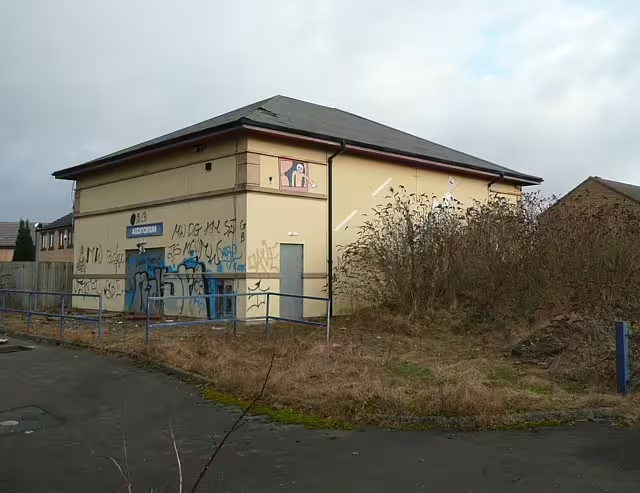
A photo of the former auditorium at Transperience

At the weekend I wrote a new Wikipedia article about Transperience.

The Transperience Museum

Transperience was a museum that I was aware of when I was younger, and I remember seeing leaflets about it. But neither I, nor my parents, had never had the chance to visit it during the short time that it was open.

It was essentially an open-air museum of passenger transport. There were some transport simulators, as well as a working one kilometre tram line and a couple of trolleybuses. In addition, there was an auditorium and some workshops were its preserved vehicles were maintained.

The museum was built on the site of Low Moor station, south of Bradford. The station used to be at the junction of the Caldervale Line, between Bradford and Manchester, with the Spen Valley Line which ran through Cleckheaton, Heckmondwike and Liversedge. The station, and the whole Spen Valley Line, were closed in the 1960s, but the Caldervale Line thankfully remains. Otherwise, my regular trips to Blackpool would be far more difficult.

Closure

Despite being right next to junction 2 of the M606 and easy reach of the M62, and costing £11.5 million to build, the park closed in 1997. It had only been open for a little over 2 years. Unfortunately, it couldn’t attract enough visitors to be viable, and was £1 million in the red by the time it was taken over by administrators. The land was mostly sold off to a private developer and is now an industrial estate. The route of the tram line now forms the first part of the Spen Valley Greenway, a footpath and cycle route which follows the route of the Spen Valley Line. Some buildings, like the auditorium remain, but overgrown and derelict.

Interestingly, the site is likely to go full circle. Metro, the public body which manages passenger transport in West Yorkshire, has plans to re-open Low Moor station. Its location close to the M606 means it would make a good parkway station. Plus, it will allow residents of Low Moor and towns in the Spen Valley to catch the train without having to travel into central Bradford or Leeds. It’s likely that the few remaining relics of Transperience will be tarmacked over by the new station’s car park. The station is proposed for 2012, subject to planning permission and funding.

It’s a shame that I never had chance to visit Transperience, as it seemed like an interesting museum that suffered from poor marketing and a lack of focus. Thankfully, museums such as the Crich Tramway Village have succeeded where Transperience failed.

Update (Dec 2016): Work on the new Low Moor railway station is underway, with a likely opening date in 2017. Most of the Transperience infrastructure that remained by 2010 is still there, albeit still abandoned.

The header image for this post is Copyright Humphrey Bolton and licensed for reuse under this Creative Commons Licence

App of the Week: Tweetie

This is the second in a weekly look at an application I’ve been using lately and come to like. All of them will run on Mac OS X but some will be cross-platform.

It should be no secret by now that I like using Twitter. I’ve been a user for almost 3 years, sending my first tweet in late spring 2007. Twitter can be used quite well from the web but it’s real power comes from its API and the multitudes of applications which can make use of it. Tweetie is one such application – it began as an iPhone application and made the move to OS X last year.

Considering there are so many Twitter clients out there, what made me choose Tweetie? Firstly, it has a free version, which is supported by a few ads in your Twitter timeline (these are obvious and less frequent than I expected) and an occasional nag screen asking you to upgrade. Paying $19.95 removes the ads and the nag screen but doesn’t provide any extra features. It’s also built natively for OS X, unlike a number of others which use Adobe AIR – while this does allow them to run easily on Windows, OS X and Linux, in my experience AIR apps are quite slow and memory-hungry. Adobe have promised improvements to AIR so this may change.

Tweetie also supports multiple Twitter accounts – useful if you have a personal account and an account for your business, for example – although I personally don’t make use of this. The interface is very Mac-like, and it includes Growl notifications for new tweets which are useful if you want to be distracted whenever new tweets are received. It also has built-in search and you can view a Twitter user’s feed in the app by clicking their userpic. Support for URL-shortening services and TwitPic/yFrog is built-in too.

Tweetie’s use of animation makes it feel very smooth and slick, and it seems like the best-designed Twitter application I’ve used so far. It’s light enough to run at all times, and can be run just as a dock or notification icon.

It’s not perfect – it doesn’t support the new Retweet mechanism yet (so when you retweet it still posts ‘RT’ in front of a new tweet by you) and doesn’t show trending topics. There’s also no geolocation features, although this is of limited use for a desktop client.

I recently switched to Tweetie after having used EchoFon for Firefox, which I now can’t use due to bug 533535 in Firefox 3.6. But Tweetie offers much better features so I’m planning to stick with it. The Twitter client arena is very crowded but Tweetie sticks out as a very good application.

Things I like about Belgium

This post is prompted by remarks by Nigel Farage, an MEP for the UK Independence Party, in which he described Belgium as a “non-country“. I think the criticism levelled at Belgium by Mr Farage is unfair and reeks of a ‘my country is better than your country, so nyah’ attitude, which I feel is unacceptable for a supposedly respectable politician.

As a Brit, I feel it is therefore my duty to do my bit to show Belgium that we don’t all think that your country is insignificant. I personally think that the country has several things that are great about it, and once I have some more cash I plan to make another visit to the small but interesting nation.

1. Brussels

Brussels is the capital of Belgium and the de facto capital of European Union. I visited in 2002 (back when this blog was barely a month old) and found it to be a great city. It’s well worth a visit and is (usually) less than 2 hours by train from the centre of London.

2. Belgian beer

We Brits are quite good at making beer, and the explosion of micro-breweries over the years has been very welcome. But the Belgians are also worthy contenders and I particularly appreciate their fruit beers such as those by Früli, Timmermans and Liefmans. Leffe is also particularly good, as is the amusingly-named Kwak which comes in an interestingly-shaped glass. Budweiser is also now owned by a Belgian company, but unfortunately that doesn’t stop it tasting a bit like a urine sample.

3. Bruges

I really want to visit Bruges again, as it’s been almost 2 decades since I was there last. It’s a gorgeous city, full of canals and old buildings.

4. Belgian chocolate

While I will always have a soft spot for Cadbury’s Dairy Milk, the Belgians have chocolate making down to an art.

5. Belgian waffles

Belgium is the country that introduced the concept of a sweet waffle, perhaps with a Belgian chocolate sauce or some ice cream. I’m genuinely pleased that Wetherspoon’s have started serving these again.

6. French Fries

They’re actually Belgian, not French.

Up and running again!

At last, the move to the new host is complete!

I’m now hosting with Bytemark, a well-known hosting company based in York with data centres in Manchester and London. The domain is managed by 123-Reg – I’ve decided to keep the domain and hosting separate to make any future host changes easier.

The hosting package is quite different to the package I had previously. Whereas before I had a simple virtual host setup with FTP, email and databases, this package offers SSH access to a complete virtual machine running Debian. In other words, I can configure everything on the server essentially as I wish – even changing to a different Linux distro if I wanted to.

I’ll be sticking with Debian for now. It brings with it Apache 2.2 and MySQL 5, and I have the ability to add things like FastCGI should I wish to at a later date. I’ve also been able to install every optional Perl module that Movable Type can use, including ones like Image::Magick and XML::Parser which require compiled code.
I’m still using Movable Type 4.3x for now – it’s still supported, with version 4.34 having come out a few days ago, and having tried MT5 for a bit I think it’s a bit overkill for what I need it for.

The move to the new host wasn’t quite as smooth as I’d hoped – some issues with having the domain released from the old host, for example, and the new machine that the site runs on had a disk failure last night, literally about 30 minutes after I updated the DNS to point to the new server. It’s also taken some time to get used to configuring the server myself, rather than having a fancy-pants admin interface to do it for me. Suffice to say I’ve learnt a lot about the Unix command line over the past couple of weeks.

Hopefully now everything will work, but give me a heads-up if it doesn’t!

New host

I have just ordered a new hosting package with a different hosting company. The package offers faster and more up-to-date servers for around £5 extra per month.

The switch will take place shortly, and will allow me to upgrade to the new Movable Type 5.01 which has just been released. MT5 requires MySQL 5.0 (released several years ago) yet my current host is still offering MySQL 4.1, as well as a very old version of Apache. There’s also no support for persistent environments such as FastCGI which are key for getting the best performance out of Movable Type.

I’m aiming to have the migration to the new host complete by the 14th, which will be the 8th anniversary of the first post to this blog.

Blackpool Zoo

Ring-tailed Lemurs

Happy new year everyone!

I spent the new year with Christine in Blackpool and on Sunday went to Blackpool Zoo. It’s open 364 days a year (seeing as the animals there need caring for all year round) and is nice and quiet outside of the busy summer tourist season. The weather on Sunday was bright and sunny (if bitterly cold) so it made an ideal day to go, and to give credit to the zoo staff the educational talks during feeding times were still going ahead despite there being probably no more than 50 people in the park all day.

Naturally I took my camera and 40 out of the 100 photos I took are on Flickr. The above picture of the ring-tailed lemurs is probably my favourite, but I was also impressed with this picture of a red panda (or firefox) and this pair of magellanic penguins.

Having done the Sea Life Centre before Christmas (which has a £5 discount per adult out of tourist season), the next big Blackpool attraction on my list is the Blackpool Tower. I’m sure I’ll get chance to do that soon.

2009 in review

Around this time last year I wrote a somewhat optimistic post about what had happened in 2008 and what I expected to happen in 2009. While I was right about there being a lot of change, 2009 proved to be a very eventful year and not always in the good sense.

January and February

January started well, despite my unemployment – I went to Edinburgh for a job interview and took a few photos while I was there. The interview sadly didn’t lead to a job, but upon my return to Bradford we ended up with a houseful of people – Hari’s little sister and her then boyfriend, and one of our friends from World of Warcraft. As it happens, World of Warcraft would be the thing that would keep me sane for the first few months of the year.

February was when things started going downhill. I was still unemployed, and was struggling to find work, despite being registered with two temping agencies. Then I heard that my grandmother, who had been ill since September 2008, had passed away. While it was somewhat expected, as she has been very ill, the funeral was a big shock. I didn’t write about it publicly at the time but even 9 months on I still miss her. She was 86, and is survived by my grandfather. Also during February, Hari went to Scotland for 2 weeks.

March and April

In March I went on a weekend trip to Dovedale and Sherwood Forest with the University Hiking Club – despite no longer being a student or member of staff there I was still involved, and my parents offered to pay for my place on the trip. As I was still unemployed, the Bank of Mum and Dad came very much into play at this time. To pass the time while unemployed, I started walking more often on my own, and did a couple of canals and disused railway lines near Bradford. Hari was still in Scotland, and eventually came back after 4 weeks. It was then that we agreed that things weren’t working and that the time we had spent apart only came to prove this. On Saturday 21st March, after 3 years and 5 months together, we split up.

April, May and June

During April I tied up the loose ends at the flat Hari and I rented in Bradford, and I moved back in with my parents over the Easter weekend. The loss of independence took a lot of getting used to and I can’t say I enjoyed it a lot, especially as most of my friends were still back in Bradford.

Come May, and things started brightening up. I managed to get a new short-term employment contract back at the University in Bradford, so spent a couple of months staying in people’s spare rooms. I also reached the grand old age of 25, and spent my birthday up a mountain in Wales.

At the end of June I moved to where I live now, in the Undercliffe area of Bradford. While it’s a bit further away from the University, I have good housemates and the house is very nice (and cheap!).

July, August, September and October

The first 2 weeks of July were spent on my first foreign holiday in 6 years, which was in France, around La Rochelle. I really enjoyed the break, which after the ups and downs of the preceding few months was very welcome. There were some really memorable moments, such as riding on a tandem and seeing Fort Boyard.
While my employment contract was initially quite short, it was extended a few times (and now runs until the end of February). August and September proved to be very busy at work, although the latter month resulted in a 23″ screen which I posted about quite a bit.

In October, I visited a friend who had recently moved to Blackpool (she was my travelling partner in France and had been a shoulder to cry on over the preceding months) who introduced me to one of her new friends, Christine. A week later, and Christine and I became an item. We went to see Ash play in Bradford, which was awesome, and have since tried to spend every weekend together.

November and December

A sign that the job market was improving was that I started getting interviews again – one in September and another in November. Despite getting very positive feedback, neither resulted in a job, unfortunately. Also in November I visited Halifax town centre for the first time – not a very interesting event but it’s somewhere I’ve passed through a lot but never really visited.

And finally in December I was diagnosed with an arselump. December was also the first month for several years where I wasn’t overdrawn on my bank account – just in time for my bank to raise the overdraft charges to £1 per day. While I’m not rolling in cash at present, I’m much better off financially than I was in 2008. Christine and I are planning to spend New Year together in Blackpool.

And as for 2010? Well, I’ll be starting it on better footing than last year, with more money and a job. I also have 2 interviews lined up for January, and a weekend break in central Scotland. If all goes to plan, I’ll be getting myself a new computer (probably a Mac Mini again but still not fully decided), and a new mobile phone (probably not an iPhone as they’re expensive, but maybe an Android phone). And hopefully Christine and I may be able to afford a weekend trip somewhere outside the UK, such as Paris, later in the year.

Hope you all have a wonderful new year and that 2010 brings you everything you could ask for.