Listening to books, part III

It’s been six months since I last wrote about listening to audiobooks. In that time, I’ve listened to seven more books, and today I’m going to write about five of them.

Animal

Sara Pascoe’s book Animal (Amazon linksponsored) is part-autobiography, part-anthropological look at the female body. It’s not a textbook – whilst Pascoe has clearly researched it thoroughly, it’s written with appropriate humour. Pascoe is, after all, a stand-up comedian.

More academic readers, especially those with an anthropology background, might take issue with some of Pascoe’s work, but I found it very enlightening. Reading… sorry, listening to it shortly after the birth of my daughter was timely, as it covers childbirth, and why human offspring are born so helpless when compared to other animals.

It can be a difficult read/listen at times, but I would heartily recommend it to everyone – not just to women, but to men and anyone who doesn’t fall into those two categories.

The Actual One

You will, by now, have noticed a trend – that I listen to a lot of memoirs by female stand-up comedians, and The Actual One by Isy Sutie (Amazon link) is yet another. Sutie, as well as doing stand-up, is probably best known for her role as the character Dobby in the Mitchell and Webb sitcom Peep Show.

The book’s title refers to Sutie’s search for the ‘actual one’ – the one person that she wants to spend the rest of her life with – but at the same time refusing to grow up whilst her friends get married and have kids.

Sutie reads her book well and it’s a charming story, but I didn’t enjoy this book as much as others.

Shrill

Lindy West isn’t a stand-up comedian, but she is a feminist and her book Shrill (Amazon linksponsored) is a memoir about being a loud woman who isn’t afraid to take up space in society. Or, at least, not now – she wasn’t always like that and she discusses her upbringing in the book, as well as her career as a journalist.

It’s a good book, although not such a good audiobook. West is a great writer but I think her delivery could be better; I put this down to having listened to several previous books read by those who perform on stage.

The Girl with the Lower-back Tattoo

Continuing with American feminists, I listened to Amy Schumer’s book The Girl with the Lower-back Tattoo (Amazon linksponsored) next.

I haven’t really followed Schumer’s career, but this book was recommended to me. It charts Schumer’s life, from being born into a wealthy family that lost almost everything, to living paycheck to paycheck in New York to becoming the household name that she is today.

I really enjoyed it. Schumer sounds like the sort of person I would love to be friends with – a definite guest at my imaginary celebrity dinner party, along with Felicia Day and others. Again, there are difficult sections that deal with non-consensual sex and abuse, and Schumer talks candidly about the shooting at a cinema in Lafeyette, Louisiana where her film Trainwreck was showing at the time. Schumer reads the book well and I heartily recommend it.

Bad Science

I bought Dr Ben Goldacre’s Bad Science (Amazon linksponsored) last summer, when it was on offer on Audible but before I’d re-subscribed. It’s a long book – about twice the length of most of the other books that I’ve mentioned today – and it’s not autobiographical. Shock horror!

I’ve followed Dr Goldacre’s work ever since he was a columnist in the Guardian, writing a column of the same name. A number of the topics that he wrote about in his column crop up again in this book, with whole chapters on Gillian McKeith, Andrew Wakefield, various nutritionists and the media. Whilst it is about science, it’s an accessible read, and I say this as a relative layperson. You’ll even learn about how to spot bogus or overstated science stories in the media, such as the ‘most depressing day of the year’ story that seems to re-appear every January.

Dr Goldacre doesn’t read the audiobook himself – instead, it is read by voice actor Rupert Farley, who delivers a good performance.

Up next

I’m currently listening to From Frazzled to Fabulous (Amazon linksponsored), the spin-off book to the popular ‘Man Who Has It All’ Twitter and Facebook page. Imagine a self-help book for women, telling them in a patronising way how to be successful whilst managing a family, but gender-flipped. It’s a comparatively short book, and was offered for free on Audible recently.

After that, I’ll be listening to:

Plus there are a couple of other feminist titles on my wishlist. Tomorrow, or whenever I get around to it, I’ll write about the two other books that I’ve listened to recently.

A day out in Oxford and its museums

Oxford Museum of Natural History

Last month, Christine and I had a day out in Oxford. I have family who moved down to nearby Bicester from Yorkshire some years ago, and so we visited as a stopping-off point on the way to our week’s holiday in London.

My relatives kindly offered to look after our baby for an afternoon, giving Christine and I some time to ourselves, and the opportunity to visit the city. I’d last been there in the 1990s, coupled with a visit to Legoland Windsor, but Christine had never been before. She arranged to meet a friend for lunch, and then we hit the museums in the afternoon.

Oxford Museum of Natural History

Oxford Museum of Natural History

Oxford’s Museum of Natural History isn’t as big as the one in London, but it is also free to get in. The museum is part of the University of Oxford, and is home to various stuffed animals and preserved skeletons. One of its more famous exhibits is the Oxford Dodo, an incomplete dodo skeleton. It’s accompanied by a model showing what we think a dodo may have looked like.

The building is also interesting. Many of the supporting columns are made with different minerals (with labels), making the building a museum piece in itself.

A number of the exhibits can be touched, which makes a change from seeing endless glass cases. There are also a number of activities for kids during school holidays.

Pitt Rivers Museum

Pitt-Rivers Museum

Tagged onto the back of the Museum of Natural History is the Pitt Rivers Museum. We only had time to look around the ground floor but there was plenty to see. It houses a series of collections of objects, many of which were brought in from overseas and are sorted by theme. There are collections of pottery, death masks, shrunken heads (which were the inspiration for those used on the Knight Bus in the Harry Potter films), charms, weapons, musical instruments and lots more besides.

I’m sure you could visit multiple times and still see something new each time. This is despite the museum fitting into one, admittedly large, room.

As we were only in Oxford for one afternoon, we didn’t get chance to see much of the rest of the city centre. But we’ll probably go back again before long, especially for a return visit to G&D’s ice cream café.

Oh, America

Like most of the world, I was rather shocked when I read the news on Wednesday morning, following the US presidential election. I didn’t want to write about it straight-away and give myself time to process it, but I’m still flabbergasted that someone as awful as Donald Trump could be elected to be the most powerful person in the world.

I’m not going to try to come up with my own theories about why it happened – I’ll leave that to those with more knowledge of the facts. Especially as I don’t live in America, nor have I ever visited. But it brings back some painful memories of earlier this year, when it was announced that a relatively narrow majority of those who voted in the EU referendum voted to leave. And it reminds me of 2004, when George W Bush was re-elected US president with a greater share of the vote.

I don’t have any solutions, but America and the world have been in bad places before, and we’re still here. There’s an analogy I’ve heard where everyone is on a plane with an incompetent pilot; if he/she crashes then we all die so we need to work together to make sure we stay in the air. Whatever happens, the next four years have become very uncertain.

And I appreciate that as a white, able-bodied, straight middle-class male who doesn’t even live in America, it’s easy for me to say that. If I wasn’t at least one of those things, then I would rightly have more reason to be terrified. We need to stick together and be good allies to each other, and hope that we will all get through this alive.

Laaaan-dun

The City of London

Next week, Christine, our baby and I are off to London for a few days. It’ll be our first trip as a family of three there; I last went in January on my own when our baby was only a few weeks’ old. It’ll also be the first time I’ve ever driven to London, as we’ve always taken the train or coach in the past.

I’m driving because we’re also visiting family on the way, but also because of the amount of luggage we’ll need. Babies may be small, but they also need several days worth of food and nappies, a pram, travel cot, high chair and other things. So whilst Christine and I could do several days in London with a rucksack each, with a baby, we’ll need the car.

We’re staying in a hotel in north London that’s easily reached by car and has parking, but is also close to a tube station. Once we’re there, I have no intention of driving in central London – congestion charge aside, I’m not keen on driving in city centres. And whilst London Underground is not great for prams or wheelchairs, our baby thankfully tolerates being carried in a sling.

Part of the reason for our visit is so that I can go to the HE Show at Olympia – if you’re going as well, drop me a line. We’re also planning to go to the Tower of London, as it’s been many years since I visited, and Christine has never been. It’s expensive, unless you have lots of spare Tesco Clubcard tokens like we do.

I always look forward to trips to London, partly because we always make a point of seeing friends who live there when we go, but also because there is so much to do. It makes a change from a few years ago when I developed a general dislike of the place. Back then, I also had access to free train travel and so could visit London (or, indeed any British city) whenever I wanted to. Perhaps I like London more nowadays because I only get to go there once or twice each year, and it usually requires weeks of forward planning – I can’t just decide to go there on a whim like I used to.

Kirkstall Forge – Yorkshire’s newest station

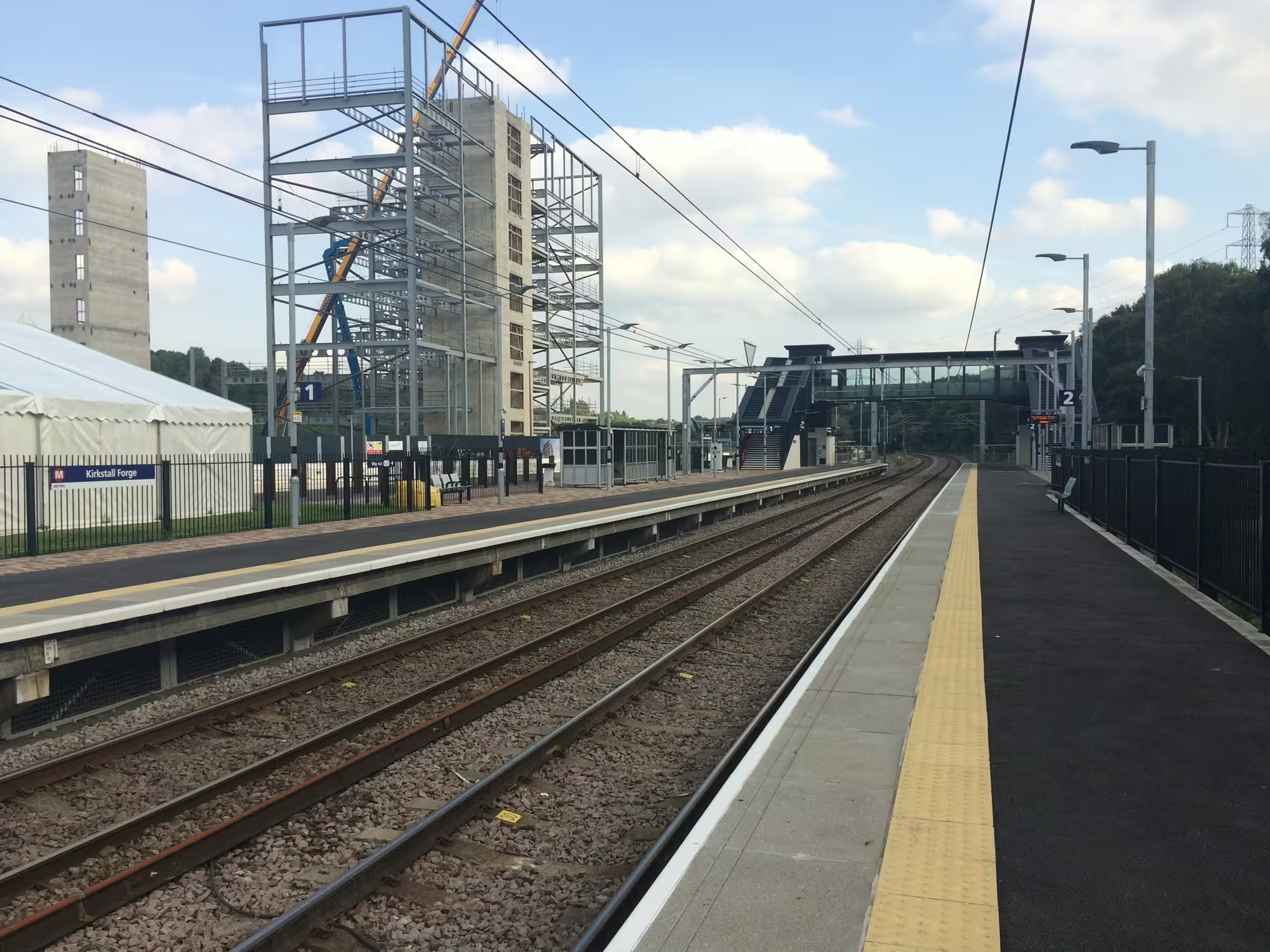
A photo of the platforms at Kirkstall Forge railway station

Earlier this summer, Yorkshire gained a new railway station on the outskirts of Leeds. Called Kirkstall Forge, it’s located on the Airedale and Wharfedale lines which offer commuter services from the Aire and Wharfe valleys into Leeds and Bradford. And on Wednesday, I went to have a look at it.

Kirkstall Forge gets its name from a large forge that used to exist on the site. It was demolished, leaving a huge area of brownfield land, ripe for development. And it happened to be right next to a railway line. So the site’s developers contributed a sizeable amount of money to ensure that a station could be built. After all, houses near railway stations tend to command higher prices.

The station has been a long time coming; plans were first drawn up 17 years ago in 1999, but it wasn’t until 2014 that all of the funding became available. Construction started later that year, although its location on the River Aire’s flood plain put its opening back to June.

As it was a nice day on Wednesday, I walked to the station from Leeds, along the Leeds-Liverpool Canal. It’s about five miles and took me a bit over an hour to get there. Of course, I was about a third of the way there before I realised that Google Maps wasn’t showing a footpath from the canal towpath to the station. Thankfully, a quick Google search verified that there was indeed a path to link the station to the canal. Indeed, thanks to the footbridge at the station, access to the canal in this area is now greatly improved.

The station itself is nothing special. Two platforms, a footbridge with lifts, a couple of waiting shelters, some seats, a ticket machine and a passenger information system. The latter two of these were out of order, showing a scrolling message about checking the paper timetables. Welcome to 2016, everyone.

Considering that a train passes through the station every 10 minutes in each direction, surprisingly few actually stop there. The basic service seems to be hourly in each direction, to either Leeds or Shipley and Bradford Forster Square. A handful of services instead go to Ilkley or Skipton, but these seem to be limited to peak times.

It might seem a bit of a waste then, to spend millions on a station with such a basic service. But then, there isn’t yet much to serve here. Whilst I’m sure that the forge site will be covered with hundreds of new houses in a few years, right now there was only a little construction taking place. Still, I was not the only person to catch the train towards Bradford, at around 4pm.

Kirkstall Forge, for now, retains the crown of Yorkshire’s newest station, but not for too much longer. South of Bradford, Low Moor station is under construction, on the site of the ill-fated Transperience museum, and is due to open next year. Well, hopefully – it’s already behind schedule after an uncapped mine shaft was found right where one of the lifts was due to be installed. There’s still a big gap in the Bradford-bound platform, at time of writing.

Scott managed to visit Kirkstall Forge before me and wrote about it – and I largely agree. Maybe in a few years, the station will be able to better justify its existence.

Car insurance renewal preparation

Cheese on Toast van

I’m about six weeks away from my car insurance policy expiring. Presently, I’m with Diamond (part of Admiral Insurance), and haven’t yet had their renewal quote. But I’m already shopping around to see if I can get it cheaper elsewhere.

I wrote a blog post last year detailing what I’d done to slim my quote down. This ultimately saved me around £200 on this year’s cover. And for three months I had a small ‘black box’ device in my car which monitored my driving. The good news is that I drove sufficiently well to get a ‘safe driving discount’ on my renewal, when it comes.

I’ve not claimed this year, so I should have one year’s no claims bonus. And I’m not a brand new driver any more. Hopefully, the combination of these factors will mean that I can simply renew my car insurance with Diamond to get the best deal, but I’m keeping my options open.

I did a quick price comparison on Confused.com, to see what other insurers could offer. Admiral Insurance itself came top at under £550, which is around £150 cheaper than Diamond was last year. There were a few others under £600, although the quotes will expire before my renewal date. Still, it’s good to get an idea of what’s out there.

I also got a car insurance quote from LV=, after receiving an email from my trade union with an ‘exclusive discount’. Their quote was almost £2000, which, for a car that is worth less than £4000, is ridiculous. Especially when another firm can offer similar cover for around a quarter of the price.

Whilst it’s a pain to have to research new car insurance policies each year, you usually have to be a new customer to get the best deal. Insurance companies presumably make most of their money from those who auto-renew every year, and don’t shop around. It is time consuming getting new quotes, but it can be worth it.

Hollingworth Lake

Hollingworth Lake

I’m a bit behind with uploading photos to Flickr, and so it’s taken me until now to write about a day out to Hollingworth Lake. We went right at the beginning of May, on a scorchingly-hot Sunday afternoon.

Despite its name, Hollingworth Lake is actually a reservoir built by humans, and not a natural lake. Built at the end of the 18th century, it served as the main water source for the Rochdale Canal – the canal that runs from Manchester, across the Pennines to our home town of Sowerby Bridge. By the 1860s it had developed into an inland tourist resort, and nowadays, it’s part of a country park. It still has the feeling of an inland seaside resort, as it retains some its hotels, pubs and amusement arcades. There’s also a sailing club based there.

Christine had been a few times before but this was my first time. I’d passed it a few times; the bridge in the background of the photo carries the M62, and I’ve had driving lessons nearby. Most people drive to get there and there are several car parks by the lake. On busy days, it may take you quite a while to find a parking space. If you don’t want to drive, Smithy Bridge is the nearest railway station (with signs saying ‘Alight here for Hollingworth Lake’) and is a short walk away. There are regular buses from Rochdale.

There’s a footpath all the way around the lake. It’s around four kilometres (2 ½ miles in old money) and makes for a nice gentle stroll. There are a couple of cafés at various points, and on hot days the ice cream vans make an appearance. It’s a nice, varied walk, with a section of the park set aside as a nature reserve.

You can view a few more photos in my Hollingworth Lake album on Flickr.

A day out in Liverpool

Liverpool

A couple of weeks ago, Christine and I ended up with a Friday off work and no plans. So, on a whim, we decided to go to Liverpool.

In the past, we would have caught the train. It takes a couple of hours from Sowerby Bridge, with a change in Manchester. But we decided to drive this time, which proved to be quicker and (probably) cheaper. We decided to stay the night, and we could bring all of our seven-month-old’s paraphernalia in the car as well. We managed to get a room in the Holiday Inn Express in the Albert Dock, which was great. It’s located in one of the old warehouses, above what used to be the studio for This Morning on ITV. The rooms still have the brick barrel-vaulting and ironwork intact, bringing some character to an otherwise bog-standard budget hotel.

We last came to Liverpool in 2010. Back then, we spent a couple of days in the city, before catching the ferry to the Isle of Man. This was before the Museum of Liverpool had opened, so now that it is open and established, we popped in. The gallery about the Liverpool Overhead Railway most interested me, as you can imagine, but the rest of the museum was worth looking around too. It’s also home to several of the Superlambananas that were created for Liverpool’s European Capital of Culture event in 2008. There’s plenty about the history of the city, although some of the exhibits about Liverpool’s suburbs will be more of interest to locals than those visiting.

Liverpool

Liverpool is one of my favourite places to visit. The area around the Albert Dock is fantastic, as is the Liverpool One shopping centre – it’s a great example of a retail development that blends into the city, rather than dominating it. I’m sure we’ll be back again in a few years time.

Pokémon Go

A screenshot of Pokemon Go on iOS

It probably won’t surprise you that I’ve spent quite a bit of the last week playing Pokémon Go. I downloaded it within hours of its official UK release; the screenshot shows how far I’ve got, and overall, I’m level 11. This is mostly through capturing Pokémon on the way to and from work, and on my lunch break.

Christine has been playing it a little longer. She has an Android phone, and so she was able to sideload the APK file from a third-party web site prior to its official release on the Google Play Store. She’s therefore slightly ahead of me, and has had the benefit of being on maternity leave to have more time to catch Pokémon.

I’m enjoying it, although it is further exacerbating my iPhone’s battery issues. As I write this, Pokémon Go has used 51% of my battery over the past 24 hours. Even before last week, I was struggling to get through a full day on one charge. To be fair, I use multiple Bluetooth devices with my phone, and use it on a train journey with frequent tunnels. So my iPhone’s battery was already getting a strong workout even before I started playing. But, notice how my phone was already down to 61% before 9am in the screenshot.

I haven’t added any Pokémon to gyms yet, and have only played a couple of battles. I’m waiting until I’ve collected more, and had the chance to upgrade or evolve them. Many of the nearby gyms have Pokémon with combat power over 1000 already, and my best is under 800.

It’s been fascinating to see how much of a phenomenon Pokémon Go has become. It’s already outperforming many other social apps, including Twitter and Tinder, in terms of how long people use it. And the news has been full of stories, both good and bad, about the game and its players. I never played Ingress, its spiritual predecessor, but I had friends who did. It seems that Niantic, its developer, has found the perfect balance between Ingress’ gameplay, and the popularity of the Pokémon franchise.

I don’t know how long I’ll keep playing. At the moment I’m still discovering new Pokémon and enjoying levelling them up – even if I’m sick of always finding Drowzees everywhere. Maybe the game will become less fun or stale after a while, but at the moment I like it.

Devastated

Tower Bridge

I’m writing this on the morning that a majority of British voters chose to leave the EU. Having stated my position as ‘remain’ and voted that way (as did Christine), I’m devastated to say the least, and terrified of what happens next.

It’s worth bearing in mind that I’m writing this having been awake since 3am, five days into a six day working week.

I’m feeling similar thoughts to 2011, when we as a country rejected a change to our voting system. I backed the change to AV, but a majority preferred to stick with the existing first-past-the-post system. But at least that was maintaining a ‘status quo’ – with the EU referendum, I fear the choices were ‘the same’ and ‘worse’, and not ‘the same’ and ‘better’.

And it’s bringing back memories of 2015, when the Conservatives unexpectedly won a majority in the General Election, and 2004, when George W Bush was re-elected as President of the USA.

What will take place over the coming days, weeks and months remains to be seen. The referendum result is not legally binding, and so the government and/or Parliament could choose to ignore it. I think one of the two following scenarios will play out.

Scenario 1: We leave the EU

The key thing to watch out for is invoking Article 50 of the Lisbon Treaty. This is like giving notice on your job – it tells the rest of the EU nations that we will leave, and gives us two years to sort things out. At the end of that two year period, we will cease to be an EU member state, unless we can get every other EU member state to agree to stop the process, or grant us an extension.

I don’t expect Article 50 to be invoked straight-away, because two years isn’t very long to unpick all of the legislation linked to Europe and implement new trade deals with every other country in the world. I’ve heard that those leading the leave campaign want to wait until 2018, with the aim of completing the Article 50 process by 2020, when the next general election is due to take place.

Whilst I think we will lose out by leaving the EU, I expect any changes to be slow – although the biggest ever fall in the value of the pound may imply that things are about to get very hairy very quickly (and probably wipe out any savings from leaving the EU). In any case, I expect many of those who voted to leave will be disappointed that leaving the EU won’t bring about the massive changes that they expect. A major claim by Vote Leave was that the £350 million that we spend each week on EU membership (which is actually much less thanks to a rebate) could be spent on the NHS, but within hours of the result Nigel Farage has said that’s unlikely.

My big worry is therefore that ‘leave’ voters will feel massively let down and disenfranchised by the whole thing – leaving the EU won’t have been the panacea promised, and their trust in the political system will disappear.

A majority of Scottish and Northern Irish voters chose to remain, and I wouldn’t be surprised if there’s a second referendum on Scottish independence in the coming years. I was neutral on the previous referendum, but I’d be very understanding if Scotland voted to go independent to re-join the EU as a new member state. As for Northern Ireland, I fear that the years of calm since the Troubles subsided could be over, especially as the Republic of Ireland remains an EU member state.

Scenario 2: The referendum result is ignored

Because the referendum isn’t legally binding, the government and/or Parliament may choose to ignore it, and not invoke Article 50. Whether this happens now, or in a couple of years when people realise what a mess we’ve got ourselves into, remains to be seen. I would naturally prefer this to happen, seeing as how 16 million British voters wanted to remain in the EU, but it is also not without caveats.

Those who voted leave will, understandably, be annoyed, and will feel massively let down and disenfranchised by the whole thing. I know, I’m repeating myself, but I genuinely think a lot of good, honest people, were convinced to vote leave on the basis of lies and false promises. But what makes this worse than the scenario above, is that these voters will struggle to find any political parties to turn to. After all, out of the 7 major British parties – Conservatives, Labour, Scottish National Party, Liberal Democrats, Plaid Cymru, Green Party and UK Independence Party – only the latter officially supported leaving with minorities of the largest two. Of course, that assumes that this won’t result in parties splitting apart – and neither Labour or the Conservatives are particularly united at the moment.

The big issue is that no-one knows what’ll happen

What scares me most about the whole thing is all of the uncertainty. Staying in the EU would have, for the most part, been business as usual. But by voting to leave, we’ve opened a massive Pandora’s Box, and who knows what we’ll find.

I really hope that my worst fears are not realised. If they are, then at least I’ll be able to tell my daughter that I voted for what I thought was the right thing. And I apologise now if, in the coming months and years, I keep saying ‘I told you so’.