Because I’m still woefully behind in writing up about our days out, today I’m going to talk about the Elsecar Heritage Centre, which we visited over 6 months ago. It’s in the village of Elsecar, near Barnsley in South Yorkshire, and is a part of the village that has been preserved to look much as it would in the 19th century.
The centre includes many ex-industrial buildings. However, rather than being a static museum, most of the buildings are now leased out, and now host an array of craft shops. The main building, in the photo, is now a soft-play gym, which I think our two-year-old very much appreciated.
Around the back of the site is the Elsecar Heritage Railway, which runs for a short distance using heritage trains. You can have a look at some of the locomotives and carriages in the yard, and there’s a station with services running at weekends.
We actually picked quite a good day to visit, as there was also a small birds of prey exhibition, and an indoor craft market in one of the larger buildings. We’d also been lucky with the weather, although we had a string of nice weekends last autumn.
That being said, without the extra events, I don’t think it would have been much worth coming to Elsecar on its own – at least, not for the distance we travelled. Whilst there are plenty of information boards around, and it’s nice to look at, it’s not really a full day out. If we were to come again, I think we would need to combine it with something else in the area, such as Cannon Hall Farm.
I’ve been feeling pretty rotten this week, having caught a particularly nasty cold. Presumably from Lizzie; she’s had a cold for a few days now and so her face has been constantly covered in snot. And she likes giving us kisses now, which is cute, but also a sure-fire way to pick up her germs.
I have still gone to work as normal, and I thought I’d write about what I do to get through a rough patch.
Please be aware that I’m not a medical professional, and none of this should be considered medical advice. If a medical professional advises you to do something else, follow their advice, not mine. This is just what works for me.
Get up and get clean
When you’re feeling rough, either because you’re ill or experiencing a decline in mental health, there’s a temptation just to stay in bed. And, if you’re so ill that you really cannot get yourself out of bed, it may be best to stay there – if you have ‘flu for example. But maybe call NHS 111 if this happens, just in case it’s something more serious.
If you can get yourself out of bed, then do. Have a shower, and put on clean clothes. Brush your teeth. Shave, if you have facial hair. You probably do these things anyway, but make a special effort to do so. If you’re feverish, then you may have shed a lot of sweat, so getting yourself clean and fresh should help.
Get some fresh air
Go outside, even if it’s just for a few minutes. If you can’t, at least try to get a window open. I felt noticeably better as soon as I got out of the house.
Go to work, if you can
This is a subjective point. I have a desk job, so work isn’t too strenuous; plus, this week a lot of people were off so the office was quiet. Also, I take the train to work, so there was no need to drive; I would have been less likely to go in otherwise. Being at work, seeing other people and being productive actually made me feel better.
Drink plenty of fluids
I mentioned fever sweats – you’re more likely to get dehydrated when you’re ill, so drink plenty of water. Avoid alcohol; the odd hot toddy is probably okay but too much alcohol can leave you dehydrated and feeling even worse. Stick to no more than one average-strength alcoholic drink a day.
Take paracetamol
Paracetamol (acetaminophen to Americans) is cheap, and can help ease your symptoms. Adults can usually take two tablets no less than four hours apart (but always read the label).
Get plenty of rest and avoid stress
Finally, whilst I do advise getting out during the day, rest is also really important when you’re ill. Go to bed early, and avoid doing too many strenuous or stressful activities so that your body has time to recover.
Here’s a photo of our current printer. It’s a HP Deskjet All-in-one F2140, and I think it dates from around 2008. Suffice to say, it predates the computer that it’s connected to, has been through several house moves and periods in storage, and even predates my relationship with Christine. You can also see how much dust is on top of it, and I’ll admit to having to shift a pile of documents stacked up on top of it to get the photo.
Okay, so we don’t use it very often. But having a printer is useful from time to time, and we use the scanner every now and then. Christine and I recently scanned all of our qualification certificates, so that we had electronic copies on hand in our shared Dropbox folder.
So why the need for a new printer? It still works, and we can still get hold of new cartridges easily.
The issue is networking.
Christine’s new laptop
Christine recently bought herself a new laptop – a very lightweight Lenovo Ideapad 320S. She’s doing a part-time university course, and her previous laptop bought in 2010 (when we first started dating) was getting too slow. It’s also big and bulky compared with what you can buy new nowadays. As she will need to print from time to time, she tasked me with setting up the printer on her laptop.
Our HP printer isn’t wireless, and so it’s connected to my Mac Mini (also dating from 2010) by a USB cable. I’ve been using Apple’s Bonjour network sharing protocol to share it across our Wifi network. For Windows, Apple offers a Bonjour Print Services utility that will discover any printers shared using Bonjour. And on Christine’s old laptop, this worked fine.
But I couldn’t get it to work on her new laptop. I think the core issue is that Apple last updated the Bonjour Print Services tool in 2010, and so it pre-dates Windows 10 by some time. Her old laptop was set up under Windows 7 and so was fine. Despite following my own printer sharing guide, and manually installing HP’s Windows 10 drivers, I could not get the Bonjour Printer Wizard to complete without failing with a permissions error (even when running as Administrator).
Whilst my Mac is generally on all of the time, it’s probably about time that we replaced it with a proper wireless printer. To get it to work with my iPhone and iPad, I’m using Printopia, which works okay but it’s a bit of a hack. Having a proper wireless printer, which works with all of our devices (Windows, Mac, iOS and Android) would be a big improvement. Especially when it comes to scanning, which we can currently only do on my very slow Mac.
A custom solution?
New wireless printers start at £30, so it wouldn’t be a big expense. In fact, it’d be about the same price as buying a new Raspberry Pi and setting up some kind of bespoke solution. Which, whilst appealing to my geeky side, would probably take a lot of the very little free time that I have nowadays. Plus, there would be the added ‘fun’ of trying to find a way of scanning documents on the Raspberry Pi, and then have them available to use on our other devices. I’m sure it’s possible, but what’s the point when you can buy an off-the-shelf product that already does this?
I could also look at buying a printer sharing hub, but again, the cost would probably be about the same as a new printer. So I might as well just buy a new printer.
We’ll have a look out for any good deals and will buy a new printer soon.
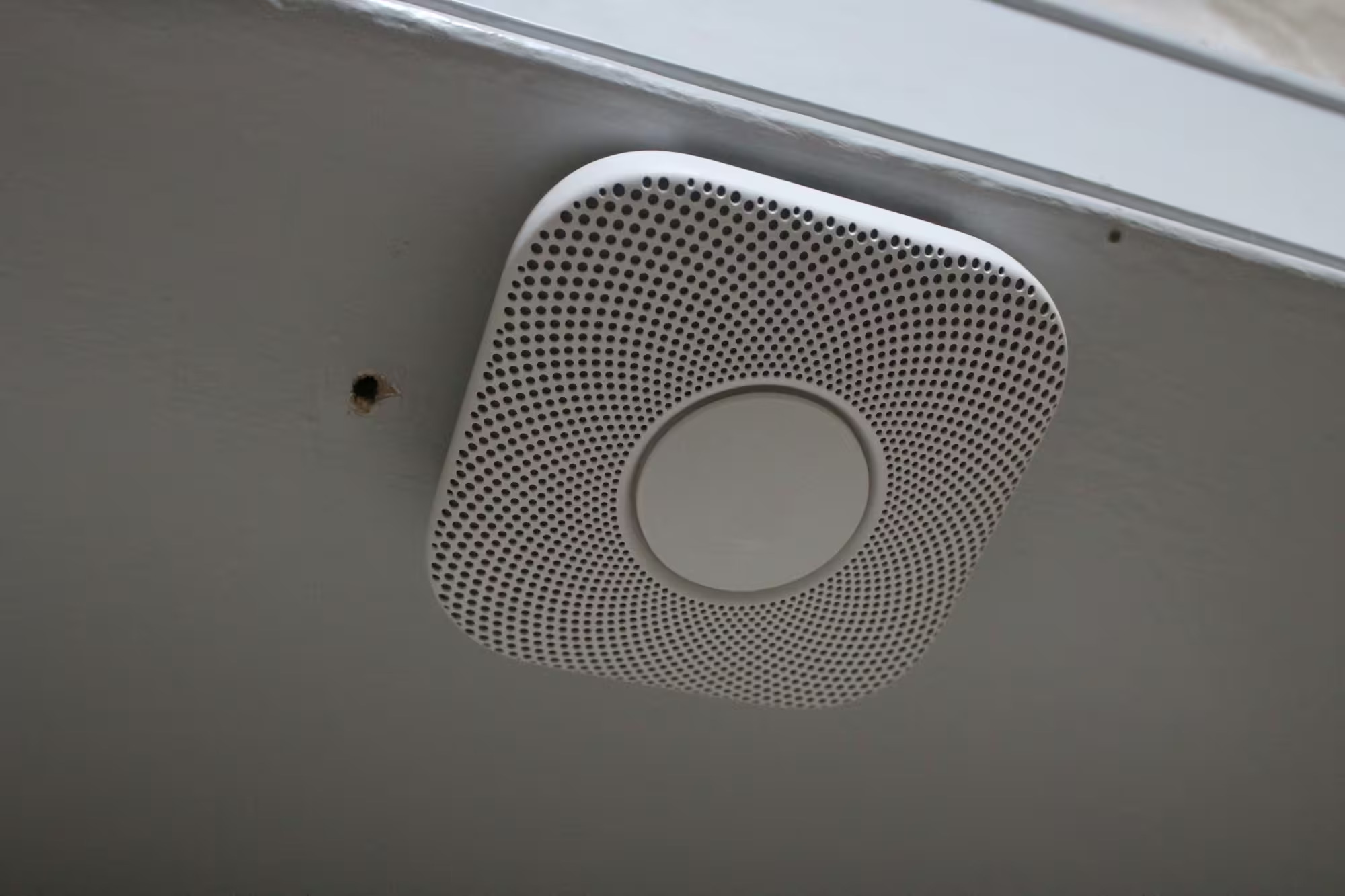
Back in January, we bought a Nest Protect smoke and carbon monoxide alarm (Amazon link). Like other Nest products, it’s a smart, ‘internet of things’ device, so it does a bit more than your regular cheap alarm.
For me, its two best features are:
Push notifications to your phone when the batteries need changing, rather than random chirping at 2am
Being able to cancel an alarm if you’re accidentally burnt your sausages but have the situation under control
Set-up is easy; it’s done through the Nest mobile app before you attach the alarm to the wall or ceilling. We went for the battery-operated model, but you can also buy a mains-connected device if you have the relevant wiring in place.
The Next Protect has a small motion sensor (like the Nest Learning Thermostat). If it’s in a dark room and detects motion, it’ll briefly illuminate with a white light. The light will also glow red, yellow or green depending on whether it has detected any issues.
There’s also a small speaker and a microphone. As well as an alarm tone, the Nest Protect will talk to you to tell you that it has detected smoke or carbon monoxide. The microphone is for self-testing; periodically, the Nest Protect will have a ‘drill’ to ensure that it’s working correctly.
Nest products work together, and as we have a Nest Learning Thermostat, the Nest Protect will tell the thermostat to turn off our central heating boiler if it detects carbon monoxide.
Before buying the Nest Protect, I considered the Roost smart battery. Roost works with your existing smoke alarm, but adds some of the smart features. Unfortunately, as it’s slightly larger than a standard 9-volt battery, it doesn’t work with all smoke alarms.
The other factor that convinced me to buy the Nest Protect was an offer that was running at the time: free delivery and a free Google Home Mini. I’ll be reviewing the latter in another blog post.
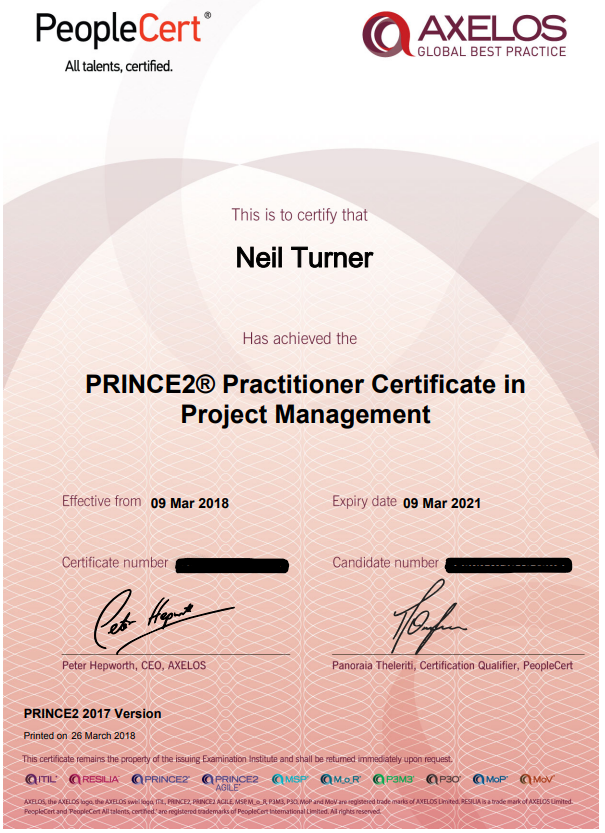
As the certificate above shows, I passed the PRINCE2 Practitioner certificate in project management. I took a week-long intensive course with QA Training in Leeds in March, which included the foundation and practitioner exams.
I was lucky to get a funded place, in a ballot held by my trade union branch at work (Unison). QA’s PRINCE2 course is not cheap, costing over £1000 – there would have been no way that I would have been able to afford it with my own funds. For your money, you get a copy of the official textbook (Amazon link – sponsored link), workbooks and full sample papers for both examinations. Refreshments are also provided, and the coffee machine is pretty good, but you need to bring your own lunch. That being said, QA is based in City Exchange in Leeds, which is the tower block overlooking the Trinity Leeds shopping centre, so there’s no shortage of places to eat within staggering distance.
PRINCE2 is a project management method, originally developed by the British government. Indeed, the Cabinet Office co-runs Axelos, the company which manages PRINCE2, in a joint venture with outsourcing firm Capita. Consequently, PRINCE2 is commonly used in project management in the UK public sector and it’s a useful certification to have.
As mentioned, the PRINCE2 course is quite intensive – especially the first two days, where you prepare for the foundation exam. You start the course on Monday, and sit the foundation exam on Tuesday afternoon. There’s around three hours of coursework to complete before the course starts, and two to three hours each week night. That’s on top of full days in the classroom. That coffee machine was very much welcome, and I’m also indebted to my wife for managing Lizzie whilst I looked myself in the bedroom to study. I’m also thankful to one of my colleagues who took the course a few weeks before I did, and was able to lend me the textbook. That allowed me to read the first few chapters before starting, so that I had a better grounding of some of the terminology from day one.
You receive provisional results from the Foundation exam straight-away, as a pre-requisite of the Practitioner exam is that you have passed the Foundation level. On Wednesday, the class gained a few additional students who were just studying for Practitioner, and we took the Practitioner exam on Friday afternoon. Both exams are multiple choice, but whilst the Foundation exam is just an hour, the Practitioner exam is two and a half hours. And I needed the full two and a half hours. In the Practitioner exam, you’re typically given four choices; two will be wrong, and the other two will be the right answer but with one for the wrong reason. This is still counted as a wrong answer though, and is the major difference between Practitioner and Foundation. You need to know why an answer is right, not just that it is the right answer.
The results took a couple of weeks, and, fortunately I passed. The pass mark is 55%; I managed 81% in Practitioner and a similar score in Foundation. You don’t get anything extra for passing well: it’s pass or fail. There’s no merit or distinction grades.
The Foundation certification is valid for life, and the Practitioner certification is valid for three years. You can extend this by doing continuing professional development with Axelos (and paying them some money), which I’ll have to contemplate.
As for my own career, having PRINCE2 doesn’t change anything in the short term. It may mean that I’m able to take on some project work in my current role at work, and I may look for other roles in project management. It was a big confidence boost though; excepting my driving tests, this was the first time I’d taken an exam since leaving university. I also feel pleased that the extra effort that I put in was worth it.
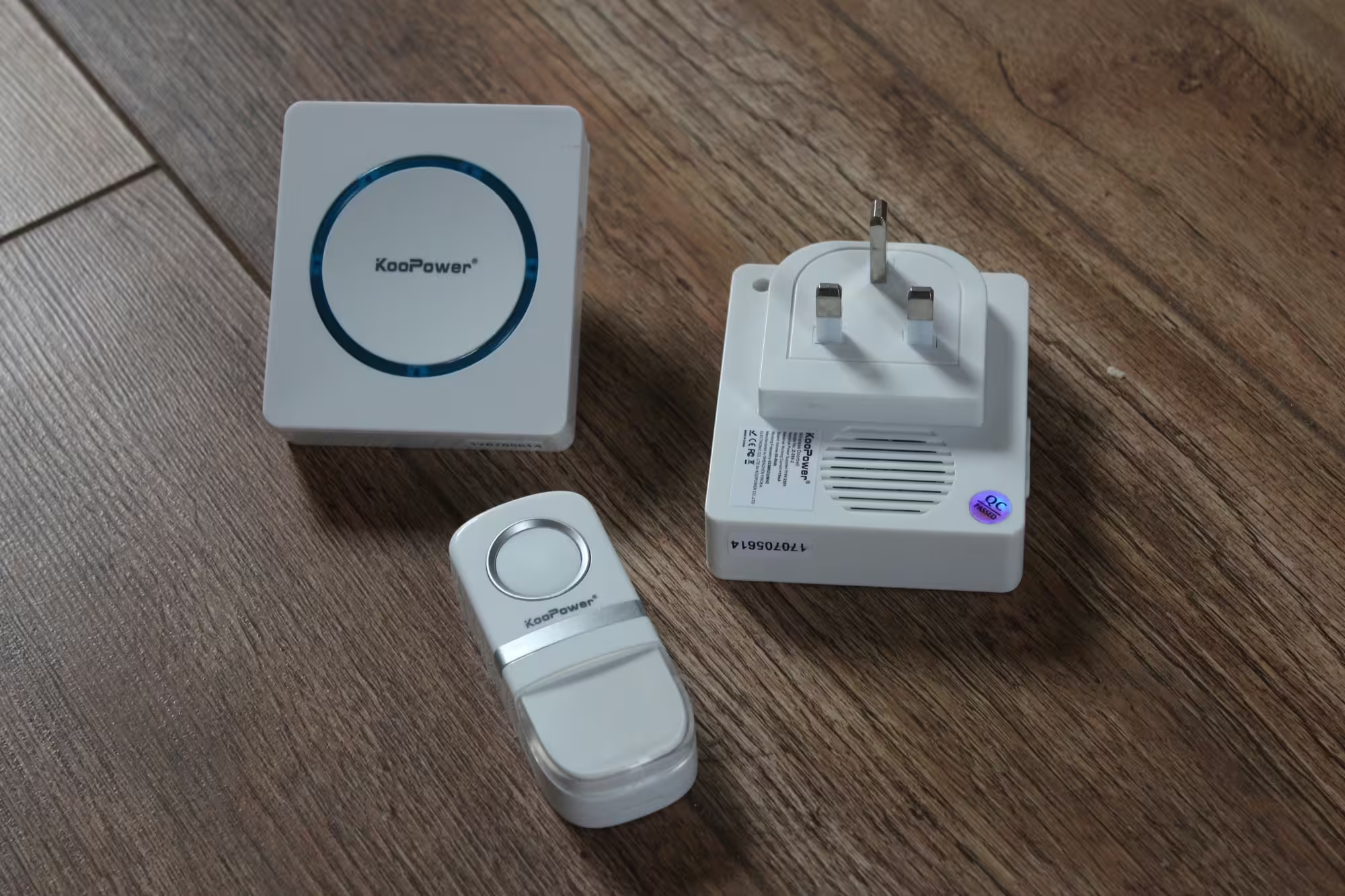
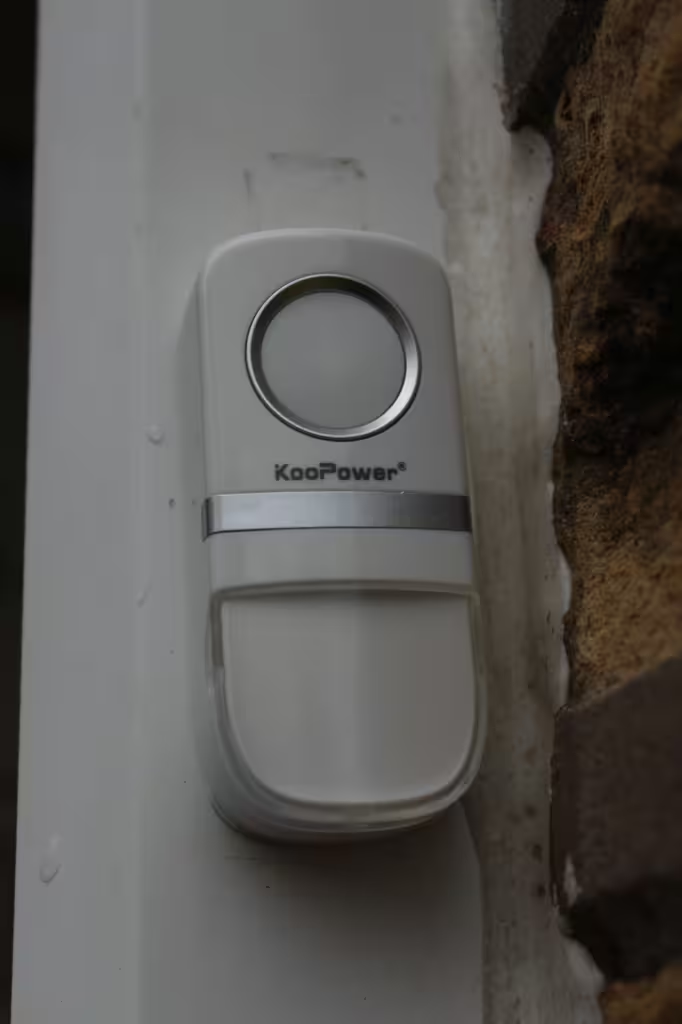
Like with most wireless doorbells, this Koopower kit has a transmitter bell to attach by your door, and a plug-in receiver that plays the chime. What sets the Koopower kit apart is that the transmitter doesn’t require any batteries.
The energy required to transmit the signal is generated by the action of pushing the button. This gets around one of the major problems with traditional wireless doorbells – knowing when the batteries are flat. Short of testing your own doorbell regularly, you run the risk of someone pressing the button and there being no chime, even when you’re in.
The Koopower kit I received contained two receivers, which is useful; I have one downstairs and one upstairs. Our house is quite long with thick walls and in the past I’ve struggled to hear our previous doorbell.
Pairing them with the transmitter was straightforward, and the transmitter includes a double-sided sticky patch for attaching to your wall/door. Compared to my previous wireless doorbell, installation was really easy.
Once installed, a couple of buttons on the receivers let you control the volume, and choose one of 25 polyphonic ringtones to play. I stuck with a simple ‘ding dong’ sound, which is the default. The receivers also flash an LED when they ring.
Whilst more expensive than other wireless doorbell kits, the Koopower system gains points for its incredibly simple installation and offering two receivers. It’s not a smart doorbell system like Ring (Amazon Link), so it won’t link to your phone. But it does well for a basic doorbell system that requires minimal maintenance.
Happy New Year! As usual, I’m making a handful of resolutions that I’ll aim to achieve in 2018. I don’t always blog about them (as a quick search of my old posts suggests), but here’s an overview and the rationale.
Try to get at least 10,000 steps on an many days as possible. I’ve been a Fitbit wearer for almost two and a half years now. 2017 brought some good streaks where I managed 10,000 steps on consecutive days, including 100 days from July through to October. I would like to have more streaks in 2018. I think 10,000 steps every day for 365 days is out of the question, especially as I’m writing this shortly before lunchtime on the 1st January and I haven’t even hit 1000 steps, never mind 10,000. But I think it’s having a positive effect on my fitness, requires a relatively small commitment each day and it’s achievable.
Become a PRINCE2-certified project manager. I’m booked onto a week-long intensive PRINCE2 course in March, with funding from my trade union. The funding was awarded from a ballot, and the course would normally cost a four-figure sum, so this really is an opportunity that I can’t afford to lose, both morally and financially. So I need to make sure that I put in adequate preparation beforehand, allowing me to make the most of it and pass the exams.
Move forward with house renovations. We did some more work on our house in 2017, but not as much as in previous years. Two rooms downstairs are almost finished, so this year I need to get on and complete those jobs. We also need to start on our two-year-old’s bedroom, which will be a major project including re-plastering and probably some electrical work.
More child-free evenings out. Christine and I managed two child-free evenings out in 2017, which were the first ones since the end of 2015 when our two-year-old was born. We’ve had several offers from potential babysitters and need to do more to take up these offers, so that we can have some more quality time with each other.
Write more blog posts. My blogging basically fell of a cliff at the end of last year. I’m going to aim to write two new blog posts each week, and re-start my answers to Richard Herring’s Emergency Questions.
Clear out our spare room and have more guests staying over. We have a spare bed, but it hasn’t been used since May 2016 because we’ve had too much stuff piled up in our spare room. We should now have enough storage space to put all that stuff away properly, so that we can actually use our spare room and have more guests staying over.
Although our child turned 2 this month, we’re planning a proper birthday party in the new year. We didn’t do one last year as I don’t think a one-year-old would’ve known what was going on, but I think they’ll enjoy having a party.
In June, we’re going on holiday! We’re spending 10 days in France with my parents. It’ll be our two-year-old’s first trip abroad, and the first time that I’ve been out of the country since my Middle East trip for work in 2015. And it’ll be my first time driving abroad.
We have two weddings in the calendar. One is the day after our own wedding anniversary in May, and the other is later in the year.
I’m hoping to buy a new iPad, and perhaps a new phone – I will have had my iPhone 5S for three years in February.
More work on the house. We’ve nearly finished the downstairs, but the room that will be our two-year-old’s bedroom needs a lot more work.
Education! Christine starts a part-time university course for a few months in January, and I’m taking a week-long intensive project management course in March.
Whilst we haven’t booked anything, we’re hoping for another London trip.
Although we did go to a New Year’s Eve party, we were home and in bed asleep when the 1st January began.
We made a return trip to the Yorkshire Wildlife Park, which is one of our favourite zoos and in within reasonable driving distance of home. We only went once in 2017 but I’m sure we’ll be back at least once in 2018.
Our first child-free day of the year saw us go to the cinema to see A Monster Calls. It’s a great film that gets very emotional in places.
As usual, January is my blogiversary, and in 2017 I marked 15 years of blogging. Whilst I barely wrote anything in the last three months of this year, I’m not planning to completely give up on blogging any time soon. I also reviewed the Google Chromecast that I got for Christmas, and which has seen extensive use throughout the year.
Halifax is home to Eureka, the National Children’s Museum, and I took our one-year-old there in March. This was the first time that I had visited as an adult, the museum having opened 25 years ago when I was a child myself. Other museum visits included the Manchester Museum and Temple Newsam near Leeds.
I contemplated buying into Apple’s updated iPad range. That hasn’t happened yet, for financial reasons, but I am likely to buy a new iPad in 2018. My existing iPad Mini 2 won’t get iOS updates after this coming summer and it needs a screen replacement. I’d rather not spend more money on it if I’m due to replace it soon.
May is my birthday month, although it was yet another year of insignificant age. In addition to a child-free day, to watch Guardians of the Galaxy volume 2, we also had our first child-free night out. We went to see a recording of I’m Sorry I Haven’t A Clue in Halifax.
May was also the time for our annual trip to London. It was our one-year-old’s first long-distance train journey, and the first time that we took a pushchair on London Underground. We had hoped to make another London trip in 2017 but we never got around to booking it.
In April, a General Election was called, and the Labour Party (of which I am a member) decided to launch its manifesto in the building where I work. It was good to see the nation’s media descend on Bradford and to see Jeremy Corbyn and his colleagues receive such a warm welcome.
And I went on a Stag Do, in Leeds and then up and down the Worth Valley.
June
The General Election took place in June and for once I wasn’t disappointed with the result. We didn’t get a Labour government, but I think the result was the best that we could hope for considering the circumstances and how far behind Labour was in the polling back in April. We had a nice afternoon riding model trains in Brighouse, and a trip to Thornton Hall Farm near Skipton. June saw the second of the two weddings. Afterwards, for the first time in a while, we had no forthcoming weddings in the calendar but we’ve recently had another invite come through for 2018.
In July, I started answering all of the questions in Richard Herring’s Emergency Questions book, 15 a week. This lasted until September, when I took an unplanned blogging hiatus. I wrote about the first thing that I bought on Amazon.
I got a new Fitbit, and our one-year-old got their first passport. We haven’t been abroad yet, but have a holiday to France planned in 2018.
August
We visited Ponderosa near Heckmondwike. I don’t know if we’ll go back, as I wasn’t happy with the way the animals were kept. We also went to the Legoland Discovery Centre at the Trafford Centre – we may go back in a couple of years but I didn’t feel like it was very good value for money.
Another trip to Manchester included the Museum of Science & Industry, which has the benefit of being free and it has a toddler room. Being open on the August Bank Holiday Monday helped too.
August and September are always busy months for me at work, but we did manage to slip in a visit to Harewood House, north of Leeds, and a day trip to Harrogate for Christine’s birthday (including lunch at Betty’s, of course). We also went back to the Leeds City Museum, for a new exhibition on skeletons. As well as being free and easy to get to, Leeds City Museum always has plenty of activities for kids, especially during school holidays.
October saw visits to the Tropical Butterfly House near Sheffield, twice in consecutive weekends. I took our one-year-old one weekend when Christine was working, and ended up going back as a family the next weekend as we enjoyed it so much. I’ll do a proper blog post about it soon.
November
Just the one day out in November, to the Elsecar Heritage Centre near Barnsley. Christine and I had a child-free week off; we had planned to go away somewhere, such as London, but we didn’t get it booked in time. We did, however, spend over £1000 in Ikea, by buying a new sofa and some storage units for the dining room. This ultimately required five people to build.
December
And finally December. We made two trips to Lotherton Hall near Leeds, the second with Christine and my parents. The first was during its Christmas experience, which sees it opening late with extra Christmas activities. It was good value for the £6 per adult entry fee, although I ended up with a filthy car after parking in a muddy field. We also went to the Trafford Centre to finish off our Christmas shopping, where we also saw the Coca Cola truck.
We had Christmas in York with my parents.
So it’s been another busy year with plenty of days out. Hopefully there’ll be many more in 2018.
Wishing you all a very Merry Christmas, from me, Christine and almost two-year-old. We’re staying with my parents in York, as per usual.
I realise that this is the first blog post in two months, and only the second since September. One of my New Year’s Resolutions is likely to be to get back into blogging twice a week, it we’ll see.
Hope you enjoy the rest of Christmas and have a lovely time with family (or a relaxing time on your own).