

Merry Christmas!

A photo of some socks received for Christmas as presents

It’s been a while since I’ve been able to write a Christmas blog post, what with having taken a few years out from blogging.

I received a variety of presents:

  • A bard outfit for future cosplay opportunities
  • A total of 13 pairs of socks (pictured above)
  • A handmade chopping board made by a relative
  • Plenty of chocolate
  • plus plenty of other things besides

We’re staying with my parents in York, as we normally do.

Christmas past

That being said, I was intrigued by Diamond Geezer’s list of places he has spent Christmas over the years, and thought about my own list.

As a child, from as early as I can remember, we would spend Christmas at my grandparents in East Yorkshire. This continued until my early 20s, when my grandparents became too old to host us and so my parents took on hosting duties. In Christmas 2008, we just had my grandfather over as my grandmother was in a care home by that point; she passed away in 2009.

This arrangement continued until 2012, by which time Christine and I had moved into our rented flat together. As a key worker in the NHS, Christine’s work patterns over the festive period meant that we had our first Christmas just as a couple – neither of us could drive back then so a parental visit wasn’t possible. 2013 was in York again but 2014 was back in the flat.

Christmas 2015 was also very different. By now, we had bought out house and I had passed my driving test and bought a car, but Christine was also heavily pregnant and so we didn’t want to stray too far from home.

2016 through to 2019 were back to normal, albeit with the addition of a small person. But then in 2020, the pandemic necessitated remaining at ours, so we had our second Christmas in our house and a scheduled Zoom call to speak to family.

Thanks to the various Covid vaccines, 2021 and now 2022 have been back to normal. However, I was surprised that I’ve only ever spent Christmas in 4 places, in almost 40 years of life.

If you celebrate Christmas, then I hope you have a joyous and merry one in whatever way suits you.
The joy of having a new kitchen

Back in 2019, my grandfather passed away, a few weeks shy of his 99th birthday. Whilst he had generally been in good health, considering his age, he had been taken to hospital with an infection. My grandmother had died 10 years earlier and we think he decided that it was his time to go.

This might seem like a rather sad and confusing way to start a blog post about a new kitchen, but his passing meant that I inherited a sizeable sum of money once all of his affairs had been sorted. We used some of this money to renovate our child’s room, a small amount was invested and I used some to fund a postgraduate university course.

The rest was used to renovate our kitchen. We moved to our current house in 2015, which is an early twentieth century property that’s needed quite a bit of work over the past 7 years. We renovated all of the rest of the downstairs before we moved in – mainly out of necessity due to damp issues – but had only made minor changes to the kitchen at the time. These were limited to a new washing machine, new power sockets and a new laminate floor.

The old kitchen mostly dated from the 1950s, when what was presumably a Yorkshire Range was removed and the chimney breast covered up. It had some new units and work surface in the 1980s/90s, when the previous owners also blocked up the access to the cellar underneath. So in all it was very dated, and once the money and opportunity came to renovate it all, we decided it needed updating.

We actually started the process over a year ago, although it wasn’t until February that we paid the deposit, and work started in May. During May we had a makeshift kitchenette in our dining room – we moved the existing fridge and freezer out, and purchased an Ikea Tillreda portable induction hob for cooking, in addition to our existing Instant Pot, microwave and kettle. Between these, we could cook most things that didn’t require an oven.

By early June the kitchen was substantially finished, but some small jobs weren’t complete until September and our decorators only finished painting it last week. As it stands, we don’t yet have the replacement fridge-freezer but it’s on order and should be here by Christmas.

Here’s an overview of what we changed:

  • Opened up access to the cellar. We removed the kitchen cupboards and work surface that were built over the steps down to the cellar, and installed a new bannister. We could then move our washing machine out of the kitchen and into the cellar, where it’ll soon by joined by a tumble dryer which we’ve not had before. This also gives easier access to our gas and electric meters, which we also had replaced with smart models, and gives us more storage space. As part of this, we had the cellar window replaced (the old one was broken and not watertight) and a radiator installed, along with plumbing and electrics for the washing machine.
  • Opened up the chimney breast. Previously there were some small but deep cupboards that were where the range presumably used to be, but these were awkward to access. Instead, we’ve got two wide draws for cookware and utensils, along with the hob and recirculation unit.
  • Induction hob. Speaking of these, we ditched our gas-powered oven and hob unit, and replaced it with an induction hob and two electric fan ovens. The old cooker unit was small and only had four rings; it was actually smaller than the space allocated for it and so we must have dropped all sorts down the side of it over the years. The replacement induction hob is twice the width and has five zones. It also heats up pans much quicker, although we had to replace the majority of our cookware as many of our older pans were not induction-compatible (i.e. they didn’t have any magnetic material in them). Not that this was a bad thing – many of our pans were cheap ones bought when we were students, whereas we could afford better ones this time. Switching away from gas to electric is also safer (no naked flames) and better for the environment, although we still have a gas boiler for heating and hot water.
  • Ovens. We opted for two identical large Bosch ovens, each with a grill, rather than a unit with a large oven and a smaller combination oven/grill (I believe Americans would call the grill a ‘broiler’). These are built-in and mounted off the wall with drawers underneath, making it easier to get food in and out of them. The ovens perform significantly better than our gas oven did – much shorter cooking time, and we particularly appreciate the pizza mode.
  • Recirculation unit. Above the hobs is an air recirculation unit, which sucks up cooking fumes, filters them and then has an exhaust back into the kitchen. Ideally we would have the outlet leading outside but this is still better than before: previously, we had an extractor fan that was on one window, well away from the cooker, and it hadn’t worked for a couple of years anyway.
  • New fridge-freezer. This hasn’t arrived yet – we only ordered it last weekend – but we decided to have one large unit that would replace the existing under-counter separate fridge and freezer. Both have seen better days; the brackets holding the bottle shelf in the fridge have broken off and the plastic drawers in the freezer are cracked. Plus, it’s not great having to constantly bend down to access the fridge, so we’ve gone with a wider, American-style fridge-freezer with the fridge compartment above. It’ll also have a cold water dispenser, which will be useful for me when working at home on hot summer days. It’s a Hisense model which seems to score well in independent testing.
  • More storage. One major issue with our previous kitchen was small cupboards, which we filled before we’d even unpacked all of our cookware, crockery and food. This time we’ve gone for more storage; the centrepiece being a full height larder where we can store (just about) all of our food and drink. We also have more, bigger drawers; like with the fridge-freezer, this should reduce the amount of bending down required. The major benefit of having more storage is that we can put more things away and keep our work surfaces clear – before, we had to keep all sorts out due to a lack of space and so often our utensils would get covered in grease.
  • Easier to clean. By being able to put more things away the whole kitchen should be easier to keep clean, and we’ve gone for relatively simple fixtures to facilitate this. We’ve also gone for painted walls; before, the walls were covered in wallpaper which over time had absorbed grease and all sorts.
  • Better lighting. Previously the kitchen had two long fluorescent strip lights, although I replaced these strips with LED bulbs a couple of years ago. Unfortunately one strip stopped working, and so we had a small Ikea clip-on light to illuminate the main working area, which helped but also meant we couldn’t close the cupboard door it was clipped to. In the new kitchen, we have under-shelf lighting for all of the worksurfaces, and seven spotlights in the ceiling.
  • Two radiators. When we moved in, there was just a small electric fire to heat the kitchen; when we had the new boiler installed in 2016, we had this replaced with a standard radiator but it had to be small to fit the space. That radiator is now in the cellar; whilst its replacement is also small, we have a much larger tall radiator at the top of the stairs down to the cellar. Apart from when the oven was on, the kitchen was one of the coldest rooms in the house before.
  • New smart dishwasher. The old dishwasher that was there when we bought the house was terrible; sometimes, our crockery would come out more dirty than when it went in, despite our efforts to clean it out. We didn’t specifically ask for a smart dishwasher but our kitchen company provided one – I understand that earlier this year there was a worldwide dishwasher shortage and that’s what they could get. As with the other built-in appliances, it’s Bosch, and uses Home Connect, which is fully compatible with Alexa, Google Assistant and IFTTT. Mainly it’s useful for getting a phone notification for when it’s finished, or when the salt or rinse aid needs re-filling, and you can ask Google how long it has left. Most importantly, it works really well as a dishwasher, and we’re able to use it more extensively than the old one, including washing cookware.
  • Tumble dryer. This is actually going in the cellar, but previously we had to use a ceiling mounted drying rack for drying clothes – which inevitably ended up smelling of bacon or whatever else we were cooking as well as getting in the way. Whilst we have also bought a heated drying rack, it takes around 24 hours to dry a full load, and having a tumble dryer will help for bulkier items like bedsheets and towels. It will use more energy, but we’re using the last of our savings to have solar panels and a battery installed next month; this was another reason for switching from gas to electric for cooking. We’ve opted for a Grundig dryer which is a heat pump model, and therefore has much lower running costs than condenser models.

We have had to make some compromises with the new kitchen, which is namely work surface space. To be able to fit in access to cellar and the larder, we have significantly less work surface available, but the extra storage means that we can actually keep what we have clear and so the amount of useable space is about the same as before. And as mentioned, we had to buy new pans from ProCook, but those that we’ve bought are a significant improvement over our old pans anyway.

It’s been a long journey, but by Christmas it should all be finished. Back in March I actually made a short video listing all the things that we hated about the old kitchen and how we’re addressing them, which informed this blog post. We’re very lucky that we inherited enough money to be able to get a kitchen which better suits our needs; it not only looks good but also works for us. I hope my grandfather will be happy with what his inheritance has allowed us to get.

We still have more work to do on the house; the downstairs is almost done but two of the three bedrooms need work in time, as does the stairwell and upstairs landing. We’ve done some redecorating in the bathroom which has made it look less 1980s but eventually it’ll need replacing. I’m hoping that we’ll be able to save some money once the solar panels and battery are installed next month.

WordPress in the Fediverse

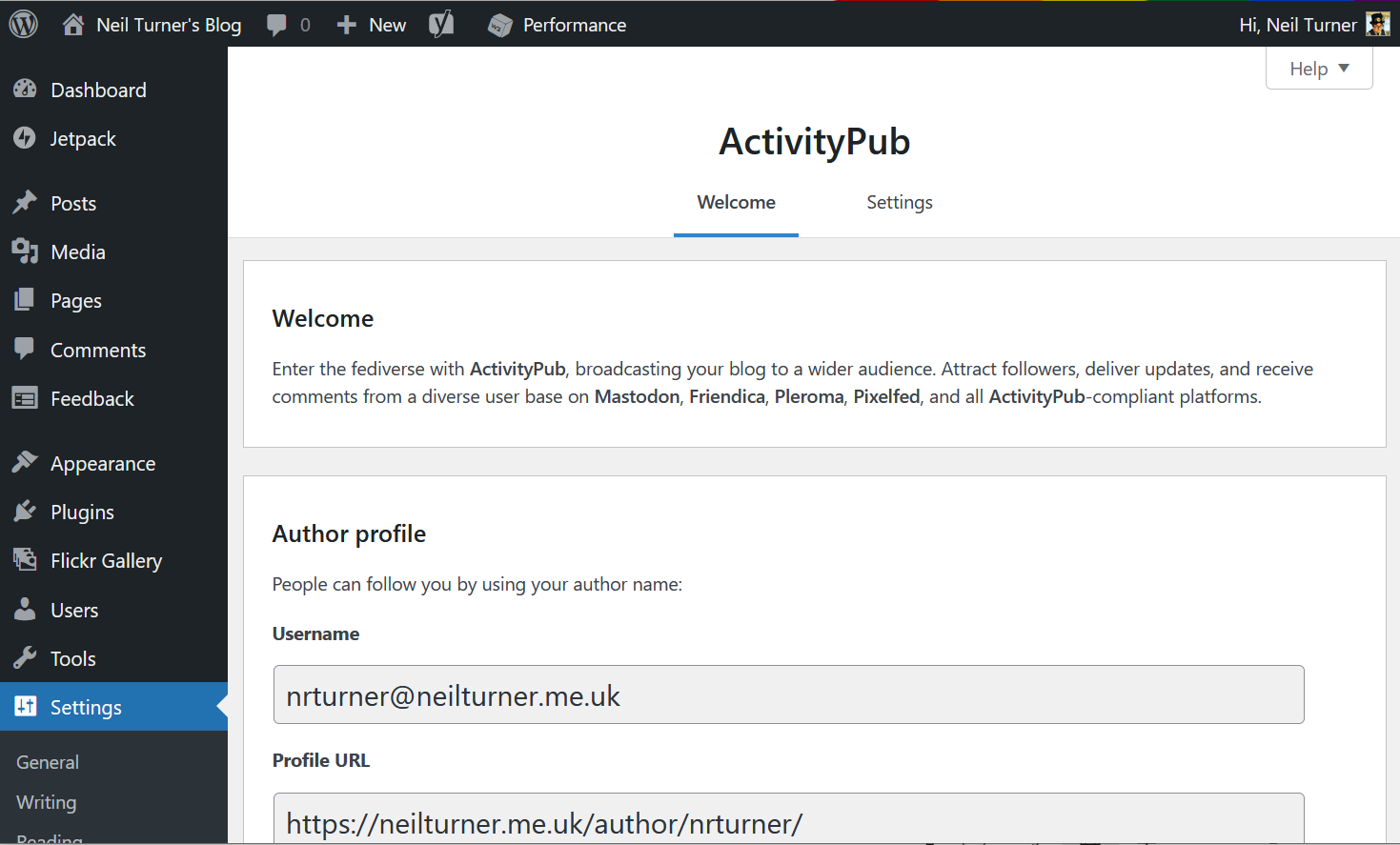
A screenshot of the settings page for the ActivityPub plugin for WordPress

If I’ve set up everything correctly, then you should be able to subscribe to this blog in your favourite Fediverse app, such as Mastodon, by following @[email protected] .

You’ll need to install the ActivityPub plugin, and then it should just work where your fediverse username is @[email protected]. If you’ve used a plugin to disable author archives, such as Yoast’s SEO plugin, you’ll need to re-enable it for this to work.

I found this guide particularly useful, as it links to Webfinger to test that you’ve set it up correctly.

(Update: since this post was written almost 12 months ago, the ActivityPub plugin has been formally adopted by Automattic and so enjoys wider support)

Good intentions and Mastodon

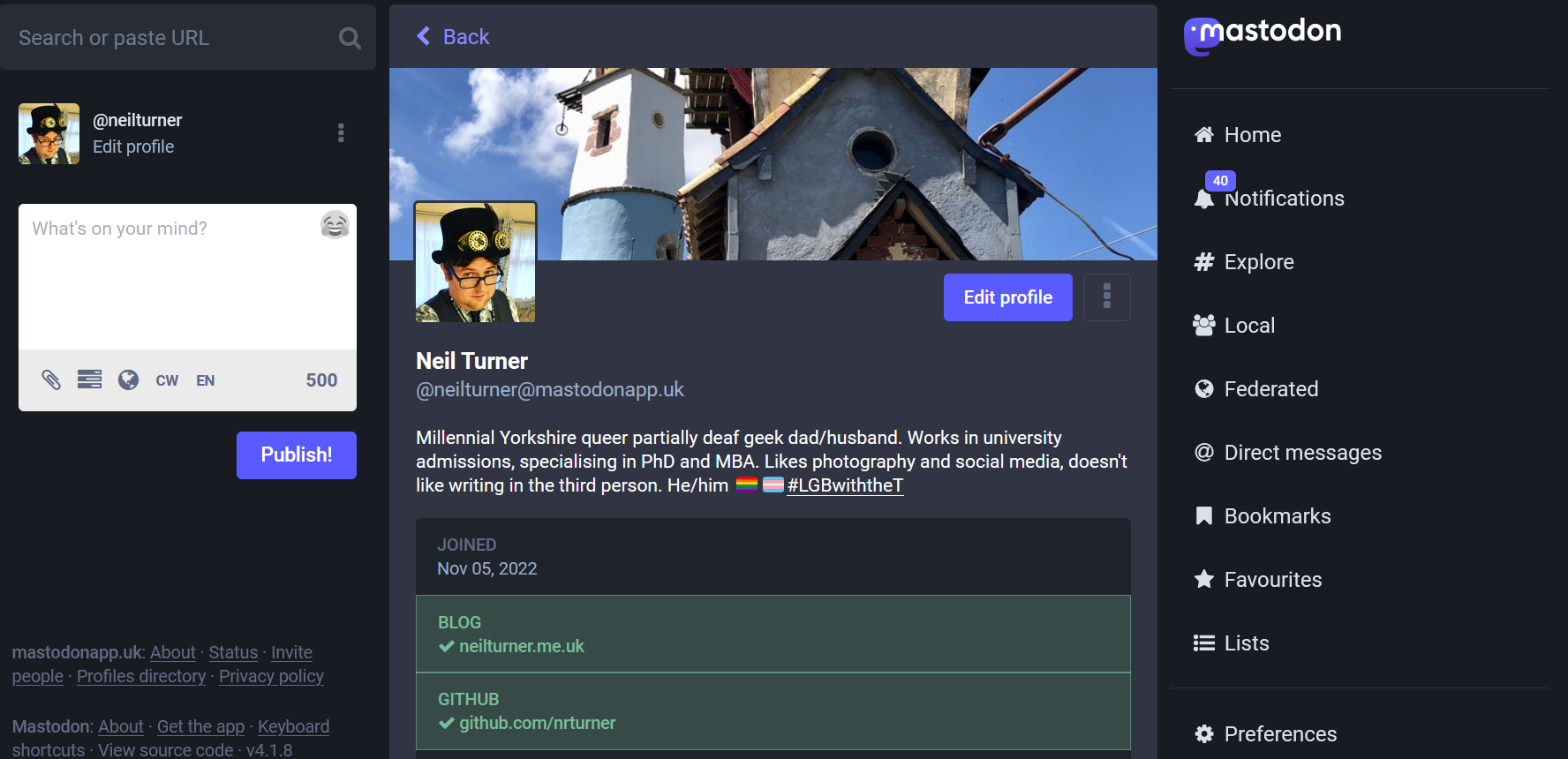
Screenshot of my Mastodon profile

Well, here was me promising to blog here more regularly, and then completely ignoring the blog for 5 months. Go me?

The main purpose of this blog post is to include a link to my Mastodon profile. As I write this, Elon Musk has taken over Twitter and looks to be unleashing his libertarian hellscape vision very quickly. Whilst I don’t intend to leave Twitter, I’ve decided to keep my options open and have set myself up on Mastodon.lol, which is an LGBTQ+-friendly server that doesn’t integrate with any servers that host fascists.

Whilst we’ve been here before with Ello, App.net, Google+, Clubhouse and innumerable other sites that have tried to compete with Twitter and failed, Mastodon seems to be the most popular ‘non-fascsist site’. Good, lord, what a thing to have to type.

We’ll see what happens, eh?

Home improvements

We bought our first home back in 2015, when my wife was pregnant. The house we bought is one that estate agents would describe as ‘having potential’. That’s not to say it was derelict, but it had dated decor and needed a lot of work doing.

We spent much of 2015 renovating the downstairs rooms – new plaster on the walls, new electrics and fixing various issues which meant that, whilst we got the keys in June, it was October before we could finally move in. In 2016, we converted a newly-partitioned room into a downstairs toilet, and had a new central heating boiler fitted.

Progress with renovating the rest of the house slowed down after this. Working full-time and having a child meant that we just didn’t have the time, and money was also an issue. But then in 2020 I inherited a sizeable amount of money from a deceased relative, and so we were able to start work again.

Whilst we had done a lot of work downstairs, the upstairs rooms had remained pretty much as before. Of the three bedrooms, the one we had earmarked for our child needed the most work, so this is the first of the bedrooms to be renovated. As with the downstairs rooms, it was a big job.

Firstly, there was a large, built-in wardrobe which had to be removed – it was falling apart anyway, and it was partly there to house a water tank which was removed when we had the new boiler fitted. Once that was out, and after stripping the wallpaper, it became clear that re-plastering was necessary here as well. We also needed new wiring – before, we only had two single plug sockets for the whole room – new floorboards, and some central heating pipes needed re-routing. Thankfully, we were able to employ a builder who could do all of this for us.

The room now looks totally different; as with downstairs, we’ve gone for painted walls rather than wallpaper. We’ve also decided to have the floorboards varnished and put rugs down, rather than carpets, so that the room can more easily evolve with our child’s changing tastes as they get older. And it’s a more flexible space, with more options for where the bed can go.

This year, we’re renovating the kitchen. I’ll write more in detail about this later, but again, it’s a big project. When we moved in, we didn’t do much work on the kitchen, compared to the other downstairs rooms – just a few extra plug sockets and a new floor – but this time it’s a total renovation. It also includes opening up one of our cellars as a utility room.

There’s still more work to be done elsewhere – the bathroom needs renovating as well, as again we only did a small amount of work when we moved in. And the other two bedrooms could do with a refresh. We’ll need some more money first though.

Parenting a six year old

So, the last time I blogged regularly, I had a 2 1/2 year old child who had just had their first trip abroad to France. Now, that child is 6 and is in their last term of their second year at primary school.

It’s been an interesting time, not least because a big chunk of 2020 was spent stuck at home. Days before the UK went into full lockdown in March 2020, our childminder closed and initially I spent time at my parents’ house in York for childcare. When that became an impossibility, I had the joy of working at home whilst trying to keep a four-year-old entertained for four months.

In some respects, I was lucky; my child hadn’t started formal education yet and so home-schooling wasn’t required, but it was hard; taking awkward phone calls for work whilst your child is demanding attention isn’t anyone’s idea of fun. A lot of CBeebies was watched, as were various Netflix and Disney+ shows. Indeed, my child watched so much of Jake and the Never-land Pirates on Disney+ that Jake became their imaginary friend for a while. I had to do this on my own as my wife is a front-line NHS worker, and had no choice but to carry on going into work throughout the pandemic. Unsurprisingly, she contracted Covid-19 in April 2020 and was very ill with it, but thankfully made a full recovery.

Fortunately, in September 2020, my child was able to start school, and settled in well. The school wasn’t our first choice – indeed, it was actually our third. Our top two choices where schools that were more convenient for us, being as they were on our commute to work; this third choice of school was further away in the opposite direction to our workplaces. However, whilst it may not have been our first choice, in retrospect, it was probably the best choice for our child as it has much smaller class sizes due to it being comparatively under-subscribed. We were also fortunate to get a place in the out of school club.

We were also blessed with good fortune in January 2021, when the country went back into lockdown and the schools closed. This time around, the government widened the categories of key workers, meaning that I qualified as well (and our HR department responded very quickly to my request for a letter confirming as such) so we were able to get a key worker place and avoided two months of home schooling. Thankfully, apart from short periods due to possible exposure and ‘having a cough’, there’s not been so much disruption to their education this year.

Despite a rough time in 2020, I’m still enjoying being a parent and we have a lot of fun as a family. We have regular days out, and our child now has regular out of school activities on Saturdays too. Most importantly, they’re happy and healthy, with a group of friends.

We still only have the one child at present; that could change in future but we’re still waiting for my wife to take her driving test before we consider having another.

What’s this? A blog post?

Well, hello. This is my first blog post in almost four years.

I last wrote a post on here in September 2018, and then took an un-planned break from blogging. This was exacerbated at the end of 2018, when I attempted to upgrade the server that this web site runs on, and ended up wiping everything. And I mean, everything, including the backups that I thought I’d saved elsewhere but hadn’t.

Just like that, 16 and a half years of blog posts were gone, along with all the comments. Now, it’s possible that I could have re-built most of the blog posts, using things like the Web Archive and help from others, but between working full-time and being a parent, I just didn’t have the time or the inclination to do so.

Furthermore, I was beginning to become uncomfortable with how much I had shared about my life over the years. Back when I started the blog, aged 17, I had a tendency to over-share. Over time I reigned that in; I was in a relationship with someone between 2005 and 2009 where I agreed not to share her real name on here, and though we’ve both moved on I’m keeping that commitment – not least because we’re still in touch and actually met up recently.

But I also wanted to reign in how much I talk about my child, who is now six. I’m happy to share their age, but I’m afraid you won’t be knowing their name or seeing recent photos, and I’m even keeping their gender off here now too. It’s about consent and privacy – as a parent, I want to protect my child, and they’re too young to really know what a blog is, never mind have lots of information about their life made public.

I am hoping to get back into the habit of blogging regularly, though not on a daily basis as I had aimed for in the past. Initially I’m aiming for twice a week, as there are four years of news to catch up on, but my minimum aspiration is for one new blog post per week.

Why now? Well, I’ve wanted to get back into writing for pleasure again. I’ve written a few things on Medium, but it feels like writing for a magazine; I’d rather stick to somewhere more personal that’s just about and run by me. I feel like I have things to say now, and hopefully the time to put those things into written words.

If you’re an old-time reader of my blog, welcome back, and I hope that this wasn’t too much of a surprise when it popped up in your RSS reader. And if you’re a new reader, hello. You can read my very dry ‘about me‘ page which is more focussed on my work, but I hope you’ll stick around and will get to know me better.

Seatfrog – how to get a cheap first class upgrade

A screenshot of the Seatfrog app on iOS

Tomorrow, Christine, our three-year-old and I are off to London (actually for the second time this week, but that’s another story). We’re going by train, and, thanks to Seatfrog, we’ll be travelling in first class, at a relatively low additional cost, having already saved some money with railcards and advance booking.

Seat auction

In the UK, Seatfrog is available on LNER services on the East Coast Main Line. You buy your standard class tickets online, as normal, and then put your booking reference into Seatfrog. The day before departure, Seatfrog holds an auction; enter your bid, and if you win, your updated tickets appear in the app.

We bid £10 per ticket for our journey, and this won (the minimum bid was £5). However, there may be a higher reserve on some services – for our return, the reserve was £9. Upgrading to first class gets you a wider, reclining seat, the majority of which are leather upholstered on LNER services. Plus, free Wi-Fi, regular offers of tea and coffee, and, for journeys over an hour, a complementary meal. This is easily worth £10 a head and means we won’t need to buy extra food for our journey.

Of course, there’s no guarantee that you’ll win, and there’s no point bidding too high as you can buy an upgrade outright for £35 per ticket. At least if you’re outbid, no money is taken.

I suppose it’s a good way of filling vacant first class seats. I could also see this being useful for people travelling on business, who can only claim standard class travel on expenses. Seatfrog would allow you to trade up to first class from your own pocket if you’re happy to pay a bit extra yourself.

For now, Seatfrog is only available on LNER services, however, it’s run by an independent company and so it’s possible that other travel companies could adopt it – potentially airlines as well as train operators,

So, tomorrow we’ll be smugly sat in first class, knowing that we paid well under the odds for our tickets,

My Podcast Diet – August 2018

Matt Haughey, who has recently quit Twitter and returned to blogging more, has posted about which podcasts he listens to regularly and semi-regularly. It’s a good idea for a blog post, and so I’m going to steal it.

Podcasts that I listen to straightaway

These tend to be topical podcasts that would go stale very quickly.

  • BBC Radio 4 Friday Night Comedy Podcast – whichever show happens to occupying the 1830 Friday comedy slot on BBC Radio 4. Normally this alternates between The News Quiz and The Now Show, but Dead Ringers pops up in summer. Weekly, every Friday, somewhat obviously.
  • The Bugle – topical satirical comedy from Andy Zaltzman and rotating guest hosts filling the gap left by John Oliver (yes, that John Oliver). Weekly, every Friday.
  • The Guilty Feminist – this was the podcast that I saw live in March 2016, which mixes discussion of issues relating to feminism and stand-up comedy. Hosted by Deborah Frances-White with a rotating guest co-host. Weekly, every Monday.
  • Standard Issue Podcast – a magazine style-show covering women’s issues, as well as interviews, women’s sport, and regular features on TV shows and Disney films. Once a month, there’s a ‘gigcast’ with celebrity chats recorded live in front of an audience. Weekly, on Wednesdays, with occasional bonus content at weekends.
  • Reasons to be Cheerful – a new podcast co-hosted by Ed Milliband and Geoff Lloyd, which focuses on a political issue each week.

Podcasts I listen to regularly

  • The Comedian’s Comedian – stand-up comedian Stuart Goldsmith interviews a fellow comic (or comedy group) about how they work. Always enlightening. Weekly, on Mondays, but seemingly on a break at the moment – probably due to the Edinburgh Festival Fringe.
  • Made of Human – stand-up comedian Sofie Hagen (formally of The Guilty Feminist) interviews people about life and how they handle it. Warm and friendly. Weekly, on Wednesdays.
  • Felicitations – Felicia Day’s relatively new podcast, about what she’s been up to, and parenting. Weekly, on Thursdays, but seemingly on a break at the moment.

Podcasts that I listen to when there’s a new season

These podcasts run as seasons and so new episodes don’t come out all year round, but I listen to them regularly when they’re on.

  • Mrs Brightside – stand-up comedian Susan Calman interviews a fellow celebrity about depression and mental health. Weekly, on Mondays. Series one has just ended, but should be back later in the year.
  • The Infinite Monkey Cage – science podcast co-hosted by Professor Brian Cox and Robin Ince, with a different topic each week. Guests are a mixture of scientists and comedians. Weekly, on Mondays, with new episodes available now.
  • Global Pillage – comedy panel show about diversity, hosted by Deborah Frances-White. Weekly, on Mondays. No new episodes at present.
  • Richard Herring’s Leicester Square Theatre Podcast (RHLSTP) – stand-up comedian Richard Herring interviews a celebrity guest in front of a live audience in London’s Leicester Square Theatre. Weekly, on Wednesdays, back in the autumn.
  • Grownupland – a podcast for millennials about adulting.
  • Newsjack – weekly comedy sketches with an open-door writing policy, so anyone can submit.

How to: fix incorrect date and time on an Amazon Kindle Fire

Today, a colleague of mine asked for help with connecting her Amazon Kindle Fire (sponsored link) to the university Wi-Fi network (which is linked to eduroam). Whilst I’m not an IT employee, I offered to help.

eduroam, for those who aren’t aware, allows staff and students at universities to access Wi-Fi at any other participating university. This includes almost all UK colleges and universities, and many others across the world. To do this, it uses WPA-Enterprise, with authentication using a username and password, rather than a Wi-Fi key like you would get on a home Wi-Fi network.

The problem was that the Kindle Fire couldn’t connect, despite the username and password being correct. And then I noticed that the time was wrong.

Problem 1: wrong date and time

The underlying cryptography behind WPA-Enterprise, and most other secure internet systems, is reliant on accurate clocks. For whatever reason, this Kindle Fire thought that it was about 3am in September 2010. Consequently, it couldn’t establish a secure connection.

So, I went to change the date and time.

Problem 2: you can’t manually change the date and time on a Kindle Fire

There’s no option to manually change the date and time on the Kindle Fire (although this may have existed on older devices). If you try to change the time, you get an error, telling you that your device will get the correct time from Amazon automatically. At best, you can change the time zone if this is incorrect, but this was no help when the clock was out by almost 8 years.

Problem 3: The Kindle Fire cannot automatically update the date and time without an internet connection

So now we’re at an impasse. We can’t get on the internet because the time is wrong, but Amazon has locked down the ability to change the date and time, and we can’t get the correct time from the internet because we can’t connect to the internet. ARGH.

Solution: use a second device as a Wi-Fi hotspot

Fortunately, I managed to solve this by using my iPhone as a personal hotspot. As this doesn’t require authentication via WPA-Enterprise, the Kindle Fire was able to connect, get onto the internet, and update the time on the device to the correct time. I was then able to disconnect from the personal hotspot, and connect to eduroam without any problems.

I can understand why Amazon have locked down the date and time settings, as, if they are wrong, all your secure connections will fail. And considering that many web sites now use HTTPS all the time, this would break a lot of things. But it doesn’t account for when a Kindle Fire’s battery goes completely flat, and it resets to a default time. Which I assume is what happened in this instance.

I checked my iPhone, and Apple does let you manually override the automatic date and time that it receives when you’re online. I assume most Android devices are similar – by default, they set the time automatically but give the user the opportunity to override this if needed. Amazon’s decision, whilst understandable, is frustrating in edge cases like this one.