Migrating from Bluesky to Eurosky

A screenshot of the Eurosky web site

I’ve moved my Bluesky account to Eurosky. If you follow me on Bluesky, then you probably won’t have noticed any difference, as everything will have migrated over.

Eurosky is a PDS (Personal Data Server) for the Atmosphere, which is the system of interoperable social media services that Bluesky uses. As the name suggests, it’s based in Europe, and so my personal data is stored somewhere with more closely aligned privacy laws to the UK.

Signing up for Eurosky

Eurosky opened for registrations last month, and is now home to a few thousand users. You can create a fresh account there, or you can migrate an existing account from Bluesky (or indeed any other app in the Atmosphere). I did the latter, and used their EU-HAUL tool to migrate my account. It took around 20 minutes in total. I previously tried the PDS MOOver tool, but this failed for some reason.

Once the migration was complete, I just needed to log out of my deactivated Bluesky account, and then log in using my Eurosky account. You can still use the official Bluesky app and web interface, so there’s no change to the user experience.

I use my domain as my username, and so my username remains the same after the migration. If you don’t have your own domain, then your username will change from [something].bsky.social to [something].eurosky.social.

Alternative PDSs

There are a few other PDSs coming online now. Blacksky is aimed at black people and is based in the US. Cory Doctorow is using one where he is the only user (he previously resisted joining Bluesky until now). In time, I imagine Atmosphere PDSs will become a bit like Mastodon instances, where there will be lots of small servers that people can run themselves, as well as the core Bluesky instance. Indeed, the Atmosphere is essentially analogous to the Fediverse, and the underlying AT Protocol works in a similar way to ActivityPub. A WordPress plugin called Wireservice is in development.

This is all very geeky stuff and I’m sure most Bluesky users will stay put on the Bluesky PDS. But I feel more comfortable using a service like Eurosky which is in a more closely aligned jurisdiction to me.


How to use Bluesky Labellers

Last year, I wrote about how to view and share pronouns on Bluesky. Bluesky is the social network that I spend the most time on nowadays and, as I write this, recently surpassed 30 million users.

The Pronouns Labeller uses an interesting feature of Bluesky called labels, which can be applied to individual posts (or skeets) and whole accounts. They can be used in a positive way, such as sharing pronouns, but can also be applied as a potential warning to other users. Today, I’m listing some of the labellers that I use – all of these are listed on the (unofficial) Bluesky Labellers page, which ranks them by popularity.

To use these, you’ll first need to subscribe to the labeller whilst logged in to Bluesky – there’ll be a big ‘Subscribe to labeller’ button on their profile. Once subscribed, you can configure which labels you want to see, and optionally hide all posts with a certain label (or all posts from users with that label).

If you want to apply a label to your own account, then there may be additional steps, usually detailed on a pinned post on the profile.

  • TTRPG Class Identifier. It’s somewhat telling that this is the most popular labeller on Bluesky. Once you follow, you’ll be given a class from a table-top role-playing game (such as Dungeons and Dragons) which will display as a label on your profile. There are commands that you can send to re-roll your class, and you can choose your race too. More details available here.
  • Nations. Allows you to add your country’s flag as a label, and see others’ flags. You can also add the standard pride flag emoji, and/or the trans pride emoji to your account too.
  • Sorting Hat. I have my issues with the author of the Harry Potter books, due to her views about trans people, but this lets you tell the world which Hogwarts house you would belong to, and see others.
  • XBlock Screenshot Labeller. Labels posts containing screenshots from other social networks, so that you can have them labelled and optionally hidden.
  • Developer Labels. Show off what programming languages you know on your posts.
  • Private School and Landlord labeller. Subscribing to this will reveal which private (fee-paying) school various (mainly UK) users attended, so you can see who benefitted from a paid-for education. Nepo Baby Labeller works in a similar way.
  • Birthdays. Will show you if it’s a user’s birthday.
  • Profile Labeller. Warns you about potential bots, and people whose posts are bridged in from other social networks.

Anyone can make a label, and there’s a Label Starter Kit on GitHub if you want to make your own. If I had the time and the skills, I would consider writing a labeller which allows users to show which British university they graduated from, for example.

Labels are one thing that I particularly like about Bluesky – especially as users can contribute their own. It’s quite a unique feature – I’m not aware that others have anything similar. Sometimes, a bit of extra context on each post is welcome.

Croissant, a social media cross-posting app

A screenshot of the Croissant app on an iPhone 13 Mini

If you cast your minds back around three years, there was just one major public-facing text-based social media platform: Twitter. Now that Twitter is called X, and only Nazis and grifters seem to be left there, we’ve ended up with some people on Bluesky, some on Threads and others on Mastodon. And so Croissant makes it easy to cross-post to all three at once.

Although I mainly post on Bluesky these days, I try to keep my accounts on Threads and Mastodon active as well.

Once you have linked your accounts to Croissant, you get a nice big space to write your post, and a character count. Whilst Threads doesn’t seem to impose a maximum character limit, it’s 300 characters on Bluesky, and 500 on most Mastodon instances.

Below, there are buttons to @mention someone (which includes a search tool on Mastodon and Bluesky), add hashtags and add images. What I particularly like about Croissant is that, when you add an image, there’s a really clear prompt to add an alt text description of the image. Draft posts can be saved, and you can set how visible the post will be on Mastodon and Threads (public, unlisted etc.). You can also add content warnings if posting to Mastodon.

Although Croissant is free to download, to unlock most features you’ll need to pay an annual subscription of £20. Also, it’s only available for iOS 18 and macOS 15 (Sequoia) or later; my elderly sixth generation iPad can only manage iOS 17 so I’m only able to run it on my iPhone.

Asking your friends a question every day

An illustration of a question mark appearing from a wizard's hat. Generated by Bing AI Image Generator

A couple of years ago, I asked my Facebook friends a question – what animal do you think our child wants as a pet? And as an incentive, whoever guessed correctly could nominate a charity to receive a £5 donation. The post got around 60 comments before the correct answer – a parrot – was guessed, and the £5 went to the Bradford Metropolitan Food Bank.

We didn’t buy our child a parrot as a pet – they’re expensive to buy and insure, and can out-live their humans – but it gave me an idea.

So for the whole of 2022, I asked a new, unique question to my Facebook friends. I wrote most of these in an Excel spreadsheet over the course of Christmas 2021, and then added to it over the year. Questions were usually posted in the morning, and all got at least one comment – but some many more.

I have around 300 friends on Facebook and so I tried to come up with questions that were inclusive, or hypothetical, so as not to exclude people. For example, not all my friends drive, so asking lots of questions about cars would exclude people. I also wanted to avoid any questions that could be triggering for people, so most were framed around positive experiences.

I suppose I was taking a leaf out of Richard Herring’s book – I suppose literally because he has published several Emergency Questions books – but it’s something I enjoyed doing. It also meant that I found out some more facts about my friends and got to know some of them better. It also reminded me of the really early days of blogging with writing prompts like the Friday Five.

This year, I’ve asked the same questions, but included my answers in the posts, as I didn’t usually get a chance to answer my own questions in 2022. This has also required some re-ordering of questions, as some related to events like Easter which were on different days this year.

And for 2024? Well, I’m slowly working on some brand new questions, although I’m only up to March so far. And I keep thinking of great ideas for questions, only to find that I’ve already asked them before.

Maybe I’ll publish them as a page on here someday.

Twittering the threads of the mastodontic blue sky diaspora

This month was something of a grim anniversary for those of us who used to call Twitter our home on social media, as it marked one year since Elon Musk took it over and basically ruined it.

In that time, many users have left for other platforms — mainly Mastodon, Bluesky and Threads. I too have left Twitter, or rather ‘X’, as Elon wants us to call it now, albeit with my account still technically active and a placeholder tweet.

For me, Mastodon is where I spend more of my time (I also use Facebook a lot, but that’s locked down so that everything is friends-only), but I have accounts on Bluesky and Threads. Bluesky seems to be where all the nice people from Twitter went, whilst on Mastodon I’m following mostly new people that I didn’t previously follow elsewhere.

As for Threads — I think I’ve posted there once but despite importing the accounts I follow on Instagram, it seems like the people I already follow there don’t use it much, so nor do I.

And yes, I’m having some nice interactions on Mastodon and Bluesky, but this recent post by Dan Sinker really resonates with me. Especially this:

One of the main topics of discussion on all three is how they’re not as good as Twitter, which is true. They are not as good as Twitter. But neither is Twitter. And the reality is that nothing will ever be as good as something that grew organically — largely through user-driven innovation — over the course of 15 years. Because, whether you knew it or not, so much of what we loved about Twitter was the work it took to become the thing we knew.

On the occasions that I do log into X/Twitter, I still see some people posting regularly, whilst others have gone to one or more of the other platforms. And the best analogy I can think of is when an event causes people to be displaced — war, famine and so forth — which results in some people staying put, and others seeking refuge in various different places.

Displaced people may gravitate to where they have existing connections. After all, if you have to move to a new place at short notice, knowing that there will be familiar people there to help you settle in may be some comfort in what would otherwise be a very stressful situation. For example, when Russia invaded Ukraine last year, a number of Ukrainians sought refuge in the UK where there was already a small Ukrainian diaspora; others went to nearby countries and some stayed put.

Similarly, when Twitter became too toxic for people, some may have chosen Mastodon because people they knew already had accounts there; whilst Mastodon took off in 2022, it has been around since 2016 and there were a series of smaller exoduses in response to changes to Twitter in the pre-Musk years. Some may also have preferred it because it had been around for longer and is a more mature platform, or liked the idea of federation and each instance having its own community.

For others, Threads will have made sense because of its links with Instagram; rather than signing up and having to search for people to follow, you could import your Instagram followers and have content to scroll through from day one.

Others will have followed their friends to Bluesky by being invited there, and may appreciate the invite-only status that it has at present which seems to be keeping out some of the nastier elements of Twitter.

Whilst this explains why some people have chosen one (or more) particular platform(s), it does mean that our friends are scattered across several places — there’s not yet one place that can amalgamate these different social networks into one feed. Mastodon does have an open and permissive API, and is part of the Fediverse, but Threads isn’t yet (although its a proposed feature) and Bluesky looks to be developing its own protocol instead. I have fond memories of TweetDeck, before it was bought by Twitter, offering a single feed with both tweets and Facebook posts in it. But its acquisition by Twitter resulted in gradual enshittification and such features were removed.

Maybe there will be some kind of super-app that will allow you to interact with your social media follows, regardless of which service they’re signed up — just like email. And maybe a post-Musk Twitter would be on there too; despite Musk’s lofty plans to turn X into some kind of everything app, I wouldn’t be surprised if he sells it on when it fails to become a financial services nexus. Something tells me that his ‘lol, whatever’ attitude to regulation is not going to sit well with the financial services regulators. But for now, we’ll have to make do with a series of smaller, more dispersed communities.

This post was originally posted on Medium.

Being more or less social

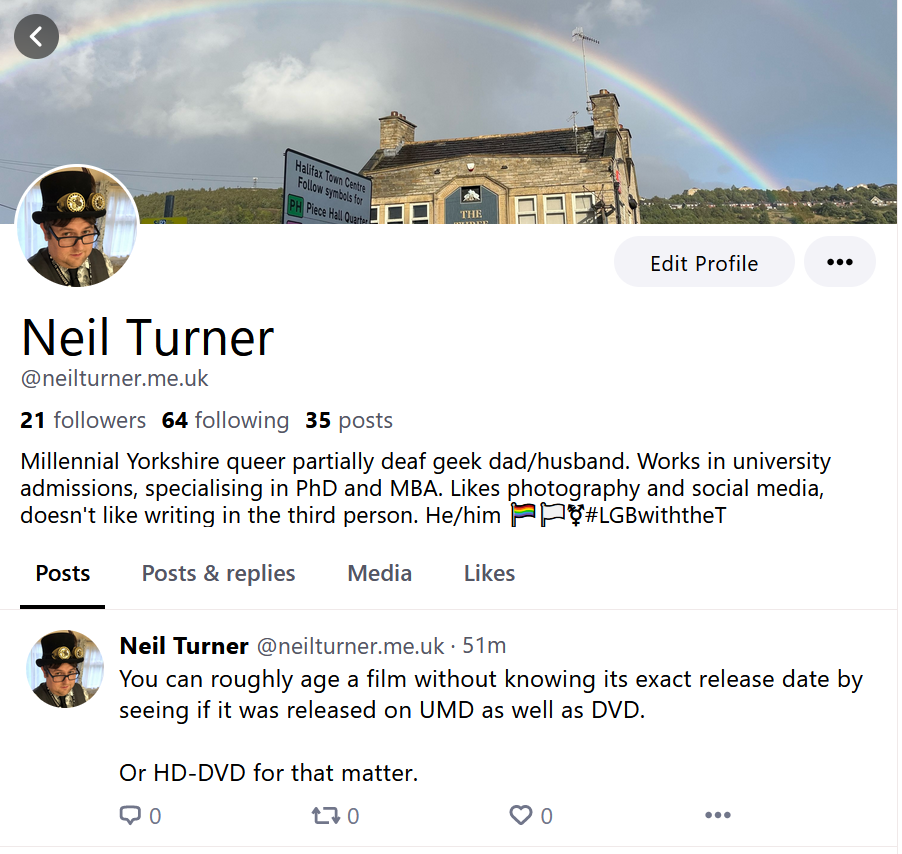
A screenshot of my profile on the Bluesky social network.

Good grief, has it really been almost 6 months since my last blog post?

I mostly dropped by to link out to a couple of additional social media profiles that you can follow, should you wish to. I appreciate that many people are leaving Twitter/X/whatever Elon Musk decides it’s called this week, and not everyone is leaving in the same direction.

Firstly, I’ve just signed up to Bluesky. It’s invite only at the moment, so I doff my cap to a work colleague who gave me her first invite. I’ve just made the one post there and I’ll see how I get on with it.

I managed to – eventually – get my account verified there, which is how I show as ‘@ppt.debianhosts.online’ and not a bsky.social address. It should have been straightforward, but over the years my DNS settings have seemingly got out of sync, and this has required some fixing. Hopefully everything works now.

And I’m on Meta’s Threads, which I joined on launch day back in August. Again, I’ve just made the one post there. It doesn’t look like many people that I followed on Instagram are active on Threads – my feed seems to basically be the same 5 people.

My primary social media presence is still on Mastodon. So, if you want to hear from me in between my massive gaps in blogging, that’s probably your best bet. I joined Mastodon back in November 2022, and I feel most-settled there.

Perhaps if Bluesky and/or Threads open up a bit more, I might cross-post things, but we’ll see.

Why I’ve sort-of quit Twitter

I’ve been a Twitter user since June 2006, apparently, and in that time there have been very few days where I haven’t been on it. It’s been a major source of both information, news and entertainment for me for over a decade.

I’m probably not your typical Twitter user, either. For a start, I generally don’t use the official Twitter app; instead, I prefer Tweetbot, a third-party client which had a ‘mute’ filter long before it became available to all Twitter users. And, barring tweets that I’ve muted, I try to read every tweet on my timeline; Tweetbot even remembers my ‘position’ in the timeline and synchronises this between devices. Typically, I would read about 500 tweets per day.

Reading tweets would start at breakfast (which is about 6:30am for me), with catch-ups at lunchtime, whilst commuting on the train, and before bed. In all, I would typically spend over an hour every day reading tweets.

It’s when I have spelt it out like this that I realise that my relationship with Twitter wasn’t really a healthy one. I had a hunch that I was probably spending too much time on Twitter, but, I found it entertaining and enlightening and it was a good way of passing the time.

Until it wasn’t.

I know I’m not the only person who was very disappointed with the outcome of the UK’s general election last month. But as a remain-supporting Labour Party member, it was pretty devastating. And when I woke up to hundreds of tweets on my timeline on Friday 13th December, I just couldn’t face looking at them.

So, I basically quit Twitter. Not completely – I haven’t deleted my account, and I’ve still posted quite a few tweets in the month since then. But you may have noticed fewer retweets and replies, and far fewer ‘liked’ tweets by others. I’m allowing myself up to 5 minutes on Twitter, no more than twice a day, to read other people’s tweets.

And so far, it seems to be going okay. I’m not really missing it as much as I thought I would. I am, perhaps, spending a bit more time on Facebook instead, but Facebook is generally full of closer friends and people that I care about, rather than random internet people.

The time that I used to spend on Twitter is now available for other things. I’ve been a major user of the ‘read it later’ service Pocket, which I use to save interesting links to read later. By December, this inbox of unread links had hit 250 – and some of those articles were hour-long reads. As I write, it’s 33, and I’m hoping it’ll be 0 very soon. It hasn’t been 0 since 2018. Of course, many of these ‘interesting links’ were saved from Twitter, and so I have saved very few new links to read in recent weeks.

Once my reading list in Pocket is clear, I’m planning to tackle a different reading list: books. Most of the books that I ‘read’ are audiobooks – indeed, last year I only finished one printed book whilst on holiday. I started the e-book of Mark Watson’s ‘Eleven’ last January and then made no progress in the subsequent 12 months. All the while, piles – both actual and virtual – of unread books have been accumulating, and it’s about time that I actually read them. I’ve set myself a stretch target of 50 books on this year’s Goodreads Reading Challenge – that’s almost a book a week. So far, I’ve finished 2 audiobooks, although one was started in 2019 and the other was a relatively short book that I powered through on a couple of long car journeys at new year. Still, I’m on target.

I’m also trying to spend more quality time with my daughter. She has recently turned 4, and wants me to play with her more. Not needing to get one last fix of Twitter before bed has given me more opportunities to read books with her at bedtime, and I’m hoping that I can be more present with her.

The timing of this change is interesting, as it comes roughly at the start of a new year and new decade. I wouldn’t call giving up Twitter a ‘new year’s resolution’ – mainly because I made the resolution two weeks before the start of the new year. But it’s something I’m hoping to stick to as the year goes on.

When you walk past gambling shops, there’s usually a yellow sign in the window saying ‘When the fun stops, stop’. I think the fun stopped with Twitter some time ago and it’s taken me some time to realise.

This was originally posted on Medium.

My Twitter archive

A screenshot of my Twitter archive

I’m probably going to regret this, but here I am, signed up to Twitter.

— Neil Turner (@nrturner) June 1, 2007

That was the first tweet that I posted, back on the 1st June 2007. I’ve waited quite some time to find out what that was, because Twitter hasn’t allowed users to view more than their previous 3,200 tweets, and to date I’ve tweeted more than 13,000 times.

Shortly after you request the download (which was a couple of minutes in my case), you get an email with a download link. This downloads a zip file. Your tweets are presented in a CSV (Comma Separated Values) file, for importing into Excel for example, and as JSON (JavaScript Object Notation) for which there is an HTML file allowing you to view your tweets in a web browser.

The browser view resembles Twitter’s web site, and lets you search your tweets as well view tweets by month. It’ll even tell you how many times you tweeted in a given month: July 2007 was my quietest month with 10 tweets, and July 2011 was my busiest with 517 tweets. There’s a notable increase in my Twitter activity after September 2010 when I bought a smartphone.

Having shown my first tweet, here was my second:

mdjdgj

— Neil Turner (@nrturner) June 1, 2007

No, me neither.

Early tweets don’t have clickable links; this was before Twitter introduced their own t.co URL shortener around November 2010, so you have to copy and paste the URLs into the address bar to view them. It’s also odd seeing links being shortened with TinyURL which few people use nowadays.

Other than nostalgia, and ensuring you have your own backup of your tweets, there’s not a whole lot that you can do with a Twitter Archive right now. However, if you are a Timehop user like me, go to twitter.timehop.com and upload your Twitter Archive so that you can get daily reminders of what you have tweeted over the years. I’m hoping that ThinkUp will support Twitter Archives in the next release as well, so that I can get an analysis of all of my tweets.

Trying out app.net

Off into the snowy distance

Thanks to Brad Choate I’ve joined app.net on a month’s free trial. App.net, if you remember, is essentially a clone of Twitter, but with no advertising, more liberal API policy and a monthly or yearly fee. It has also just added 10 GB of online storage for each user.

Previously, the reason why I hadn’t joined app.net because of the cost – $5/month, or $3/month if you pay for a year up front ($36). I didn’t want to pay for something to find that no-one was using it and I was paying for nothing. At least with a free trial, I can test the waters and see if it’s worth it.

Co-incidentally, NetBot, which is essentially TweetBot but for app.net, is currently free to download at the moment, so I’m using that as it’s a familiar interface and I like using TweetBot.

I’ll do full reviews of app.net and NetBot at some point in the future. I only signed up this morning and so it would be a bit premature to do give an opinion about it just yet. In the meantime, you can follow me on app.net as @nrturner.

10,000 tweets

Robin

Last night I posted my 10,000th tweet, although as I had been anticipating it, it was an announcement rather than just something random:

And this is my 10,000th tweet! Only taken almost 5 years…

— Neil Turner (@nrturner) May 21, 2012

I joined Twitter on the 1st of June 2007, so it’s taken me a mere 11 days shy of 5 years to tweet that much. My blog post at the time implied a little animosity – perhaps because this was yet another social network to join. I’d only joined Facebook a few months previously. And I don’t think I imagined Twitter would become as popular as it has today.

Although 10,000 tweets over 5 years implies 2,000 tweets per year, it’s probable that my tweet rate (number of tweets per day) has been much higher over the past 18 months, what with having a smartphone that can tweet at any time. Before, I’d have to use a computer or send a text message.

Whether I’ll still be using Twitter in 5 years remains to be seen, but it’s done well so far.

Creative Commons License
Except where otherwise noted, the content on this site is licensed under a Creative Commons Attribution-ShareAlike 4.0 International License.