Being a tourist

Helmsley Castle

I spent the weekend being a tourist, twice in my home town of York. York is a city that, since I no longer live there, I have actually come to appreciate more. Whilst growing up there you took the historic buildings for granted, and the hordes of guided tours just got in your way. But now I see the city in a very different light.

On Friday afternoon, we spent a bit of time at the National Railway Museum – one of my favourite museums as a child, but my last visit was in 2007 (although I blogged about it last year). The main attraction is the return of Mallard, which spent many years in the main hall at the museum but was recently sent to the Shildon Locomotion Museum in County Durham; however, it’s in York on a brief visit and presently takes pride of place on the main turntable. The museum is undergoing a lot of renovation at present, which includes a new entrance hall, so there are fewer attractions than normal – the station hall in particular was rather sparse, which was a shame.

On Saturday, we eschewed York and headed up to the small market town of Helmsley, on the edge of the North York Moors National Park. In particular, we visited Helmsley Castle, parts of which date from the 12th century but has been mostly ruined since the British Civil War in the 1600s. It’s now looked after by English Heritage, and for a little under a fiver each for adults you can spend a couple of hours wandering around. There’s also a museum section, which shows some of the finds that have been excavated as well as information about the castle’s history and how it would have looked over various key periods in its history.

Finally on Sunday we went back into York city centre, partly for some sightseeing but mostly for shopping, for which York is very good. Whilst there aren’t many large branches of chain stores (with the exception of a large Marks & Spencer, split across two sites), there are plenty of smaller shops and thankfully most don’t sell tourist tat. There’s now a sausage shop on The Shambles, and we also called in at Betty’s for some of their fondant cakes which change regularly. We were hoping to go to the Jorvik Viking Centre – again, despite living in York I haven’t visited this in nearly 20 years – but it’s rather expensive unless you make a day of it and go to the other museums (DIG, Barley Hall and Micklegate Bar Museum) – a £16 ticket lets you into all four.

In a way, it’s refreshing to be a tourist in your home town. You can take time to go to the places that you walk past every day, and maybe discover things that you never knew existed. At the same time, you have the advantage of knowing your way around and knowing the best places to eat, or what to avoid. Whilst not every town is set up for tourism, if yours is, give it a try. You can even do it in places like Bradford.

National Railway Museum

Swag

I’ve been sent a package by the PA to the National Railway Museum’s Director of Fun, Sam Pointon. While it may not seem odd for a museum which is popular with families to have a director of fun, Sam is only 7 years old, and he’s been there for a year now.

Sam, or rather his PA, has asked me to write about my experiences with the museum and tell you about some of the events that are being held this summer, so here goes.

Like Sam, when I was his age, I was also very keen on trains – having a father who worked for British Rail helped as it meant lots of free rail journeys. I also grew up in York, home of the National Railway Museum and was a regular visitor. At one time, my mum took me almost every Sunday, even when there wasn’t free entry like there is now. My earliest memories were of its ‘Great Rail Exhibition’ in the former York Goods Station, as at the time the main hall was receiving a new roof. Now both the main hall and goods station are used for the museum and open to the public. Further expansions have added a workshop where you can see classic trains being overhauled and restored, as well as access to some of the museum’s archives.

Mallard

Moving out of York in 2002 has meant that my visits have been sadly less frequent. My most recent visit was in 2007 which included a trip on The Yorkshire Wheel, a London Eye-style big wheel which was unfortunately only a temporary attraction and is now elsewhere. As well as seeing classic trains from both the UK and overseas (there’s a driving car from Japan’s Bullet Train, for example), there’s plenty of information about the history of Britain’s railways, and various interesting artefacts.

This summer, a sand sculpture is being built from 20 tonnes of sand by the same people who created a sand sculpture of Charles Darwin in Centenary Square in Bradford last summer. There’s also a major 1930s exhibition, linked in to the recently restored streamlined steam engine the Duchess of Hamilton, which you can see in the photo at the top of the page.

The National Railway Museum is a really great museum and you can easily spend a day there. There’s plenty to do, whether you’re a young child or a grown-up child like me. Best of all, it’s free, and only a few minutes walk from York station. You should go and visit it sometime.

Bradford – things to see and do as a tourist

This post is a retort to the news that Bradford has been named as Britain’s worst tourist city in a poll by Travelodge, whose ‘Bradford’ hotel is actually closer to New Pudsey.

Having lived in Bradford for over 7 years I wholeheartedly disagree that Bradford is ‘dangerous, ugly and boring’ as the survey suggests. It’s no less dangerous than any other major UK city and while Bradford has its fair share of 1960s monstrosities in architecture, there are some fine examples of stone-built Victorian buildings which have been faithfully restored and look rather splendid, all over the city.

As for boring, there are plenty of attractions for tourists to visit:

1. In the city centre:

  • National Media Museum – this is the UK’s most visited museum outside of London, and has a wide range of galleries focussing on film, photography, television, radio and new media such as the internet. Its latest addition is an arcade games gallery, where you can play a range of 1980s arcade machines. It’s also home to Yorkshire’s only Imax cinema. Best of all, it’s free to go in (bar the cinemas and some special exhibitions). It was influential in Bradford’s successful bid to become the world’s first UNESCO City of Film, which launches this weekend.
  • Peace Museum – one of Bradford’s lesser-known gems, this has a fantastic collection of items and records. It’s open on Wednesday and Fridays, and for pre-booked groups.
  • Bradford Sculpture Trail – around the turn of the millennium, a series of sculptures were commissioned across the city. This trial takes you around 27 different sculptures and statues, including those of JB Priestley, the famous Bradford-born author.
  • Curry houses – Bradford has a huge range of curry houses across the city and any visit isn’t complete without visiting at least one. There’s the world famous Mumtaz, the student favourite Omar’s, Markaz on Centenary Square and many more. What’s more is that they’re all very affordable.
  • Bradford Cathedral – being one of Britain’s newer cities (the Royal Charter was granted in 1897) the cathedral is quite small compared to the likes of York, Lancaster and Lincoln, however, it’s still an old building with parts dating from the 15th century. It holds regular events and sits in an area of Bradford known as ‘Little Germany’, full of well-preserved and renovated Victorian buildings.
  • Alhambra Theatre – one of several venues in Bradford (there’s also St George’s Hall, Bradford Playhouse and the Theatre in the Mill), the interior of this theatre has been thoroughly restored and looks magnificent. It hosts many major shows throughout the year.
  • The Wool Exchange – once the centre of Bradford’s wool trade, this fantastic piece of 19th century architecture has been restored and now hosts probably the nicest-looking branch of Waterstones in the country. There’s also a Starbucks on the mezzanine level.
  • Bradford 1 Gallery and the Impressions Gallery – these two new art galleries are in Centenary Square and host a number of exhibitions.

2: In the suburbs

  • Bradford Industrial Museum – located in late 19th century mill, this working museum has various examples of mill machinery, as well as a horse-drawn tram, worker’s houses and a transport exhibition. Entry is free and it’s open 7 days a week.
  • Lister Park – open to the public since 1870, this large park includes a boating lake, café, adventure playground, gardens and is also home to the Cartwright Hall art gallery which has recently been host to an exhibition of work by David Hockney, who originally came from the Bradford area. It was named Britain’s Best Park in 2006.
  • Peel Park – across the valley from Lister Park, this opened in 1850 and now plays host to the annual Bradford Mela which is one of the biggest festivals of British Asian culture in the UK.
  • Undercliffe Cemetery – Bradford was at the heart of the UK wool industry and many of the great and good from Bradford’s past have been buried here with some very elaborate and decorative memorials.
  • Bolling Hall – a mansion house which now houses exhibitions showing the life and times of Bradford families over the past few hundred years. Like many of Bradford’s other museums, entry is free.

3: Further afield:

  • Saltaire – a UNESCO world heritage site, and home to Salt’s Mill, which houses a permanent exhibition of art by David Hockney and a range of specialist shops and restaurants.
  • Keighley & Worth Valley Railway – a working steam railway that takes you through the pretty Worth Valley. Connects with the main line at Keighley station.
  • Haworth – a hillside village with a great range of independent shops and fine public houses.

While I think this list is pretty exhaustive I’m sure there’s bits I’ve missed. But there’s certainly no shortage of things to see and do as a tourist in Bradford and it’s well worth spending a day or two to look around. There’s also the City Park which is under construction and will be open by next summer.

(See also another take on the article and an article in our local newspaper)

Transperience, Bradford’s forgotten transport museum

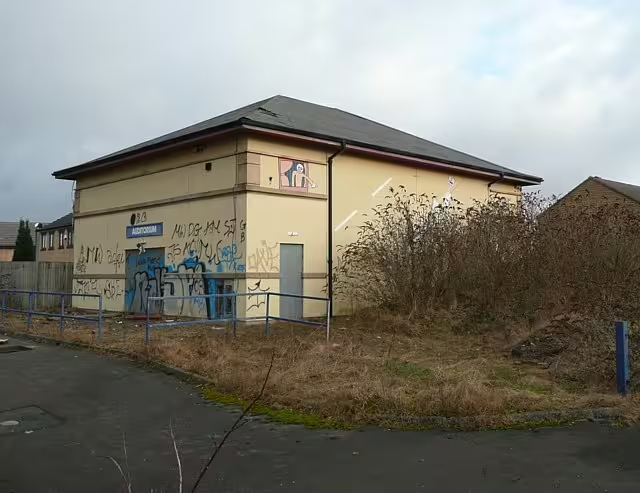
A photo of the former auditorium at Transperience

At the weekend I wrote a new Wikipedia article about Transperience.

The Transperience Museum

Transperience was a museum that I was aware of when I was younger, and I remember seeing leaflets about it. But neither I, nor my parents, had never had the chance to visit it during the short time that it was open.

It was essentially an open-air museum of passenger transport. There were some transport simulators, as well as a working one kilometre tram line and a couple of trolleybuses. In addition, there was an auditorium and some workshops were its preserved vehicles were maintained.

The museum was built on the site of Low Moor station, south of Bradford. The station used to be at the junction of the Caldervale Line, between Bradford and Manchester, with the Spen Valley Line which ran through Cleckheaton, Heckmondwike and Liversedge. The station, and the whole Spen Valley Line, were closed in the 1960s, but the Caldervale Line thankfully remains. Otherwise, my regular trips to Blackpool would be far more difficult.

Closure

Despite being right next to junction 2 of the M606 and easy reach of the M62, and costing £11.5 million to build, the park closed in 1997. It had only been open for a little over 2 years. Unfortunately, it couldn’t attract enough visitors to be viable, and was £1 million in the red by the time it was taken over by administrators. The land was mostly sold off to a private developer and is now an industrial estate. The route of the tram line now forms the first part of the Spen Valley Greenway, a footpath and cycle route which follows the route of the Spen Valley Line. Some buildings, like the auditorium remain, but overgrown and derelict.

Interestingly, the site is likely to go full circle. Metro, the public body which manages passenger transport in West Yorkshire, has plans to re-open Low Moor station. Its location close to the M606 means it would make a good parkway station. Plus, it will allow residents of Low Moor and towns in the Spen Valley to catch the train without having to travel into central Bradford or Leeds. It’s likely that the few remaining relics of Transperience will be tarmacked over by the new station’s car park. The station is proposed for 2012, subject to planning permission and funding.

It’s a shame that I never had chance to visit Transperience, as it seemed like an interesting museum that suffered from poor marketing and a lack of focus. Thankfully, museums such as the Crich Tramway Village have succeeded where Transperience failed.

Update (Dec 2016): Work on the new Low Moor railway station is underway, with a likely opening date in 2017. Most of the Transperience infrastructure that remained by 2010 is still there, albeit still abandoned.

The header image for this post is Copyright Humphrey Bolton and licensed for reuse under this Creative Commons Licence