Young V&A

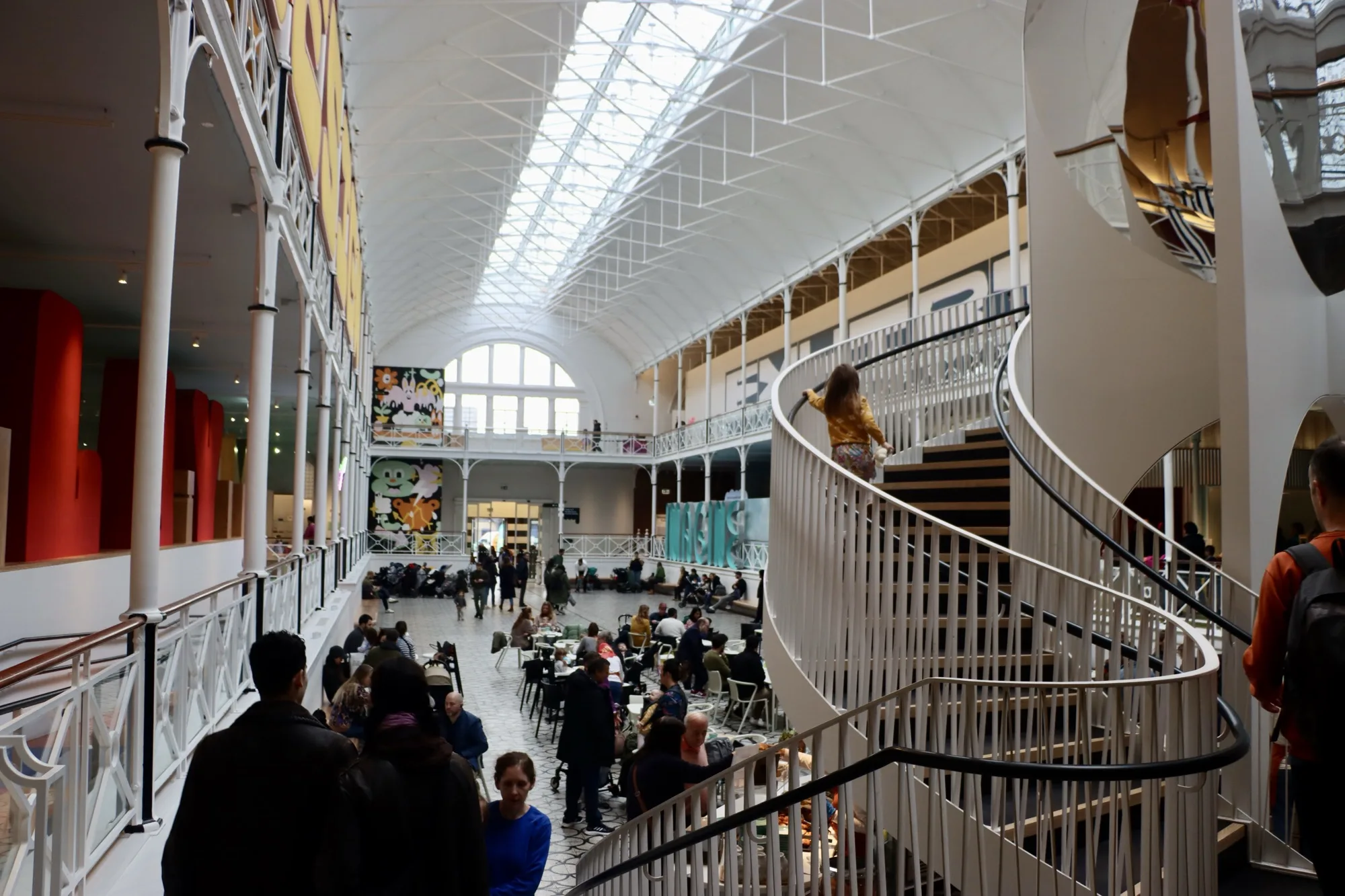
A photo of the interior of the Young V&A.

This is the third in the series of blog posts about places we went to in London – you can also read about the Bank of England Museum and the Cute exhibition at Somerset House.

The Young V&A is the new name for the V&A Museum of Childhood. It’s still in the same place, outside central London in Bethnal Green, but the new name reflects a complete refurbishment. We last went in 2017, and it’s changed massively since then. Before, it was very much a museum, with lots of objects in big glass cases and not much to interact with. Now, whilst there are still some objects to look at, it’s a much more interactive space, and somewhere to bring young children to play. Indeed, our eight-year-old was probably one of the older kids there. Dropping the ‘museum’ from the title therefore makes sense.

The gallery spaces have been split into themes – Play, Imagine and Design. Play arguably caters for the youngest children, although there’s a big screen with a playable Minecraft version of the museum (thankfully it resets regularly to discourage hogging). Imagine includes the dollhouse collection from before, and design looks at how products are designed. There’s a particular focus on recycling waste into useful furniture.
Japan: Myths to Manga

Japan: Myths and Manga

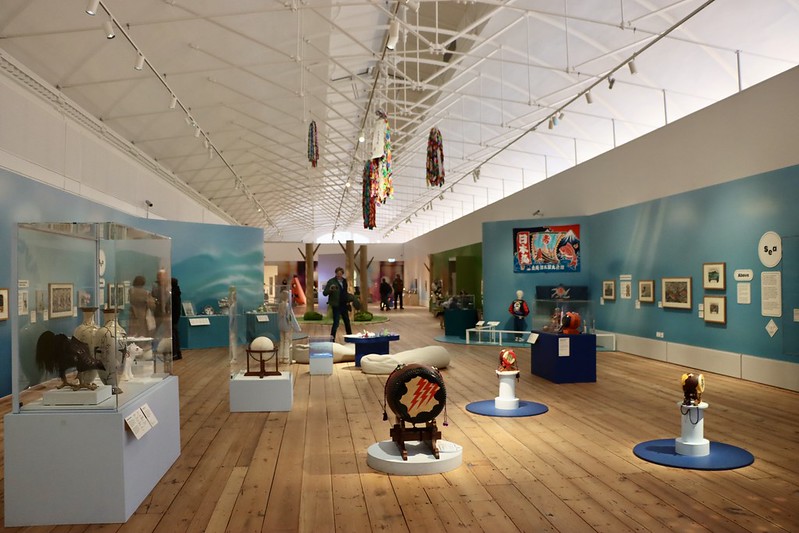
Then there’s an exhibition space, and the opening exhibition is called Japan: Myths to Manga. Whilst the main museum is free to enter, you have to pay to access the exhibition space, and tickets are limited. We made the mistake of not booking in advance, so when we were ready to visit the exhibition on a Saturday afternoon, no more tickets were left. So, we ended up booking tickets for the Sunday and came back the following day.

Personally, I concur with Ianvisits and found the exhibition a little under-whelming, but my wife and child seemed much more engaged. The exhibition is rather sparse, and I would have expected to see more objects there. However, I’m not in the target market for this and we did spend over an hour in the exhibition. There’s several clips from Studio Ghibli films to watch and plenty of Pokemon; but it was also good to read about the traditional Japanese stories and myths which inspired these works.

Accessibility

Because our hotel was located between Aldgate and Whitechapel, we caught the bus to the Young V&A, but it’s also a short walk from Bethnal Green tube station which is on the Central Line. It’s also not too far from Cambridge Heath station on the London Overground, on what will soon be known as the Weaver Line. Around the corner is the new permanent home of the Vagina Museum, although we didn’t have chance to visit this time around.

As you would expect from a recently-renovated museum, there is step free access everywhere, and there’s a dedicated quiet space in the Reading Room. Which we found quite welcome; although the renovation has been extensive, it’s a listed building and so there are limits. Any building popular with children is bound to be noisy, and the open space in the middle is quite echo-y.
Cute at Somerset House

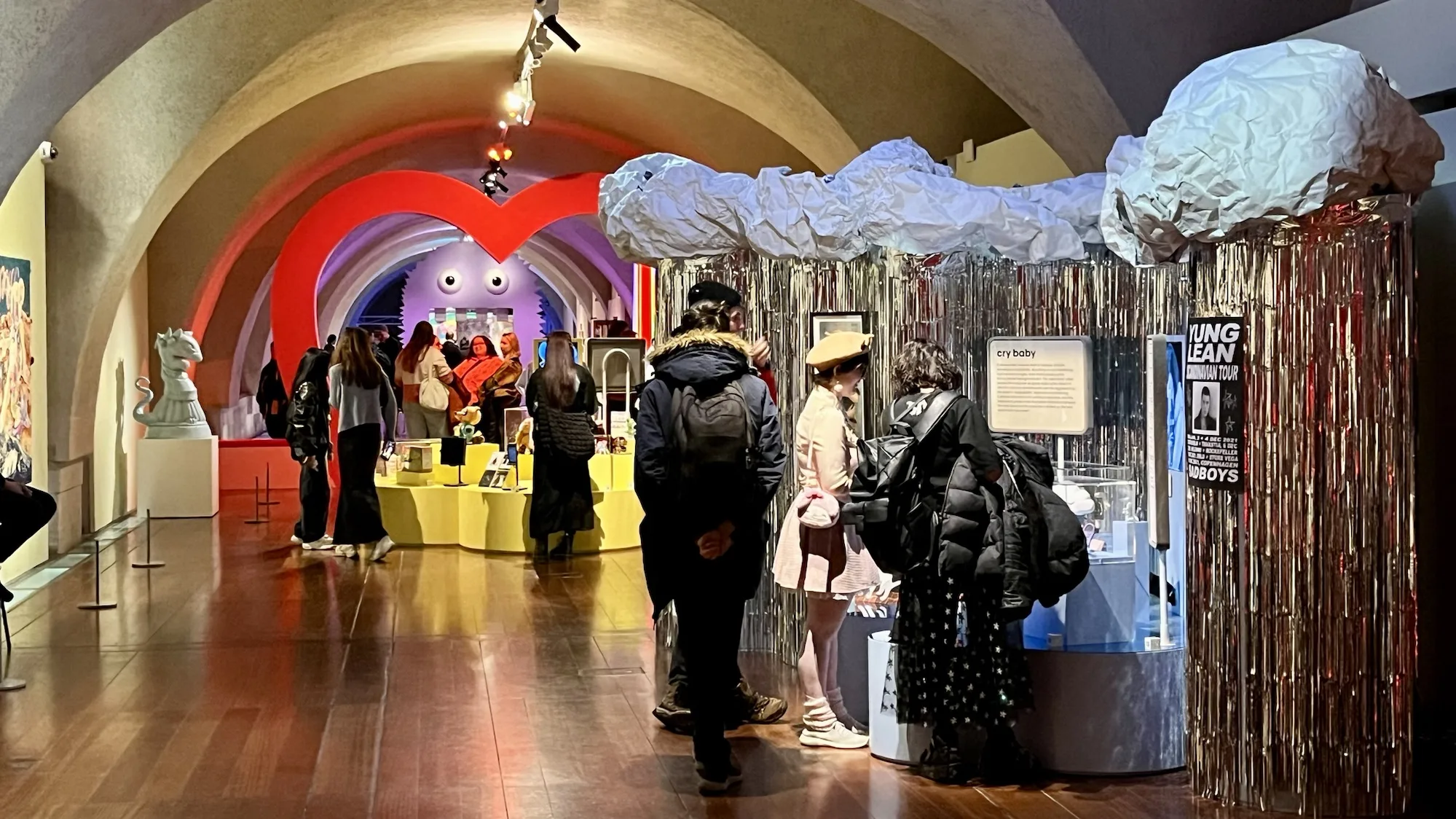
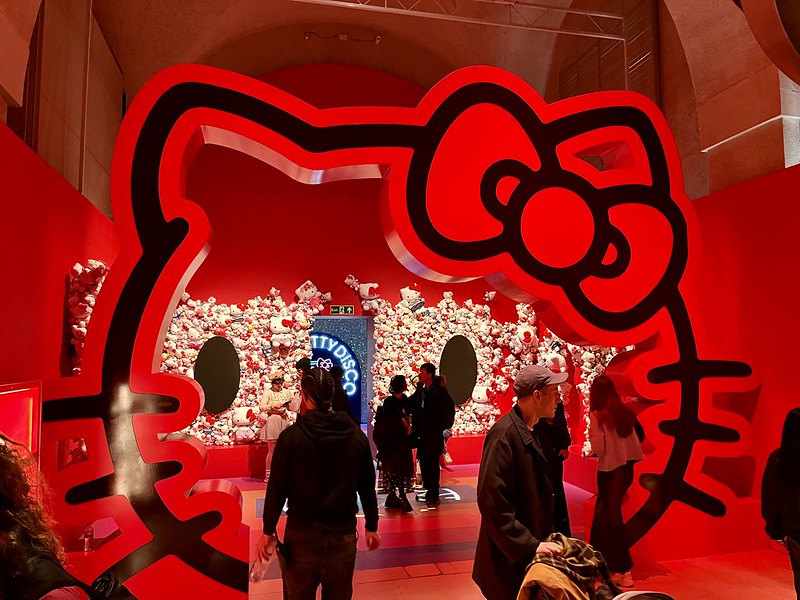
The Cute exhibition at Somerset House in London.

After we spent the morning at the Bank of England Museum, the second place we visited on our trip to London was Somerset House for their Cute exhibition.

Like previous exhibitions at Somerset House, Cute includes some new commissioned art and existing pieces, as well as donated memorabilia. Back in 2021, we went to an exhibition about the Beano, and this filled the same space in the South Wing. It’s an exploration of cute things and its impact on society, including kawaii.

Hello Kitty

The exhibition also marks the 50th anniversary of Hello Kitty, and a large section of the exhibition is devoted to the memorabilia collected by one person. Including Hello Kitty Spam.

There are some interactive parts too. There’s a room with some arcade games, old and new, including some indie games like Froggy Pot.

Some of the art produced for the exhibition is AI generated, and the theme image features a kitten with a unicorn horn and seemingly seven paws. I suspect that they’ve kept this in because it shows the weird-er side of cuteness.

Pop-up cafe

Alongside the exhibition is a pop-up Hello Kitty themed café. We had to queue to get in, as it’s a small space, but the food was nice albeit very full of sugar.

The exhibition runs until the 14th April, so you’ve got about five weeks to go to see it. We went on a Friday when walk-up tickets were available, but I imagine it’ll be busier at weekends and so you may wish to consider pre-booking. You can also look at all of the objects online at cute.guide.

Accessibility

The southern entrance to Somerset House is the closest to the exhibition, and is very close to Temple tube station on the District and Circle lines. It’s also close to Waterloo Bridge. Whilst there are stairs, all are duplicated by several lifts giving access to the exhibition, which currently have furry insides. Access packs, containing large print guides, noise-cancelling headphones, magnifying glasses and a stress ball, are available to borrow from the box office.

Bank of England Museum

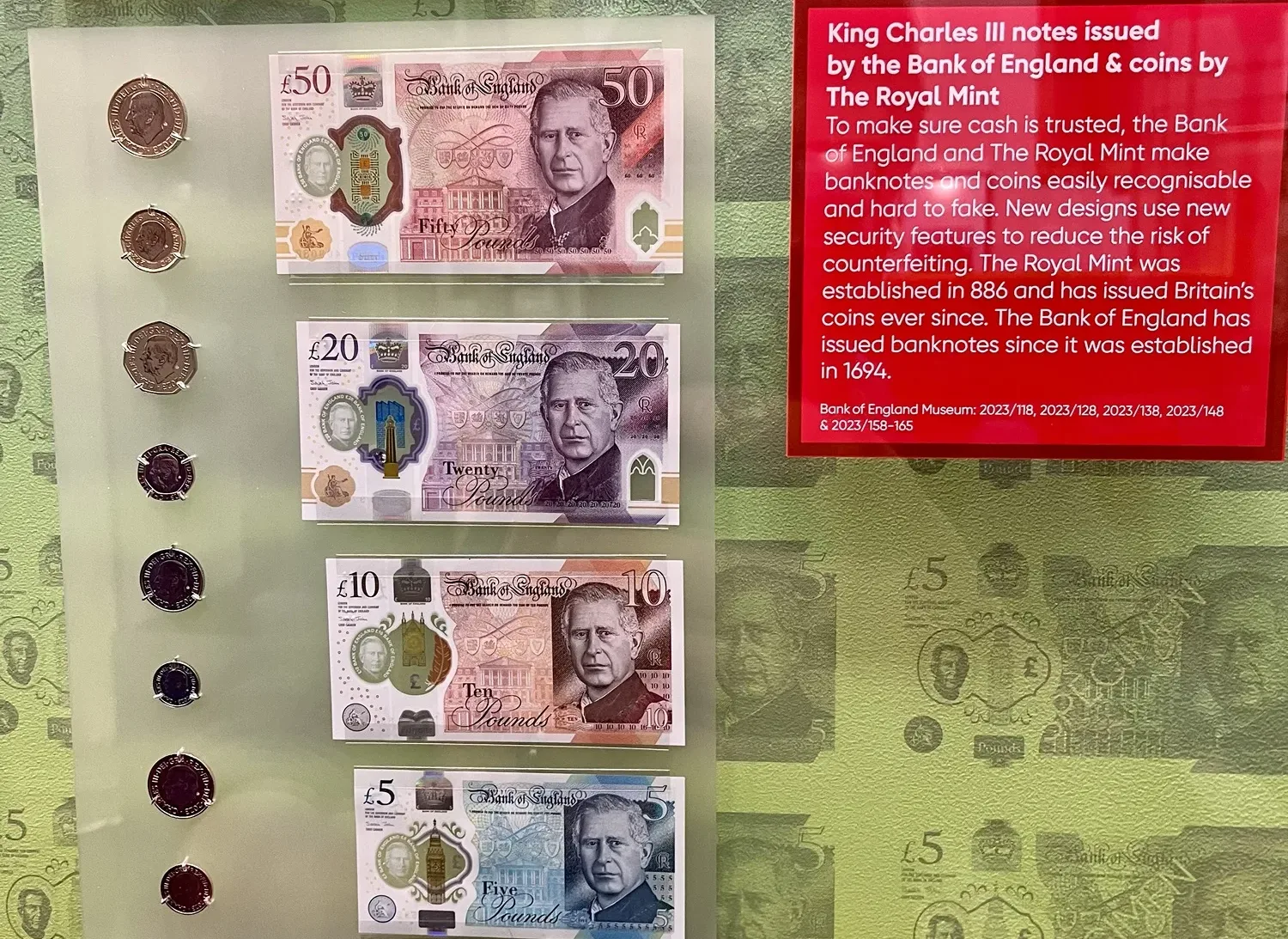
A photo of the new King Charles coins and bank notes at the Bank of England Museum in London

The first place we went to on our trip to London last weekend was the Bank of England Museum. Which is pretty much what you would expect it to be – a museum based at the Bank of England headquarters in the City of London. Access is via a side entrance, and, as you would expect, you have to go through a security scanner to get in.

This is only the second time that I have been to the Bank of England Museum. The first time was a long time ago. I can’t remember exactly when, but I was definitely still living at home, so probably 25-ish years ago. Part of the reason for this is that the museum is only open on weekdays, and we normally visit London at weekends. As we had the benefit of an extra day, we were able to visit last Friday.

It’s not a big museum – a typical visit will take 1-2 hours – but it’s free to get in. And the exhibits are regularly updated. As shown in the photo above, there are samples of the new coins and banknotes featuring King Charles III which are not yet in general circulation. I was also amused by the satirical FTX t-shirt in an exhibit about cryptocurrencies. These are in a new exhibition called The Future of Money, which opened a couple of days before we travelled and runs until next September.

Like many museums, the Bank of England Museum has also acknowledged the darker sides of its past. Recent new exhibits include copies of ledgers listing the names of slaves that came into the bank’s possession, and there’s a display about the Windrush generation. On arrival in the UK, many of those who travelled on the Empire Windrush to start new lives were denied access to traditional banks, and the museum has a series of panels on Pardner Hand to allow people to borrow or save money.

Other permanent exhibits include some examples of forged bank notes (including some introduced by the Nazis in the Second World War to de-stabilise the economy), and of course there’s plenty on the history of the bank.

If you haven’t been to the Bank of England Museum before, I’d recommend going. It’s not a full day out, but it’s free and there are some interactive elements for children.

Accessibility

Predictably, the nearest tube station is Bank, which has step-free access from the Northern and Waterloo & City Lines, and the DLR. There are steps in the museum, including at the entrance, however, security staff can escort those with mobility issues from the bank’s main entrance and ramps can be provided once inside. There isn’t a quiet room, but ear defenders are available to borrow.

Back from London

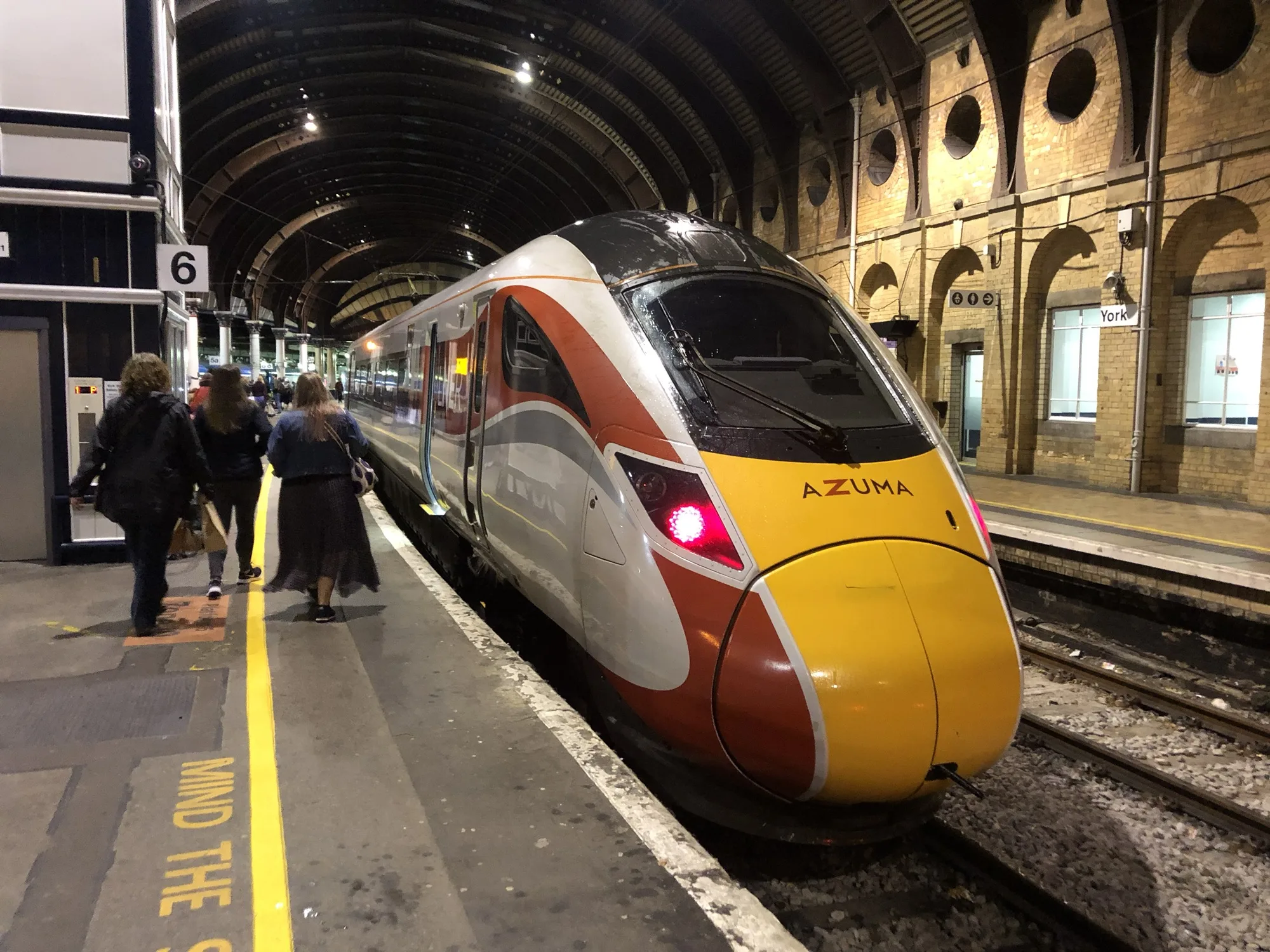
An LNER Azuma train at York station, due to depart to London King's Cross station

We’re back from our trip to London. We got there a bit later than planned, due to action short of a strike by the drivers’ union ASLEF resulting in our planned train from Leeds to London being cancelled. This wasn’t ideal, as it meant we didn’t arrive until 10pm; however, we made it, and had an enjoyable trip.

I’ll post separately about the specific places that we went to over the next week or so. We had also planned to visit the Horniman Museum, as the gallery containing its famous over-stuffed walrus closed this week for two years, but we couldn’t quite fit it in. As usual, Ianvisits was invaluable for finding out about special exhibitions and served as inspiration for a few of our visits.

We managed a couple of trips on the new Elizabeth Line; it was partially open on our last trip to London in 2022 but we didn’t need to use it then. The stations are impressive and I appreciated the greater accessibility, but I couldn’t help but feel that the trains themselves already look a little tired. It may be the use of grey interior panels; they felt a little dark and not as bright internally as other new trains elsewhere. It’s good to see it being well-used despite being opened for less than two years.

We normally manage one trip to London each year – we missed 2020 for obvious reasons, but also didn’t manage to go last year either. We may have a shorter visit later this year, but with journeys taking 3 hours each way and the costs, it’s not something that we can do on a whim.

Leaping towards London

An AI-generated image of a woman on a horse leaping through a portal that says 'February 29'

It’s the 29th February today!

Well, actually, I’m writing this on Saturday 24th. I tend to write blog posts in bulk at the weekends, and then schedule them to go live every other day over the week. In any case, I’m unlikely to have time to write much today, as this morning I’m at work and then we’re off to London tonight for a long weekend.

But as the opportunity to publish a blog post on the 29th only comes around once every four years, here you go. And I missed 2020 as I wasn’t blogging then. Had I been, I’d have probably said something about the-then looming pandemic. Ironically, I wrote this on the 29th February 2016:

Maybe something interesting will happen on this day in 2020, but you’ll have to wait another four years to find out, I’m afraid.

I suppose it’s a case of being careful what you wish for. You can also see what I wrote in 2012 (being ill), 2008 (heading to Scarborough for the weekend), and 2004 (not a lot).

I’ll write more about our trip to London once it has actually happened.

Some collected thoughts about today’s London tube bomb

This morning, what appears to be an improvised explosive device detonated on a London Underground train at Parson’s Green station. At the time of writing, we know that:

  • 18 people have received non-serious injuries, mostly burns
  • There are no confirmed fatalities
  • It is being treated as a terrorist incident.

I’m basing what I know purely on what I’ve read on the BBC, as I trust them to report accurately and to verify their statements. I will be making some assumptions, and these are based on my 30+ years of living in the UK. I’m not a terrorism expert (although colleagues of mine are) — I am just a regular person who follows the news.

1. We don’t know who did it

Naturally I’ve seen some people jump to conclusions that this is an attack by Islamic fundamentalists groups, possibly linked to Islamic State. We don’t know this.

Notably, this did not appear to be a suicide bomb. Most of the recent attacks, especially the Manchester Arena attack in May this year, were caused by suicide bombers. This appeared to be an abandoned object.

Leaving suspicious bags or packages behind was a tactic more commonly used by the IRA, the Irish terrorist group. It has been a long time since there was an attack by an Irish group, thanks to the peace process in Northern Ireland. And I would be surprised if this marked a resurgence.

2. It looked like a bomb

It’s rare that we get to see the remains of what exploded. In this case, it appeared to be a large plastic tub contained inside a plastic bag from a well-known German supermarket (I feel sorry for their PR team). Photos and videos of the smouldering remains also seemed to show wires, and the BBC report that the remains of a timer were recovered.

This, in my mind, rules out this being an accident. My view is that this was an incendiary device that was deliberately planted.

3. It didn’t do what it was supposed to do

The device did explode, but appears to have caused minor injury. Again, from the BBC news report, it seems to me that more people were injured trying to evacuate from the scene, than by the explosion itself.

Because we have been able to see photo and videos of the device, we have also been able to see how little damage has been caused to tube train. And whilst I have sympathy for the victims of the attack, I am also pleased that the injuries were minor.

This bomb did not managed to cause the devastation brought on by the bomb at the Manchester Arena, nor the tube bombings of July 2005.

4. It may be some time before a terrorist group claims responsibility

Because it wasn’t a large explosion, and hasn’t resulted in fatalities, I don’t think that any of the major terrorist groups will rush to claim responsibility for it. If anything, this may be viewed as a failure; I expect that services on that part of the District Line will be disrupted for a few days, but it won’t cause widespread panic or disruption.

5. London remains open

I think we’ll see the usual responses following a terrorist attack: a potential raising of the overall threat level, more police on the streets and so on. But it hasn’t — and probably won’t — send large parts of London into lockdown.

Indeed, London Underground is still running a reasonably good service on most other lines, as I write this a few hours after the explosion. Parson’s Green is on the Wimbledon branch of the District Line and so this is, of course, closed. The rest of the Wimbledon branch between Earl’s Court and Edgware Road is also experiencing delays, which is understandable, and there are some delays on the Piccadilly Line.

But the rest of the Tube is fine. London is a resilient city that has seen more than its fair share of attempts to terrify its residents. I think most Londoners will see the events of today as something of an inconvenience, rather than a concern.

As I said before, I’m not an expert — this is mostly a collection of my thoughts. I wish the victims a speedy recovery, and await the outcome of the full investigation into what happened. I also hope that this isn’t used as another attack on the vast majority of peaceful Muslims (especially if it turns out that this wasn’t an Islamist attack).

This post originally appeared on Medium.

V&A Museum of Childhood

V&A Museum of Childhood

Not all of London’s museums are in the centre of the city. The East London suburb of Bethnal Green is home to the V&A Museum of Childhood, home to a wide range of toys from several decades.

Now that our 18-month-old is an easily-bored toddler, we felt that we needed to go to a museum that would keep them interested. Thankfully, a museum filled with toys fits the bill, especially during school holidays. It’s technically part of the Victoria and Albert Museum, but doesn’t focus on art and sculpture like its larger Kensington sister museum.

A lot of the toys are enclosed in big glass cabinets, but there are some interactive exhibits. The most popular of which was simply a big pile of differently sized cardboard boxes, perpetuating the oxymoron that children are sometimes more interested in the box than the toy inside. Upstairs there was a sandpit, and we arrived just in time for an interactive story-telling session.

Our 18-month-old also enjoyed the sensory exhibit, with bubble tubes and multi-coloured lights. Christine and I appreciated the range of toys, which included the very old and the quite new. At the back is a large display of dolls houses, lit up as if in a large night-time scene.

We didn’t have the time to see everything as we had to go to meet a friend in the afternoon, so we only had a fleeting glance at the upstairs exhibits (sandpit aside). There’s quite a good café in the central atrium of the museum, which seemed quite busy even before lunchtime.

Entry to the museum is free, and it’s just up the road from Bethnal Green tube station on the Central Line. The museum itself is fully accessible but the nearby tube station doesn’t have step free access. We brought Lizzie in her sling as we knew we’d struggle with a pushchair.

Step-free access on London Underground

Bakerloo at Waterloo

I’ve talked briefly about our recent trip to London. It was our second trip with our toddler, but last time I drove us all down. This time, we went via train, and we brought a pushchair.

Our toddler now has two pushchairs. There’s the big Bugaboo Chameleon, which we’ve used since birth, and a lighter folding pushchair. The latter fits in our car boot more easily and can be stowed away in luggage racks, but it’s not so good on rough ground and doesn’t have a rain cover. So we still use the Bugaboo now and again, if it’s wet or we’re going somewhere off the beaten track. But for London, we took the lighter pushchair.

On the whole we coped well. The only station where we had major problems was Kew Bridge, a South West Trains station near where we were staying. Although it’s a simple two platform station with a footbridge, there’s no step-free access, and a very wide gap between the train and the platform edge.

We coped okay with the Underground. King’s Cross St Pancras has lifts serving all of its platforms, following a comprehensive rebuild of the station to tie in with the new Eurostar station. This is a major improvement over 2004, when I travelled to London with a friend in a wheelchair. It took two of us to balance the chair on the main escalator. Fortunately we were heading for Olympia, and both Earl’s Court and Kensington (Olympia) stations had lifts even back then.

This time, we were heading for Waterloo, to take a train to Kew Bridge (as mentioned before). Though not the most direct route, we were able to take the Victoria Line to Green Park. Lifts were installed at Green Park in 2012, ahead of the Olympic and Paralympic Games. Changing at Green Park took quite a long time, with some long walks between the platforms. Had we been able to use the escalators, I expect this would’ve been quicker.

Then, onward to Waterloo on the Jubilee Line. When the Jubilee Line was extended in the late 1990s, all of the new stations had step-free access from the beginning. Unfortunately, at stations like Waterloo, this didn’t include existing lines, so although it’s possible to get from the Jubilee Line to the street and mainline station without steps, you can’t change to the Northern, Bakerloo or Waterloo & City lines.

Step-free Tube guide

Transport for London (TfL) publishes quite a good step-free Tube guide. Whereas the basic tube map only shows stations with step-free access from the street to the platform or train, the guide goes further. For example, there is step-free interchange between the Bakerloo and Victoria lines at Oxford Circus, but no lifts to the exit. Others, like Cannon Street, have step-free access in one direction only. A map is provided and it greys out stations and lines that are not accessible. The whole of the Bakerloo Line south of Oxford Circus is missing, for example, as is the whole of the Waterloo & City Line.

It also tells you how wide the gap between the train and platform is at those stations which are accessible, and there are some detailed notes. For example, changing trains at Kew Gardens requires a 600 metre walk on nearby streets.

It’s perhaps also worth mentioning that the entire Docklands Light Railway, and Croydon Tramlink are step-free, should you find yourself in East or South London.

Future improvements

TfL is rebuilding a number of Tube stations, and these should all gain step-free access. Farringdon and Blackfriars recently became accessible as part of the Thameslink Programme, and Crossrail… sorry, “The Elizabeth Line”, will see many other stations gain lifts. These include Ealing Broadway, Paddington, Bond Street, Tottenham Court Road, Moorgate, Liverpool Street and Whitechapel.

Additionally, TfL are rebuilding Victoria and Bank stations, with plans for Camden Town. Again, these should all become step-free when the work is complete. Frustratingly, the recent rebuild of Shepherd’s Bush tube station on the Central Line, to tie in with the opening of the Westfield shopping centre, did not include the addition of lifts, apparently due to costs.

Planning a London trip

Westminster

In a couple of months time, Christine, our one-year-old and I are off down to that there London for three nights. Typically, we go to London once or twice a year.

Travelling down

Our last visit was in October, and we travelled down by car for the first time. This was because we went via Oxford, but also because of the logistics of managing a 10-month old baby on a train for three hours each way was daunting. Especially when you add in all of the extra paraphernalia that you need to haul around with a small baby. Last time, we had to take plenty of food, changes of clothes, nappies etc.

This time, our toddler will be approaching 18 months old, and so we’re going to attempt the train. We’ll do without a pushchair, as our toddler should still be small enough to carry in a sling, and can walk short distances now. And, apart from a few snacks, our toddler doesn’t need their own food, as they’re happy eating from regular menus now.

It’ll also be cheaper. Fuel and parking cost us around £60 last time, plus the pressure of driving. Christine hasn’t passed her test yet and I can’t supervise her, so I have to do all of the driving. By contrast, two standard class adult returns with a Two Together Railcard booked last month cost us just £41. And, we’ve accumulated enough Nectar points to get two £20 Virgin Trains East Coast vouchers, so we actually only paid £1. That’s cheaper than the Megabus.

Staying over

Booking well in advance also ensured a cheap hotel stay. When booking accommodation, my usual tactic is to check the major budget hotel chains one by one, and then an aggregator like Expedia or Lastminute.com (which are often not the cheapest). Typically, we end up staying in a hotel in the IHG group, as I’m an IHG Rewards member, but they didn’t come out cheapest this time.

As usual, we’re not staying in central London. London’s public transport is really good, and the cost of travelling a bit further out is usually much less than the price of a more central hotel room. This time, we’re staying near Kew, in south-west London.

London attractions

The hotel is handy for the London Museum of Water & Steam, which I’ve not heard of before but it looks interesting. It’s in an old pumping station, and now tells the history of London’s water supply. This will be the second London pumping station that we’ve visited, after going to Crossness in 2015. It looks like it’ll be good for kids – especially if it’s a nice day where Lizzie can play outside.

The Musical Museum is also nearby and we may visit, depending on time.

Further away is the Museum of London Docklands. We popped in for about an hour on our last visit, but were only able to see the gallery on the top floor, about slavery and the history of the area. So we’d like the see the rest of the museum, but also the special exhibition on the archaeology of Crossrail that runs until November.

The Hunterian Museum has been on our to-do list for some time. Sadly, it closes next month for a three year refurbishment, so it’ll be shut when we visit.

Seeing friends

We try to make time to see friends when we’re in London, and so, in addition to the above, we’ll plan to meet up if we can. There’s a lot to fit in to a three night stay but we’ll do our best.

Laaaan-dun

The City of London

Next week, Christine, our baby and I are off to London for a few days. It’ll be our first trip as a family of three there; I last went in January on my own when our baby was only a few weeks’ old. It’ll also be the first time I’ve ever driven to London, as we’ve always taken the train or coach in the past.

I’m driving because we’re also visiting family on the way, but also because of the amount of luggage we’ll need. Babies may be small, but they also need several days worth of food and nappies, a pram, travel cot, high chair and other things. So whilst Christine and I could do several days in London with a rucksack each, with a baby, we’ll need the car.

We’re staying in a hotel in north London that’s easily reached by car and has parking, but is also close to a tube station. Once we’re there, I have no intention of driving in central London – congestion charge aside, I’m not keen on driving in city centres. And whilst London Underground is not great for prams or wheelchairs, our baby thankfully tolerates being carried in a sling.

Part of the reason for our visit is so that I can go to the HE Show at Olympia – if you’re going as well, drop me a line. We’re also planning to go to the Tower of London, as it’s been many years since I visited, and Christine has never been. It’s expensive, unless you have lots of spare Tesco Clubcard tokens like we do.

I always look forward to trips to London, partly because we always make a point of seeing friends who live there when we go, but also because there is so much to do. It makes a change from a few years ago when I developed a general dislike of the place. Back then, I also had access to free train travel and so could visit London (or, indeed any British city) whenever I wanted to. Perhaps I like London more nowadays because I only get to go there once or twice each year, and it usually requires weeks of forward planning – I can’t just decide to go there on a whim like I used to.

Creative Commons License
Except where otherwise noted, the content on this site is licensed under a Creative Commons Attribution-ShareAlike 4.0 International License.