Sci-Fi Weekender XVI – a retrospective

Paul McGann and Daphne Ashebrook being interviewed by David J Howe at Sci-Fi Weekender

So we got back from this year’s Sci-Fi Weekender on Sunday, and now that I’ve had a few days to recover, here’s what we got up to.

Thursday

We arrived on the Thursday evening. For lunch, we stopped off at Thaymar Ice Cream, which is just off the A1 near Retford and has a lovely tea room and farm shop. Oh, and the ice cream is great – I can particularly recommend the damson and liquorice flavour. After some food, we attended Pirate Pete’s Quiz and Karaoke. Sci-Fi Weekender normally opens with a quiz, and though the format was different this year, it was good fun.

With it being the first day, we called had a (comparatively) early night.

Friday

Our first on the Friday morning was a panel featuring Lauren K Nixon. Lauren is an author and a friend from university, and one of the people we gave a lift to down from Yorkshire on Thursday. Panel discussions are a big part of Sci-Fi Weekender, and Lauren was there for four of them, including discussions about traditional vs indie book publishing, and fantasy vs romantasy.

The headline guest for this year’s SFW was the eight doctor, Paul McGann, who appeared on stage with Daphne Ashbrook who played his assistant Grace Holloway in the 1996 TV film. They were both excellent guests, with really insightful answers to questions. Their interviewer was David J. Howe, one of the organisers of Sci-Fi Weekender and a writer of many Doctor Who handbooks.

In the evening, it was a welcome return for Jollyboat, who have performed at three previous SFW events.

Saturday

Whilst cosplay is encouraged throughout SFW, the cosplay competition normally takes place on Saturdays, starting with the preliminary round in the morning. The standard of cosplay is always really high, and there’s a really strong cosplay community around SFW. Throughout the weekend, there were several unofficial cosplay meets themed around fandoms like Star Trek.

There were also two events featuring John Robertson – a Q&A event at lunchtime, and then the The Dark Room in the evening. John has been at the majority of SFW events in recent years, but missed last year’s due to a clash. It was a welcome return – whilst the format of The Dark Room is consistent, there’s a lot of improvised material and it’s always hilarious.

Another session that we enjoyed on Saturday was a motion capture demonstration by Creature Bionics. They specialise in motion capture for films and videogames – especially for non-human creatures. It was really interesting and great to see the footage in realtime too.

There was also a great workshop by Artyfakes, a costume and props company, where they made an axe out of a plastic pipe and foam in about 90 minutes.

Right before The Dark Room were the Cosplay Finals on the main stage, where the 10 best entrants from the morning were asked to do a short piece of singing or acting. The winners were Hoggle and Ludo from Labyrinth, and much of the outfits were crocheted.

The Holodeck

SFW has normally been split between three rooms – the Main Void, the Spaceport, and the Timeport. The Main Void has the main stage, and the Spaceport is a smaller venue used more for panels. Over the past couple of years, the Timeport has just been used for vendors; this year it was home to various workshops. Meanwhile, the Games Room at the holiday park was rebranded The Holodeck, and was home to more vendors, a retro gaming set-up and ‘Full Size D&D’, which unfortunately we didn’t have time for. It was great to see this space better used; in previous years, it’s only been used for table-top gaming.

Things we didn’t get to see

Seeing as it’s split across four rooms, and we also needed to eat and drink occasionally, we didn’t get to see everything. The other big guest was Noah Hathaway, who we missed on the Friday, and there were some panels that we wanted to see but couldn’t. There’s more about this year’s event on Blazing Minds.

SFW XVII

Tickets for next year’s event are already on sale, and indeed may be close to selling out if the various emails and texts that I have received are anything to go by. There’s also a competition to win tickets – we were competition winners all the way back at SFW 9 in 2018, and it seems like lots of people have been lucky with the competitions in the past.

We’ve already booked for next year, and this time we will be sharing our accommodation with four of our friends to keep the costs down.
How many British Prime Ministers have you lived through?

I had an idle though recently about the number of people who have been British Prime Minister in my lifetime, and how that compares to people older or younger than me.

I was born in 1984, when Margaret Thatcher (urgh) was Prime Minister. She was first elected in 1979, and was around until 1990, when John Major took over. Then in 1997, Tony Blair came to power for 10 years, followed by Gordon Brown, until the general election in 2010 which saw David Cameron take over.

Following the Brexit referendum, Cameron stepped aside to allow Theresa May to take over for 3 years, and then we had 3 years of Boris Johnson. In 2022, we had Liz Truss for all of six weeks before Rishi Sunak took over, and then when Labour won last year’s General Election, Kier Starmer took over. And that’s where we are now.

So, in my 40 years of being alive, I’ve known 10 British Prime Ministers. A simple mean average of a new Prime Minister every four years then.

However, let’s compare that to our nine-year-old, born whilst David Cameron was Prime Minister. In their lifetime, there have been six Prime Ministers so far, for an average term of 18 months.

What about my Dad, who is in his 80s? He’s known 19 Prime Ministers (I’m counting Winston Churchill’s non-consecutive terms as one here), so an average of four and a bit years.

The point I’m trying to make, I suppose, is that historically Prime Ministers have lasted around four years on average, until very recently. Sure, Liz Truss only having been in power for six weeks has skewed things quite a bit. But Rishi Sunak also had a comparatively short term, and Gordon Brown, Theresa May and Boris Johnsons’ terms were all around the three year mark. The political upheaval we’ve seen in Britain in recent years is therefore unusual.

As for how long Keir Starmer will remain in power? I would be surprised if he’s not still Prime Minister in 2029, which is when the next election is due. That would make five years, and so would push the average up a bit. Whilst last summer, I was confident that Labour would win the 2029 general election, I’m not so confident now.

I’m hosting a webinar for LGBT+ History Month

A photo of the official LGBT+ History Month 2025 badge.

It’s February, which means that it’s LGBT+ History Month in the UK. LGBT+ History Month started in 2005, so this year is its 20th anniversary year, and the theme for this year is ‘activism and social change’.

In 2021, when we were back in lockdown, I hosted and co-hosted a couple of webinars through work. One was about Section 28, the legislation in force during my years at school which banned the ‘promotion’ of homosexuality in schools. The second was a panel discussion with two other colleagues about what it is to be bisexual and some debunking some common myths about bisexuality.

This year, I’m hosting another webinar, with the rather long title of ‘From Ace to Zir – the A-Z of LGBTQ+‘. Over the space of an hour, I’ll be delivering a glossary of LGBTQ+ terms, including what they mean, and when to use them (or not use them if they’re now considered slurs). Starting with A, and terms like asexual, I’ll be going though each letter of the alphabet to help LGBTQ+ and their allies to understand the various terminology used. Many of these words are relatively new, and so I’m hoping it’s useful. I’ve also tried to include as many of the various pride flags as I can.

The webinar is free to attend – here’s the Eventbrite link to register. We’re also hosting several other webinars this month:

  • The fight for liberation – How it all started, about the Stonewall riots.
  • Queer South Asians – Looking back and forward, about South Asians with queer identities, especially in Bradford, and hosted by my colleague Usman
  • Stonewall postal action network documentary screening with Austin Allen, a screening of a short documentary and a discussion with Austin Allen, who ran a postal LGBT action network from his home in Queensbury, near Bradford.

There are also other events taking place across the wider Bradford district during February – details are available here.

Whilst Pride Month takes place in July, LGBT+ History Month is also important and different. Pride is, depending on your view, a protest and/or a celebration for LGBTQ+ people and allies. Whereas LGBT+ History Month has a more educational focus, looking at LGBT+ people in history and the key events that have pushed LGBT+ rights forwards (and sometimes backwards). As I work for a university, LGBT+ History Month is closer to our mission, and also happens during term time. Pride, alas, takes place when our undergraduate students are on their summer break.

By the way, if you want to buy the pin badge shown in the image above, here’s the link.

DNA – Data Not Amendable

I’ve always been intrigued by sites like 23andMe and AncestryDNA which give you insights based on a DNA sample. They claim to be able to tell you about your family heritage, identify other users with a close DNA match, and potentially indicate whether you’re susceptible to certain inherited diseases.

But I’d never got around to signing up for one. They’re not free; usually you have to pay for a kit. Also, I can’t imagine that I would get much useful data from them either. Ethnically, I’m White English, and as far as I know, so are most of my family tree going back several generations. Indeed, we haven’t really moved much out of the north of England. So such sites would be unlikely to tell me anything that I didn’t already know.

As it happens, recent events have made me even less inclined to sign up. A smaller UK firm, Atlas Biomed, seems to have gone bust, with no indication of what will happen to the data that users have provided. And the aforementioned 23andMe is in trouble; it’s cutting 200 jobs, representing 40% of its workforce, and seems to be losing multiple millions of dollars. Oh, and it got hacked last year.

Your DNA is not something you can change. It’s not like a bank account; should someone gain unauthorised access, then it’s possible for your bank to give you a new account number and cards. You can change email addresses, and, under witness protection schemes, even gain a whole new identity if needed. But you can’t make wholesale changes to your DNA (gene therapy notwithstanding). And so if your DNA leaks out, or is sold on, there’s not much you can do about it.

If you’re reading this and are thinking about using a DNA testing service, maybe undertake some due diligence first. Ask questions like: where is the company based, and where is it storing your data? How will they keep it secure? Will they securely delete all your data if you withdraw consent?

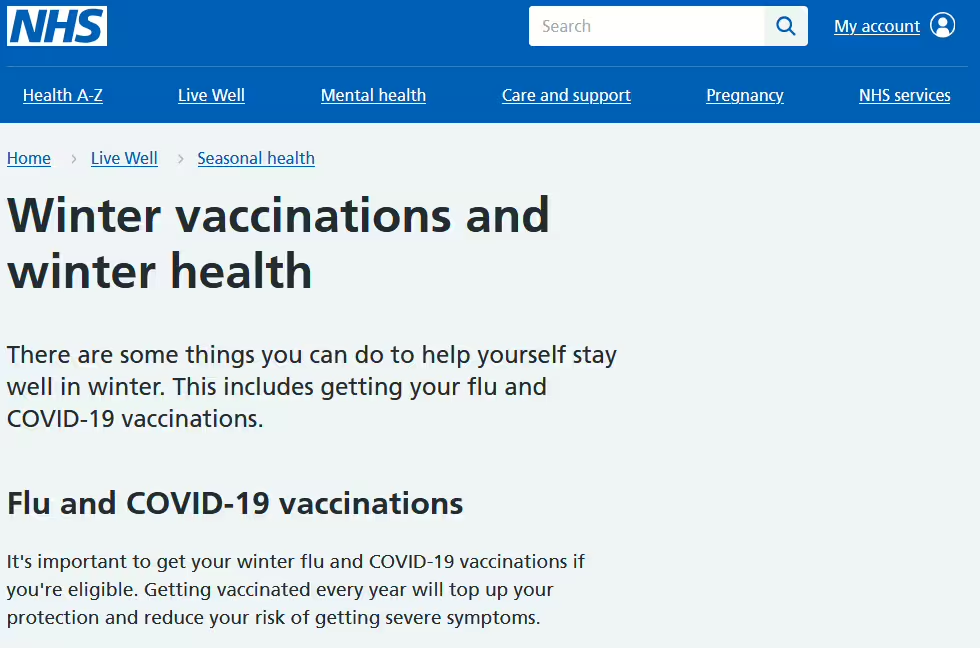
Fully-vaccinated and ready for winter

A screenshot of the NHS winter vaccinations page

We’re halfway through October, the weather is getting colder and the nights are getting longer. So, it’s also time to get your winter vaccinations.

I’m asthmatic, and so I qualify for a free flu vaccine each year. I’m also eligible for a free Covid-19 booster; my last one was two years ago, but it looks like the eligibility rules have changed in my favour.

I had both vaccines last week. Apart from some tenderness in my arms where I had the vaccines injected, no side effects for me thankfully. Back in 2021, my first dose of the Covid-19 vaccine (AstraZeneca) gave me a fever for a few days, but subsequent vaccinations (Pfizer and Moderna) have been much milder.

You’ll probably find that, if you’re eligible for a free flu vaccine on the NHS, your GP surgery will contact you to ask you to make an appointment. For the Covid-19 vaccine, I was able to book this myself on the NHS app.

Getting vaccinated privately

If you don’t qualify for a free vaccine, but still want to get protected, you can pay for one privately. Boots will charge you £22, and Superdrug £20 (or £10 if you have their loyalty card). Alternatively, check with your workplace; my employer offers vouchers for a free flu vaccination with Boots to all employees who aren’t otherwise eligible for one on the NHS.

The Covid-19 vaccines are rather more expensive – about £100 at Boots, although some may sell them for less, with the cheapest Novavax vaccine costing £45.

If I didn’t get them for free on the NHS then I would probably pay for the flu vaccine. The last time I had flu was in October 2003. The fact that I can remember the rough date 21 years later shows how much I’m happy to have the vaccine to avoid going that again. I was eligible for a flu vaccine back then too, but managed to get flu before I could get vaccinated.

As for Covid-19 – I’ve definitely had it at least once since March 2020, an almost certainly twice. In both cases, it was just like a bad cold (but over more quickly). But I also lost two friends to that virus in 2020, and so I know how serious it could be.

RSV and pneumococcal vaccines

If you’re 65+ or pregnant, then you may also be eligible for one or two other winter vaccines: RSV, against the respiratory syncytial virus, and pneumococcal, against some forms of pneumonia and meningitis. If your GP surgery hasn’t already been in touch, have a chat with them if you meet the eligible criteria.

And remember, vaccination isn’t just about protecting yourself. Not everyone can have vaccines, but if you’re vaccinated, you’ll help to prevent the spread of diseases which continue to kill thousands of people in the UK each year.

Sometimes it’s good just to write utter rubbish

On the one hand, this blog post is just some filler content. I’m trying to keep up with my schedule of a new blog post every other day and needed to write something, and so this will have to do. I’m writing this on a dull, wet Saturday afternoon and have next to no inspiration to write anything useful. What I write won’t rank highly on search engines, or get reposted lots of time on social media. In fact, you’re probably wasting your time reading this because I’m only writing it because I feel I have to, and not because I necessarily want to. After all, Google and other search engines like web sites that are updated frequently, and if I take another long break from blogging then my posts will drop down the rankings and no-one will ever visit.

On the other hand, sometimes it’s good just to write utter rubbish. It gets your brain going, and once you’ve written some utter rubbish and cleared your head, you’ll be warmed up to write something more useful. At least, that’s the theory, according to this book by Gillie Bolton and Russell Delderfield (sponsored link) that I read back in 2021.

I read the book as part of a postgraduate university course that I did, mostly during lockdown, which included teaching on reflective practice. This wasn’t one of the core books on the reading list, but it was recommended to me by, err, well, Russell Delderfield himself. He’s a former colleague of mine. Gillie Bolton, the principal author, is a big fan of writing anything for a few minutes, and recommends it at the start of each exercise in the book.

Does it work? Well, it’s not a method that I use much – most blog posts that I write have spent at least a few days in my head before I write them down. But when faced with the need to write something, I suppose it’s helped here. I’ve left the first paragraph in; if I was writing professionally, I’m sure that an editor would probably remove it and want me to SEO optimise the remaining text. That’s not going to happen here. This is going to be a completely un-optimised, un-edited stream of consciousness blog post that might be useful for some people. And sometimes that’s okay. I mean, it’s my blog after all.

Welcome to August

It’s the 1st August today. That means that it’s Yorkshire Day, and for once, I’m actually in Yorkshire as normal on Yorkshire Day for the first time since 2020.

But August is also my busiest month of the year at work. I work in university admissions, and the 15th August is the date when most 18-year-olds get their exam results, so there’s a lot of work to be done either side of this date. I’ll be working longer hours that day, as well as a couple of weekend days.

What this means is that most blog posts this month will have been written in advance. I still have the rest of our holiday to write up, which you’ll hopefully see over the next couple of weeks. And I’ll try to intersperse these posts with other topics. But there’s also a good chance that I may fall behind on my aim to publish a new blog post every other day, if I don’t manage to get enough posts written ahead of time.

Cheap international roaming – Airalo eSIM

A screenshot of an iPhone 13 Mini running iOS 16 which has both a regular SIM and an eSIM installed

It used to be that, before Brexit, all of us Brits had free roaming on our mobile phones across other EU member states. Now, O2 is the only Big 4 mobile provider not to charge for roaming in the EU. I’m with Three, who re-introduced roaming charges despite being one of the first to scrap them even before they were required to.

So, in the second of my two blog posts about things we’ve done to make our holidays a little easier, I’m going to talk about eSIMs, and how you can use them to get cheaper data when travelling. The first post was on using a tag to pay for motorway tolls in Europe from Monday.

An eSIM is an ’embedded SIM’. So, unlike a SIM card that you put into your phone, an eSIM is built in. However, newer phones make this eSIM re-programmable, and so you can download a profile to change your eSIM to a different network. Normally, this is in addition to whichever physical SIM card is in your phone.

What this means is that you can have your regular SIM for making calls and sending/receiving SMS messages, and then a different eSIM for data. This can be a local eSIM, so you don’t have to pay roaming charges. And, because your regular SIM is still there, you’re still reachable on your regular phone number.

A screenshot of the Airalo web site which lets you buy an eSIM

Buying an eSIM from Airalo

Whilst in France, I bought my eSIM from Airalo. You install their app, purchase your eSIM, and then install it so that your phone can use it. It’s straightforward, and the eSIMs are not expensive. I paid $10 for a 3 GB eSIM that was valid for 30 days, which was sufficient. By contrast, I would have spent £2 per day to roam with Three, which would have added up to £20. $10 is roughly £8, so it saved a little money. Airalo also offers ‘Airmoney’ which is essentially cashback on each purchase, that can be accumulated towards buying more credit.

When you have both a regular SIM and an eSIM active, your phone should show the signal for both. In my case, I was connected to Bouygues for voice and SMS, and Orange for data.

If you use an iPhone, then you’ll need an iPhone XR, XS or XS Max or later. These were the models announced in September 2018, so unless you have a very old iPhone, you should be able to use an eSIM. Obviously support for Android phones will vary by manufacturer; my wife has a Samsung Galaxy phone of a similar age and this didn’t support an eSIM.

Whilst there are other eSIM retailers besides Airalo, this is the one I have experience with. If you want to try them yourself, then if you use the code ‘NEIL6715’ when signing up, you’ll get $3 credit.

AboutMy.email

Screenshot of the aboutmy.email screen

So, now that I’m sending out email newsletters, I need to be sure that people will actually receive the emails. Because email spam is still a problem after all these years, the big webmail providers have strict requirements to ensure that email reaches their user inboxes, and AboutMy.email is a really simple testing tool.

When you open the web page, you’ll be given an automatically generated unique email address. All you need to do is send an email to this address, preferably by adding it to your email list. Once the email comes through, AboutMy.email will analyse it, and let you know what you need to improve.

I had already set up DMARC, DKIM and SPF on my domain, and so, as you can see from the screenshot, it scored quite well. Other things that I’ve gained points for are my site having an IPv6 address, and using TLS for email connections.

To improve the score further, I’ve subsequently added a BIMI record, and need to look into adding unsubscribe headers from my emails. But it’s a very good start, and should reduce the chances of my emails ending up in user’s spam folders. I like how simple AboutMy.email is – you don’t need to register an account, and there’s no spam follow-ups afterwards (which would be ironic I suppose).

Sprive – a mortgage over-payment app

A screenshot of the Sprive app on iOS

If you’re lucky enough to own your own home, and are paying off a mortgage on it, then you may want to consider signing up to Sprive.

Sprive is an app for iOS and Android, that lets you easily make over-payments on your mortgage. Once you’ve registered, it’ll ask to link to your bank account using Open Banking, and you can then set a minimum and maximum amount to over-pay each month.

The minimum payment can go out on a date that you set, and then Sprive will monitor your current account balance and suggest further payments if you have sufficient money left. Sprive normally gives you a notification a few days before it talks a payment and they’re easy to cancel.

I’m using the absolute minimum amounts – £25 per month, and a maximum of £75 per month. However, even such small additional contributions should mean that we pay off our mortgage earlier. The Sprive app visualises this, and reckons we’re on track to be mortgage-free about 18 months earlier than we would be without over-payments. That translates to around £2000 less interest that we would have to pay otherwise. It’ll also show you what loan-to-value rate you are eligible for, and how much of your house you own. Having bought our house not quite 9 years ago, we now own 55% of it, although this is more due to the house increasing in value rather than our repayments.

Sprive Rewards

As well as siphoning off money from your bank account, there’s Sprive Rewards. This allows you to buy gift cards for many retailers (including all the major supermarkets) where a percentage is then used as a mortgage over-payment. For example, you could buy a £50 Tesco gift card, and have 3% (£1.50) used as an over-payment. You can, of course, use these gift cards for your own shopping, so whilst the savings may not seem like much, they can add up. You can even save 1% with Amazon; when I spent £75 there recently, that 75p has the potential to save me as much as £16 down the line in mortgage interest. I’m not a fan of gift cards, but this is where they can be used to save money.

MoneySavingExpert has a useful mortgage overpayment guide, including what you need to bear in mind. Most mortgage providers do let you overpay up to 10% of your mortgage each year, but it’s worth checking your paperwork. If you over-pay too much, you may pay a penalty for doing so.

If you like what you’ve read, and want to sign up to Sprive, you can use my referral code which is HTWH65PM. This will give you an additional £5 head start – so it’s basically free money, albeit not much and only redeemable as an over-payment on your mortgage.