An overview of other people called Neil Turner

An amalgamated screenshot of web sites about other people with the name Neil Turner

I suppose one problem with having a (relatively) common first name and surname, is that I’m not the only person called Neil Turner. If you do a Google search for ‘neil turner’, this blog is currently not the first result, although it has been in the past.

When I first joined Facebook, almost two decades ago, I was invited to two separate groups for people called ‘Neil Turner’. And I have even met someone in person called Neil Turner, albeit with a different middle name. And I get plenty of email to my Gmail address, which is derived from my name, meant for other people whose surname is Turner and who has a first name beginning with ‘N’.

So who are these other Neil Turners? Here’s a quick overview of the ones that I have found.

Neil Turner, the British author

The number one result on Google at present is a British author called Neil Turner, who writes financial thriller books after a career working at hedge funds in London and Frankfurt. Three of his books have been published so far.

Neil Turner, the Canadian author

I came across the Canadian author called Neil Turner because several people emailed me, expecting me to be him, to invite me to attend various book club meetings. Indeed, a few months ago I added a note to my contact page advising people that I am not the same person.

This Neil Turner is also an author of thrillers, focussing on the lawyer Tony Valenti. So far, there are 10 books in the Tony Valenti series.

Neil Turner, the retired Labour politician

If you go to the Neil Turner page on Wikipedia, nowadays you will see a disambiguation page which links to five other pages. However, in the past, it would have taken you straight to the former MP Neil Turner, who represented Wigan for the Labour party from 1999 to 2010. He was briefly a junior minister in Tony Blair’s latter days as Prime Minister, but announced in 2009 that he would not stand for the next election.

The Wigan constituency remains a Labour seat, with Lisa Nandy having retained it since the 2010 General Election.

Neil Turner, the photographer

Previously, Neil Turner the photographer was also a number one result on Google for ‘neil turner’. This person is based in Bournemouth and is a professional photographer who also has a blog. I suppose that makes him the opposite of me in a way, as I’m more of a blogger than a photographer, although I do neither professionally.

Neil Turner, the former rugby league player

Back to Wikipedia, and there is a former Rugby League player called Neil Turner. He played for Hull FC and Doncaster, as well as spending time as a police detective (if an unsourced statement on Wikipedia is true).

Neil Turner, the Australian politician

It seems that more than one person with my name has gone into politics as there was a politician called Neil Turner in Queensland, Australia. He served time as the Speaker of the Queensland Legislative Assembly in the mid-1990s, but he died in 2011.

Neil Turner, the Australian scientist

Another Australian namesake on Wikipedia is Dr Neil Clifford Turner, although he was born in the UK. He is an agricultural scientist who looks at how crops can adapt to dryer landscapes as a result of climate change.

Neil Turner, the retired British researcher

At the nearby University of Leeds, there’s Dr Neil A Turner, who researches cardiology and is based at the university’s medical school. He’s now retired but contributed to some published papers as recently as 2024.

Neil Turner, the British co-author

There’s a book called Toby and Sox, about an autistic boy and his therapy dog, which was authored by Vikky Turner and co-authored by her husband, Neil.

Neil Turner, the architect

There’s a Neil Turner who works for a Durham-based architecture practice called Howarth Litchfield. The company is currently involved in renovating Redcar station on the north-east coast.

Neil Turner, the footballer

There was a footballer called Neil Turner who died before I was born. He was born in Scotland, which figures as ‘Neil’ is originally a Scots-Gaelic name, and played for a number of teams in Scotland, England and later the USA.

Neil Turner, the British professor

Yet another member of academic staff with my namesake. Professor Neil Turner researches project management and supply chains at Cranfield University, and teaches on their research MSc programme in project management.

Neil Turner, the psychotherapist

If I lived in London and needed counselling, then I could make things really confusing by visiting a psychotherapist with my namesake.

There are many more people out there with the same name as me – these are just the people that came up on the first few pages of searching. What is notable is that almost all of these people are older than me; I think by the time I was born in the 1980s, the name ‘Neil’ was starting to go out of fashion. Indeed, it’s no longer in the top 100 baby names and so I can’t even track its popularity.

None of these people are especially famous. When I decided to write this, I was aware of three of them (the British politician, the British photographer and the Canadian writer) but mainly because these are people that I have been confused with in the past. I was unaware of the others until I researched this.

Also, should I ever decide to write a fiction book, I might need to write it under a pseudonym, or use my middle name. Having three published authors with the same name would get unnecessarily messy.

Unblogged January

A photo of January's 'Wolf Moon', taken by me in Derbyshire

I didn’t do one of these in December, although I think anything that I would have written about went into the 2025 review. Instead, here’s what I got up to in January that didn’t merit a full blog post.

The Wolf Moon

That photo of the moon at the top isn’t a stock photo – I took it myself! A full moon in January is known as a ‘wolf moon‘, and the moon happened to be closer to the earth than average so it appeared much larger in the sky.

The photo was taken on my Canon EOS 90D DSLR camera, but I admit there was some luck involved. I used the pop-out screen to set the correct exposure automatically, rather than experiment with various settings. I didn’t even need to use a tripod, and that photo was the first and only one I took. It’s been minimally cropped and edited.

As for where I took the photo? Well, after visiting Hardwick Hall, we took a detour and went to the Chatsworth Farm Shop. That photo was taken in the car park – being out in the countryside meant there was less light pollution. It also meant that, as well as getting a fabulous moon photo, we also picked up some of Chatsworth’s excellent maple-cured bacon. Seriously, it is probably the best bacon we’ve ever tasted.

A return visit to NESM

Last April, we went to the National Emergency Services Museum in Sheffield. As the tickets automatically become an annual pass, earlier this month I went back there with our ten-year-old. On our previous visit, there had been a Steampunk event on (it looks like it’s returning this April) and so we never got to visit the top floor, or the police cells.

This visit was an opportunity to rectify that, and so we got to learn about HM Coastguard, the Royal National Lifeboat Institution (RNLI) and the Yorkshire Air Ambulance. There’s also a recreation of a multi-agency response, where different emergency services have to work together – in this instance, a car crash which requires the police, ambulance and fire & rescue services. The museum is fundraising for a much-needed extension and I hope it’s successful – it’s a fantastic little museum and clearly needs more space.

Also, we bought a Plague Ducktor in the gift shop.

A screenshot of our results from the RSPB Big Garden Birdwatch

Garden Birdwatch results

We took part in the RSPB Big Garden Birdwatch on Sunday morning, which happened to be really wet and dreary. Despite this, we managed to see around 14 birds – mostly sparrows, but also a couple of blackbirds and bluetits. We fleetingly saw a wagtail too, which wasn’t on the core list.

(not) Changing Mobile Network

My mobile phone contract came to an end this month, and so I used a Martin Lewis trick to request a Port Authority Code (PAC) to port my number to another provider. This resulted in my current provider giving me a better offer than their standard upgrade deals, so now I have almost three times more data each month for less money than I was paying before. And, I don’t have to switch to a different network. All the haggling was done via Live Chat too, so I didn’t even need to call someone.

A photo of a Star Wars themed Lego set at the Calder Valley Brick Show

The Calder Valley Brick Show

We popped into this year’s Calder Valley Brick Show in Mytholmroyd last weekend. It’s an annual show for amateur Lego builders to show off their creations. Some are based on standard sets – often the older sets from the 1980s and 1990s – whereas others are custom builds. There were quite a few Star Wars dioramas there, but there was a good mix. Next month, there’s Bricktastic at Manchester Central (what used to be G-Mex) which is a much bigger event, although it looks like a number of the sets we saw will be there too.

The RSPB Big Garden Birdwatch

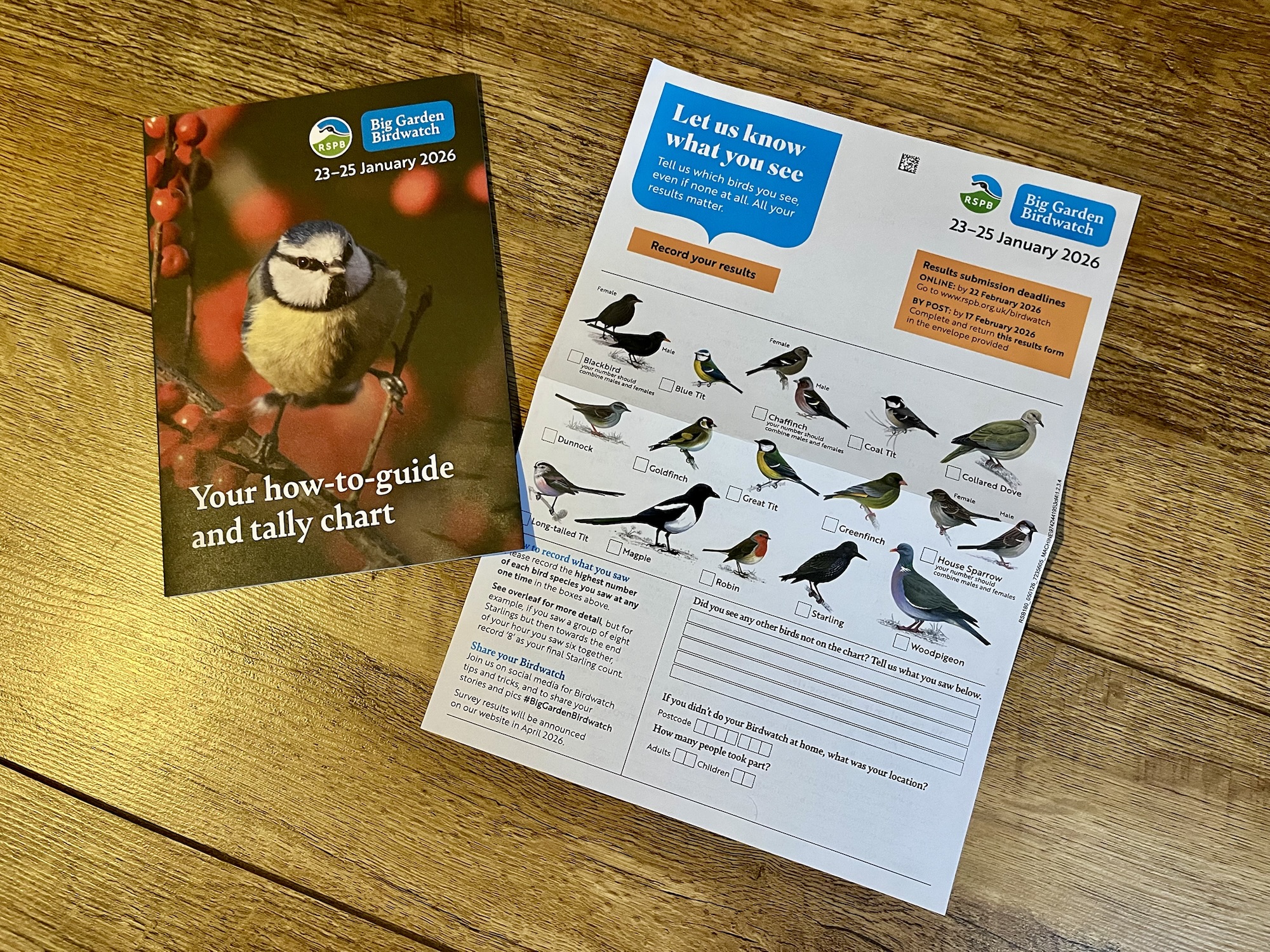
A photo of the guide and tally chart for the RSPB Big Garden Birdwatch

If you have a garden, and a spare hour this weekend, you could take part in the RSPB’s annual Big Garden Birdwatch. It’s a citizen science project that allows the RSPB insights into which birds are most common in British gardens, and identify trends over time.

The RSPB Big Garden Birdwatch normally takes place on the last weekend of every January. Anyone with a garden can take part – you don’t need to be an RSPB member. In fact, even if you don’t have a garden, you could go to a public park, or monitor a shared space from a balcony. The aim is that you record the birds that land in the space during a one hour period.

If you’re really keen, you can count the birds in more than one place. For example, if you have both a front and a back garden, you could spend an hour counting birds in one, and then a second hour counting the birds in another. The key aim of the Big Garden Birdwatch is that as many open spaces as possible are monitored, for an hour each, over the course of three days.

How to take part in the Big Garden Birdwatch

You don’t need to be a knowledgable birdwatcher to take part. We signed up some time ago, and so the RSPB sent us a pack in the post (pictured above). It’s a bit late for posting things now, so there’s a downloadable PDF which includes the most common species of bird that you’re likely to see. You can tick them off – but remember to count how many of each species you see too.

After the hour is over, you can submit your results online. The form will be open until the 22nd February, so there’s no rush. You can also post your results to the RSPB, but the form is quicker and will accept a wider list of birds. So if you’ve been really lucky and spotted (for example) a jay or a sparrowhawk, then you’re probably better submitting online. We’ve previously had both in our garden, but not during a Big Garden Birdwatch session.

Filler content

I try very hard to make sure that a new blog post goes live on here every two days. And sometimes I have so much to write about, that I have three weeks’ worth of blog posts scheduled to go live. Typically, this is just after we come back from holiday, for example.

This is not one of those times. So this is a filler blog post, to make sure that I keep my unbroken streak of posting every other day, going back to last June.

We haven’t had many days out of late, and those that we have had, have all been written about already. Unless we went out somewhere yesterday – I’m writing this on Tuesday – but I probably won’t have time to write that up until later this week if we do. I also haven’t bought much new technology recently, nor had much time to tinker with WordPress or Home Assistant.

In terms of blog posts that I’m planning, I expect I’ll discuss our reasons for changing to a new ISP, and also reviewing the new router that we got. There’ll probably be an ‘unblogged November’ round-up of things that weren’t quite important enough for a blog post on their own. And probably a ‘oh good grief, how is it December already!’ post.

Button battery charger

A photo of a button battery charger with a LIR2450 battery inserted.

Battery chargers are just for AA and AAA batteries, right? Nope – it turns out you can buy rechargeable button batteries (also known as coin batteries) and a charger for them. Today, I’m reviewing this starter kit that I bought from Amazon (sponsored link) which includes a charger and four LIR2450 batteries.

The battery charger can charge two button batteries at a time. A red light shows that the battery is charging; it shows a green light when there’s no battery inserted, or the battery is fully charged. It’s not an intelligent charger, so it won’t tell you if the battery is dead, or give you an idea of progress.

As well as the provided LIR2450 batteries, this battery charger can also charge LIR2032 and LIR2025 batteries if you have these. These batteries should be compatible with any devices that take CR2450, CR2032 and CR2025 batteries, which aren’t rechargeable. It’s quite small, and gets its power via a USB-C cable, which is included. Batteries seem to take around two hours to fully charge.

I’ve got a Zigbee motion sensor that uses a CR2450 battery, and whilst it’s not needed its battery replacing yet, I can ensure that its new batteries are rechargeable. Disposing of batteries properly can be a pain, as they’re not supposed to go in household waste.

The starter pack, that includes the battery charger and four batteries, currently costs £16. Extra packs of four batteries seem to cost around £8 (sponsored link), so the equivalent of £2 each. That’s more expensive than buying the equivalent disposable CR2450 batteries, which can be had for about 50p each, but they should last longer and are better for the environment.

Miscellaneous notes on North Wales

This is the one final holiday post before I get on with writing about the other things we’ve done on this holiday. It’s a few assorted notes and observations from our time away.

North Wales is popular with dog owners

If you want to bring your dog on holiday, then North Wales seems to a popular choice. The cottage we rented was dog-friendly, with hard floors in most of the rooms, and in Llandudno we saw at least one hotel specifically marketing itself as dog-friendly. In fact, there was even a dog toileting area to the side. Alas, I didn’t catch the name of it, and can’t find it on Google Street View, but I think it was on Church Street.

We certainly saw plenty of people out and about with their dogs.

Charging our electric car wasn’t much of an issue

Getting a new electric car less than a week before we went on holiday was an interesting decision in retrospect, but we coped well. Whilst there are literally no public chargers in Conwy, and we weren’t permitted to charge it at the cottage we rented, there were a couple of rapid chargers a few minutes away in Llandudno Junction. These kept us going when we couldn’t charge on days out, however, several of the places that we visited did offer public charging. We only had to go out of way once to charge up; the rest of the time, we fitted our charges around the activities that we’d planned.

Signage is in Welsh first, then English

North Wales has a higher concentration of people who speak Welsh as their first language, than other parts of Wales. So, Welsh tends to appear first on road signs with English beneath. This isn’t universal, and elsewhere in Wales it’s English first. And whereas in Ireland, where the Irish text on road signs is in italics, both the English and Welsh are in the same font, same colour and not italicised. I don’t speak Welsh – I tried it on Duolingo for a couple of weeks before going back to French – and so reading signs took a little longer as I had to look where the Welsh stopped and the English started.

Christine, meanwhile, is still learning Welsh on Duolingo.

It’s also notable that all the Welsh signs instantly disappear as soon as you cross the border back into England.

The Welsh NHS is separate to the English NHS

I forgot to pack any spare hearing aid batteries, and so needed to find somewhere that sold them. Being English, I went to the nhs.uk web site to find somewhere that would sell them, but it turns out that, despite ending in ‘.uk’, nhs.uk is just the web site for NHS England. So when I searched for nearby pharmacies, for example, all the results were in Cheshire and Merseyside.

Healthcare is a ‘devolved’ matter in the UK, and so the regional governments in Wales, Scotland and Northern Ireland have their own branches of the NHS. (Technically, it’s not the NHS in Northern Ireland but HSC instead).

NHS Wales confusingly has two web sites. The main NHS Wales web site, at nhs.wales, is more of a corporate web site – if you want health advice, or to find services, you need NHS 111 Wales, which is at 111.wales.nhs.uk.

I know NHS England is being abolished but you would expect a web site called ‘nhs.uk’ to apply to the whole of the UK, and not just England.

For completeness, health advice in Scotland comes from NHS Inform, at nhsinform.scot, and in Northern Ireland, it’s part of NIDirect.

LanguageCert HE Summit in Athens

Screenshot of the home page of LanguageCert's web site

The purpose of my recent visit to Athens was to attend a summit for staff working in admissions and English teaching in higher education, hosted by LanguageCert. LanguageCert offers tests in English, Spanish and Classical Greek for those wanting to prove their language proficiency for work, study or immigration.

I don’t tend to talk much about my day job on this blog, but as someone who works in international university admissions, I was already aware of LanguageCert. They offer a suite of tests, including an Academic test which is more focussed on the English skills needed for academic study at an English-speaking university. LanguageCert took over the running of the International ESOL (English for Speakers of Other Languages) test from City & Guilds in 2015, and moved into online testing in 2019. Which, considering everything that happened in 2020, was a very wise move in hindsight.

Online testing

LanguageCert tests can be taken in a test centre – indeed, they’re one of only five providers offering a Secure English Language Test (SELT) approved by UK Visas and Immigration. But their tests are also available to be taken online at home, and it was good to hear more about the security and identity checks that they do for testers. I won’t go into too much detail, as I don’t want to share information given to me in confidence. Test takers have to download apps to their computers and mobile devices to verify their identity and to detect any cheating tools. We also got to see some examples of how they’ve been able to catch paid impersonators who have taken tests on peoples’ behalves. Their mobile app, ExamShield, can read the chips located in most modern passports, which can be compared with the printed details to avoid issues with fraudulent identity documents. The same app can also be used as a second webcam, typically positioned 135° from the primary webcam on the computer, to allow the proctor to see that the workspace is clear of any unauthorised materials. There’s more detail available here if you’re interested.

We also got to see behind the scenes, to see live exams being remotely proctored. They offer exams 24 hours a day, seven days a week.

The AI elephant in the room

The topic of Artificial Intelligence came up several times during the summit, both in terms of opportunities and threats. AI, when used correctly, can assist humans with tasks – especially around fraud checks. But it can also be used for fraud, and this is something that LanguageCert are tackling. They have various tools and pre-test verification checks to detect deepfakes, where an impersonator will use live face-swapping technology to make themselves look like the person who was supposed to take the test. Their software is designed to lock down a computer, so, for example, it wouldn’t be possible to paste answers from ChatGPT into the writing section of a test.

Preventing fraud using AI is an ongoing arms race. LanguageCert’s software and platform is developed in-house – again, we got to see where their programmers work – and so they are well-placed to be agile in responding to new developments in the AI space.

The English testing market

LanguageCert is a relatively new entrant to the market for English testing. Most British universities steer people towards the IELTS test, which is run collaboratively between the University of Cambridge, IDP and the British Council. Meanwhile, TOEFL from ETS is usually preferred by American universities and Pearson PTE by Australian universities. Widening access to university education is something I feel passionately about, as I say peoples’ lives being changed every day by being able to undertake further study, and so having a wide range of accessible and affordable tests facilitates this.

Besides learning about LanguageCert’s products, and those from the wider PeopleCert group, the summit was also a good opportunity to network with colleagues from other universities. Several British universities besides my own were represented, but also universities from the US, Canada, Belgium, Netherlands, Italy and Poland. It was good to speak to other professionals, especially during a turbulent time for higher education in the UK and US.

It was a very useful and well-organised summit, and I really appreciated LanguageCert extending an invite to my employer and for covering our travel costs.

Integration

With Home Assistant, I think it’s fair to say that some of its integrations are easier to set up than others.

Some services offer a nice public API, and an easy way for users to get hold of an API key. Then, it’s just a case of popping this API key into Home Assistant, and off you go.

Some services are not so easy. They may offer an API, but require you to jump through hoops to sign up as a developer and create an application before you can get what you need. Or they may not offer an API, and the only way to integrate it with Home Assistant is to scrape web pages. Meanwhile, the integration developers have to constantly amend their integration to carry on working.

Now, this isn’t a blog post about Home Assistant – it’s using Home Assistant as a metaphor for immigration, and it’s inspired by this Guardian Comment piece from last week. We seem to want people who come to the UK to integrate with British culture, but integration works best when both sides work together.

In the late 1990s, there was a pioneering British sketch comedy TV show called Goodness Gracious Me, which was the first to feature an all British Asian cast. One of the recurring sketches was The Coopers, an Asian family that tries a little too hard to be British. I think it’s relevant to this, because, as someone who is white and indigenous to Britain, I have a duty to those who want to integrate with British society to feel welcome. We can’t tell people to integrate harder when we’re unwilling to do the same. Just because we happened to be lucky to be born into a country where lots of people want to live.

Britain is a better country because of immigration. I appreciate living in a multi-cultural society, where I can experience different perspectives on the world. Where there’s a range of different food shops and restaurants from the various diasporas who have settled here. Where the jobs that British natives don’t want to do get done, especially in health and social care. Where Christmas is celebrated alongside Eid, Diwali and Passover. When we all work together so that we can live together in peace, the world is a better place.

No Mow May

No Mow May logo

If you want to encourage wildlife in your local area, you can pledge not to mow your lawn this month, as part of No Mow May.

Allowing your lawn to get a bit longer allows wildflowers to grow, which helps pollinators like bees and butterflies. May is a peak month for wildflowers, and so it’s a good time to put away your lawnmower and let your garden be a bit more natural for a few weeks.

We’ve ‘done’ No Mow May for a few years. We only have one small garden and don’t actually own a lawnmower, but we have put our strimmer away for the month of May. I can’t say that this has always been a conscious decision; I’m not at all green-fingered, and Christine tends to be too busy to manage the garden on a regular basis. So sometimes we’ve not mowed the lawn at all in previous Mays just through pure laziness. The fact that we’ve probably helped the local wildlife in doing so is a nice side-effect.

No Mow May is a campaign by the charity Plantlife, and they have plenty of resources on their web site if you’re interested in managing a wild lawn all year round.

If you don’t have your own garden, there are other ways to get involved too, including contacting your local councillors to ask for public green spaces to be mowed less often. Leeds City Council has ‘relaxed mowing areas‘ alongside major roads to encourage wildlife, although the cynic in me reckons its partly a cost-saving measure too.

Is it the Easter holidays?

An egg with googly eyes in a flamingo-shaped egg cup. This is supposed to somehow represent 'Easter holidays'.

In most years, schools have their two week Easter holidays either side of the Easter weekend. But this year, Easter falls comparatively late – Easter Sunday will be the 20th April and a full three weeks later than last year.

If schools were to stick to the ‘two weeks either side’ model, that would mean they would be off this week and next week, with kids not back at school until the 28th April. It also means that the spring term at school will have been longer than normal, leaving a long stretch of teaching from Christmas onwards, and then a compressed summer term. So, our nine-year-old’s school is now in its second week of the Easter holidays, having had last week off as well. School re-opens the day after Easter Monday, on Tuesday 22nd April.

But not all schools are doing this. One local secondary school had an extended half term break before Christmas, giving them two weeks in October/November, and then shortened the Easter holidays to just a week and a bit. Over in South Yorkshire, they’re already done with their Easter holidays – they broke on the 28th March and were back at school on Monday. The actual Easter weekend is therefore detached from their Easter holidays. I suppose this keeps the spacing of the holidays more consistent but it feels a bit weird to have ‘Easter holidays’ that don’t include the actual Easter weekend.

My workplace always offers a customary holiday on the day after Easter Monday, and so I’ll be off work when our nine-year-old goes back to school. It gives me an extra break, I suppose.

Next year’s Easter holidays

In 2026, Easter Sunday will be a couple of weeks earlier on the 5th April. And, certainly where we are, that means a return to the standard pattern where the Easter holidays wrap around the Easter weekend. It’ll be another week earlier in 2027 as Easter Sunday will be the 28th March.

If you need to know when school holidays are, you can check local authority web sites which usually have dates for both this year and next year. However, individual schools may vary their dates – especially if they have Academy status.

The latest date for Easter

Wikipedia has a list of when Easter falls, and, in particular, the earliest and latest possible dates for Easter. Easter Sunday is comparatively late this year, but the latest possible date is actually the 25th April. The last time this happened was in 1943, and it’ll happen again in 2038. We’ll also have a late Easter in 2030 when it falls on the 21st – a day later than this year.

The earliest date for Easter is the 22nd March, and the last time this happened was before living memory, way back in 1818. Indeed, the next time it happens will also be (most likely) beyond the lifespan of anyone living today, as it won’t be until 2285. However, Easter Sunday fell on the 23rd March in 2008, something which I apparently didn’t blog about at the time. A shame, because the next time Easter Sunday falls on the 23rd March will be in 2160.

So, is it the Easter holidays?

So, to answer the question I posed in the title of this blog post: it depends. Most schools are off this week (the roads have definitely been quieter) but not all of them are. It’ll most likely be back to normal next year though.