A General Election debrief

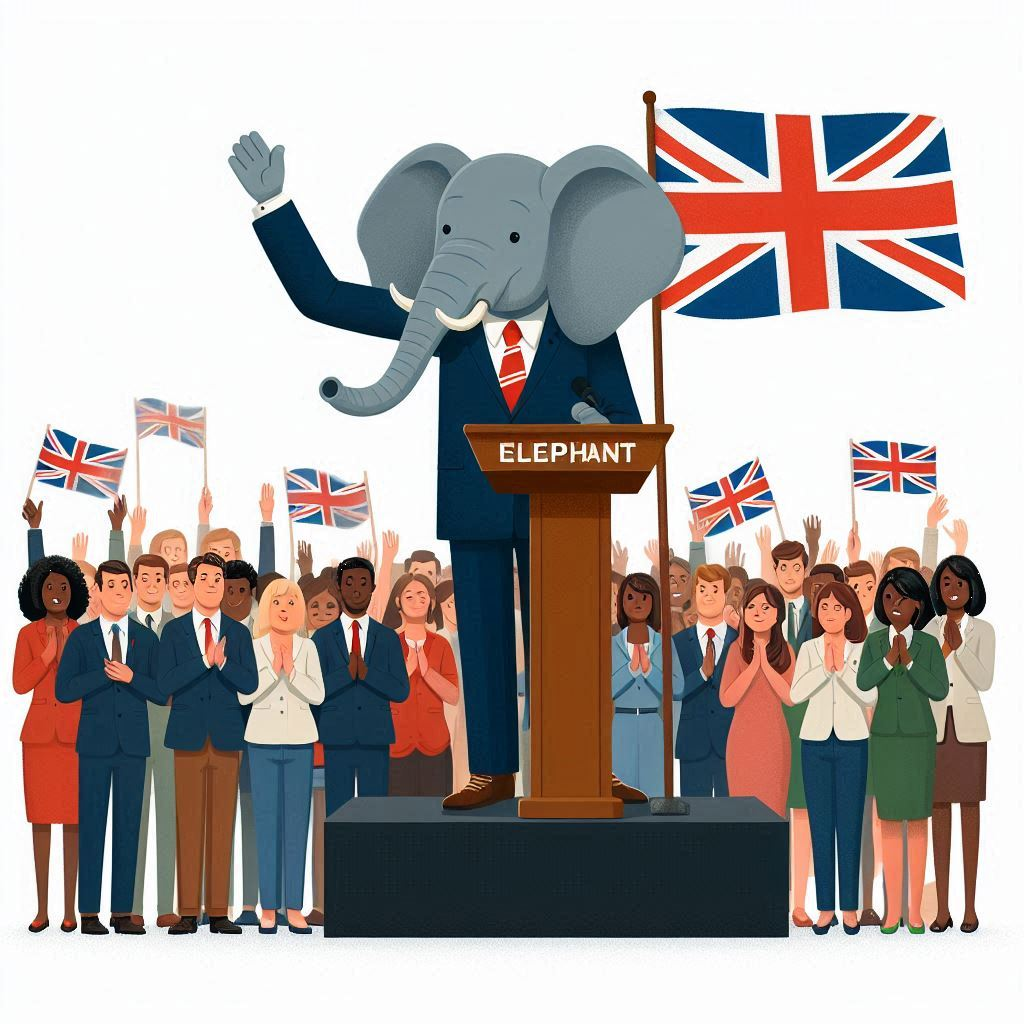
An AI-generated illustration of an elephant dressed as a politician standing in front of a podium, surrounded by supporters.

So, it’s been around 13 hours since the polls closed last night, and we have a new Prime Minister in Sir Keir Starmer. Obviously, as a Labour Party member, I’m delighted that Labour have won the election, and with a sizeable majority too.

This is a quick, stream-of-consciousness blog post reacting to the results, and what I think it means for each party. I’ll be referring to these statistics from the BBC throughout.

Labour

Obviously this is, for the most part, a fantastic result for Labour. Having had a dire outcome in the last General Election in 2019, to come back and win a sizeable majority of seats is an impressive turnaround.

It’s not a perfect result; some polls in the run-up to the election suggested an even bigger win, and Labour has only gained 1.6% of the total votes compared to last time. And some seats have been lost, notably two in Leicester and one in the new Batley and Dewsbury constituency (which covers part of the old constituency of Batley and Spen where Jo Cox was assassinated in 2016). These both have large Muslim populations who have not approved of Labour’s stance in relation to the war in Gaza.

The limited swing in the popular vote suggests that people have not voted enthusiastically for Labour, but are voting against the Conservatives. Whilst it could be 2029 before we have another election, Labour may need to do more to convince people to stick with them next time. I believe Labour’s strategy has deliberately been vague and uncontroversial to get elected, and marks a break from the Jeremy Corbyn era (who incidentally retained his seat as an independent candidate). Now that they’re in power, with a healthy majority, I hope that they will pursue a more progressive agenda. Labour could definitely do more to reward those on the left who have backed them, especially around LGBTQ+ issues. Kier Starmer wrote an op-ed piece for Attitude magazine, to which its editor has had to add clarification based on Starmer’s comments about Trans* people in recent weeks.

Conservatives

The Tories have taken a deserved battering. After winning a majority last time, we’ve had two changes of Prime Minister, and a government that has looked increasingly out of ideas. Big issues like the state of the NHS, failing school buildings, universities approaching bankruptcy, and thousands of refugees fleeing conflict risking their lives on small boats in the English Channel, have not been tackled. Instead, we’ve had ‘culture wars’ and inaction.

No wonder this became the worst defeat in the party’s history for what it calls itself ‘the natural party of government‘. It wasn’t as bad as some polls suggested – one had the Tories in third place behind the Liberal Democrats. But they have less than 1/5th of the seats in the Commons now, with a net loss of 250 – more than two-thirds of the seats they were defending. And whilst Rishi Sunak retained his seat, many of his government colleagues did not – nor did previous Prime Minister Liz Truss. It’s also notable that Wales now has no Tory MPs anymore.

Liberal Democrats

As mentioned, some pre-election polls predicted that the LibDems would win more seats than the Tories, making them the official opposition. It would be very funny if that had happened, with both the government and main opposition formed of centre-left parties. This didn’t come to pass – the Tories didn’t quite as terribly – but with 71 seats, the LibDems have more than they did in 2010 when they entered a coalition with the Tories.

Whilst Ed Davey has some skeletons in his closet from his time as a minister with responsibility for the Post Office during the Horizon scandal, he ran an entertaining and well-targeted campaign. His various stunts brightened up the pre-election period, and by focussing their campaign on a number of core target seats, they’ve pulled off a great result.

Reform UK

Urgh. If I have to say the phrase ‘The Right Honourable Nigel Farage MP’, it’ll be through gritted teeth. On his eighth attempt, he has finally become an MP, representing Clacton-on-sea in Essex. Reform’s popularity surged throughout the pre-election period, and even last night’s exit poll predicted that they would win 17 seats. Despite more than 4 million people voting for them (urgh again), they only picked up 4 seats – three of which are seaside constituencies: the aforementioned Clacton, along with Great Yarmouth and Boston & Skegness.

If we had some form of proportional representation, then Reform would have won more seats than the LibDems and become the third-largest party. As it is, by fielding a candidate in just about every constituency, arguably they spread themselves too thinly. At best, they split the right-wing vote and helped Labour into power.

Green Party/ies

The Green Party of England and Wales have held a single seat in Brighton for a few years, but never managed to capitalise on this elsewhere. Until now, having won 4 MPs this time, and almost 2 million votes. That puts them on a par with Reform, so, theoretically they should receive the same amount of airtime. This is a really good result for them.

Workers Party GB

George Galloway’s latest vehicle has run into a siding, again. Having won a by-election in Rochdale just four months ago, Galloway managed to lose his seat, and none of their other candidates did any better. Nationally, they picked up over 200,000 votes, which is more than Plaid Cymru achieved in Wales. No doubt Galloway will pop up again in another constituency by-election in time.

A new Prime Minister

So, we have our sixth Prime Minister since our eight-year-old was born in 2015. I’m hoping for a period of relative stability – for context, I was 32 when my sixth Prime Minister, Theresa May, took up the post in 2016. Keir Starmer has promised ‘change’ – let’s hope it’ll be effective change for the better.

As for the rest of the world? I hope that Britain’s ability to move on from having a right-wing populist government will give some hope to those in the USA and France, who have imminent elections.

It’s polling day!

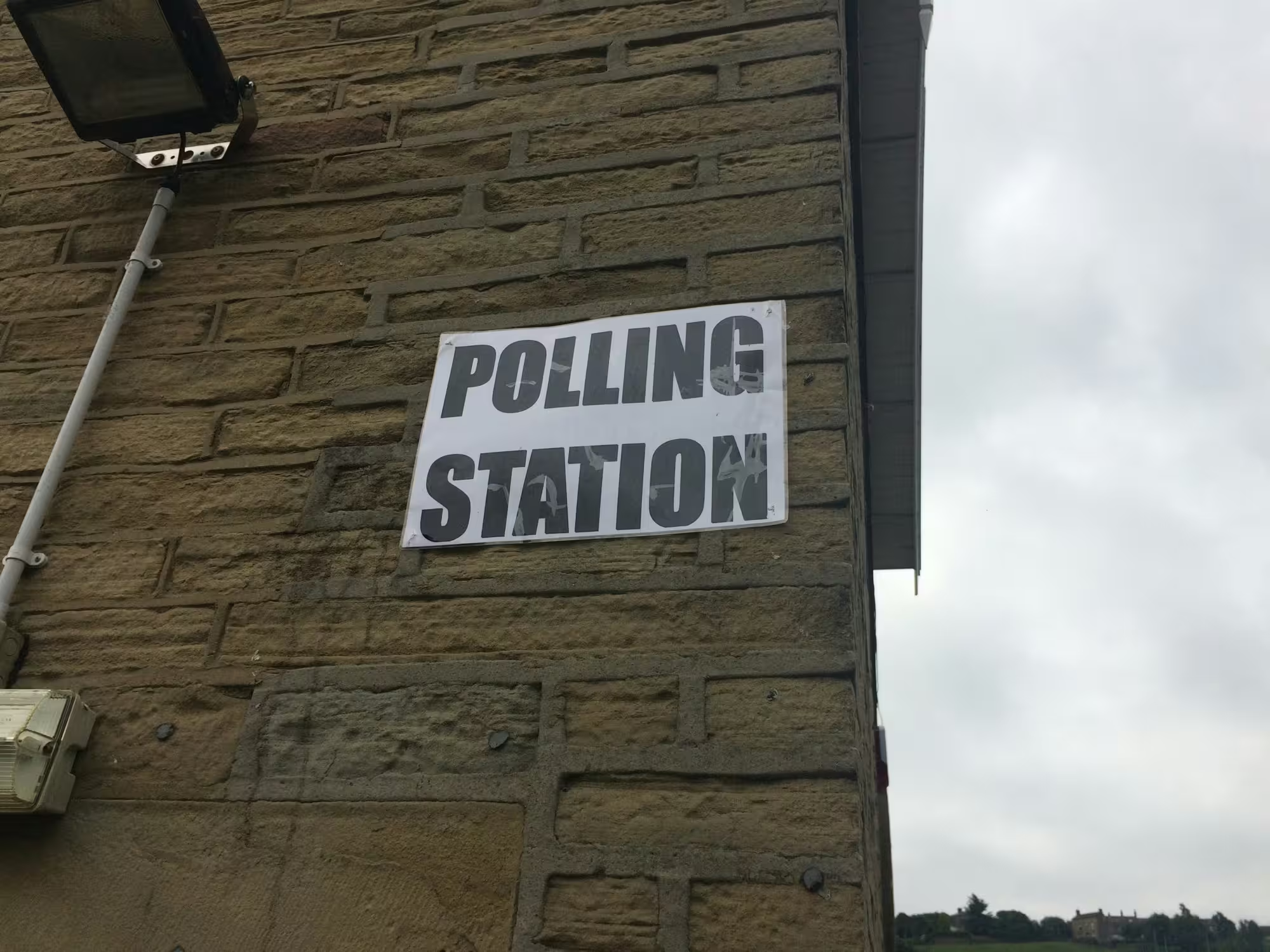
A photo of a sign saying 'Polling Station' on the side of a building

Today’s the day when you can vote in the UK’s General Election (assuming you haven’t already voted by post). The polling stations opened at 7am, and you have until 10pm to get out there and vote.

If you’re not sure where your polling station is, use WhereDoIVote.co.uk – just pop your postcode in. Similarly, WhoCanIVoteFor.co.uk will tell you who will be on your ballot paper, and (most likely) some more information about the candidates and what they stand for.

You don’t need to take your polling card with you, but you must bring some photo ID with you. The Electoral Commission has an extensive list of what forms of ID are accepted, but the main ones include your passport and driving licence.

I’ll be off to vote in person this morning. Tomorrow, I’ll try to find the time to write about the result, once we have a picture of which party (or coalition of parties) is likely to be in government. I may or may not stay up for the exit polls tonight.

The 7 election candidates in Halifax

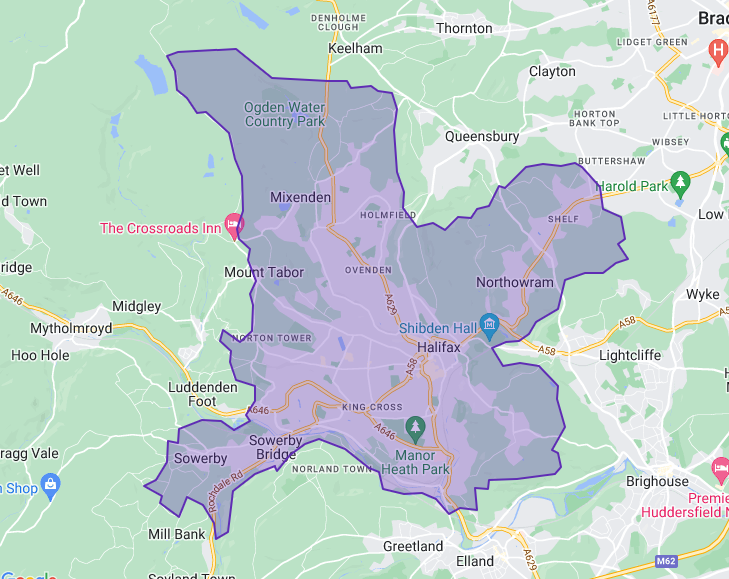
A screenshot of the map of the Halifax parliamentary constituency

So, there’s a General Election coming up on the 4th July. Although I live in Sowerby Bridge, our local constituency is Halifax, as we’re lumped with the larger town just up the road.

Since the last general election at the end of 2019, there’s a couple of changes.

New constituency boundaries

The first change is the constituency boundary. Whilst there will still be 650 constituencies across the United Kingdom, the boundaries have changed to ensure that there’s a more even balance of population in each. In our case, the Halifax constituency has grown slightly, and now includes part of the Ryburn ward which used to be in the neighbouring Calder Valley constituency. This adds the villages of Sowerby and Triangle.

A new MP

Our previous Labour MP, Holly Lynch, decided not to run again. She is currently pregnant with her second child, and trying to run a re-election campaign whilst expecting doesn’t sound like my idea of fun. She’s been our MP since the 2015 general election, and was re-elected in 2017 and 2019.

So, using the list from WhoCanIVoteFor, here’s who I’ll be able to consider voting for next month:

Labour: Kate Dearden

Kate is the Labour candidate, and most likely to win; Halifax has elected a Labour MP at every election since 1987. Indeed, since 1964, the Tories have only held the seat for the four years prior to 1987. As I’m a member of the Labour party, I’ll be voting for Kate.

Though not born in Halifax, she grew up not too far away in Bingley, and has worked in trade union roles prior to becoming a political candidate.

Reform UK: James Griffith-Jones

Reform is Nigel Farage’s latest political vehicle, and is fielding candidates in just about every constituency in England, Wales and Scotland this time. Previously known as the Brexit Party, James previously stood for UKIP in a local council election in 2016, but there’s a lack of information about him on Reform’s web site. Reform may be popular with some of the more rural areas of the Halifax constituency but I can’t see him winning here. The Brexit Party previously came third in 2019, beating the Liberal Democrats, but only winning 6% of the vote.

This post was edited on Wednesday 26th June in response to a comment from James Griffith-Jones who states that he is not a ‘far-right’ candidate.

Green Party: Martin Hey

Martin is already active in local politics, having been elected a local councillor in the Shelf and Northowram ward a couple of years ago. Judging by his profile, he’s a bit of a NIMBY and concerned with the amount of housebuilding proposed for the area. In the last general election in 2019, the Greens came last with just 2% of the vote.

Independent: Perveen Hussain

In addition to the six parties fielding candidates, there’s one candidate standing as an independent, who is Perveen Hussain. According to her candidate statement, she’s a local businessperson and a campaigner, especially around Palestine. The Park ward in Halifax has a large Muslim community and she may see some support here.

Liberal Democrats: Samuel Jackson

We don’t know what Samuel Jackson’s middle name is, so I’ll leave the Nick Fury comparisons out for now. He’s a local lad, born in the constituency, who works in one of the local textile factories. As mentioned, the LibDems polled fourth in 2019 with a little under 5% of the vote.

Workers Party of Britain: Shakir Saghir

Now this is an interesting one. The Workers Party GB is George Galloway’s latest vehicle, and Shakir recently outed Labour in the Park ward in the recent local council elections. I happened to drive through the ward on election day last month, and his posters were everywhere, alongside photos of Galloway and lots of messaging around Palestine. Policy on Palestine has been one of Labour’s weak points this year.

WhoCanIVoteFor reveals that Shakir was previously a Tory, having stood several times for the Conservatives in local council elections. His switch to the Workers Party seems to have helped him get elected in Park ward, but I would be surprised if he can repeat that success across the wider Halifax constituency. Also, as someone who used to work in Bradford West during Galloway’s last stint as an MP between 2012 and 2015, he comes across as an absolute grifter.

Conservatives: Hazel Sharp

Hazel Sharp has her own, rather basic web site. She’s originally from Scotland, but now works as a physiotherapist for the NHS. Which, considering the current Tory government’s record when it comes to the NHS, is surprising. Having looked at her Facebook page, her campaign seems to be focussed on a handful of more rural areas, with nothing from the suburbs of Halifax itself.

The Tories have come second in every election since losing the seat in 1987, and only lost by 400 votes (1%) in 2015. However, with their frankly disastrous campaign and falling poll ratings, I would be very surprised if Hazel is elected as Halifax’s next MP.

FWIW, I realise that Diamond Geezer has done the same for his constituency in London, but I had planned to write this for some time. Anyway, if you live in Halifax, vote for Kate Dearden on the 4th July.

An incoming General Election

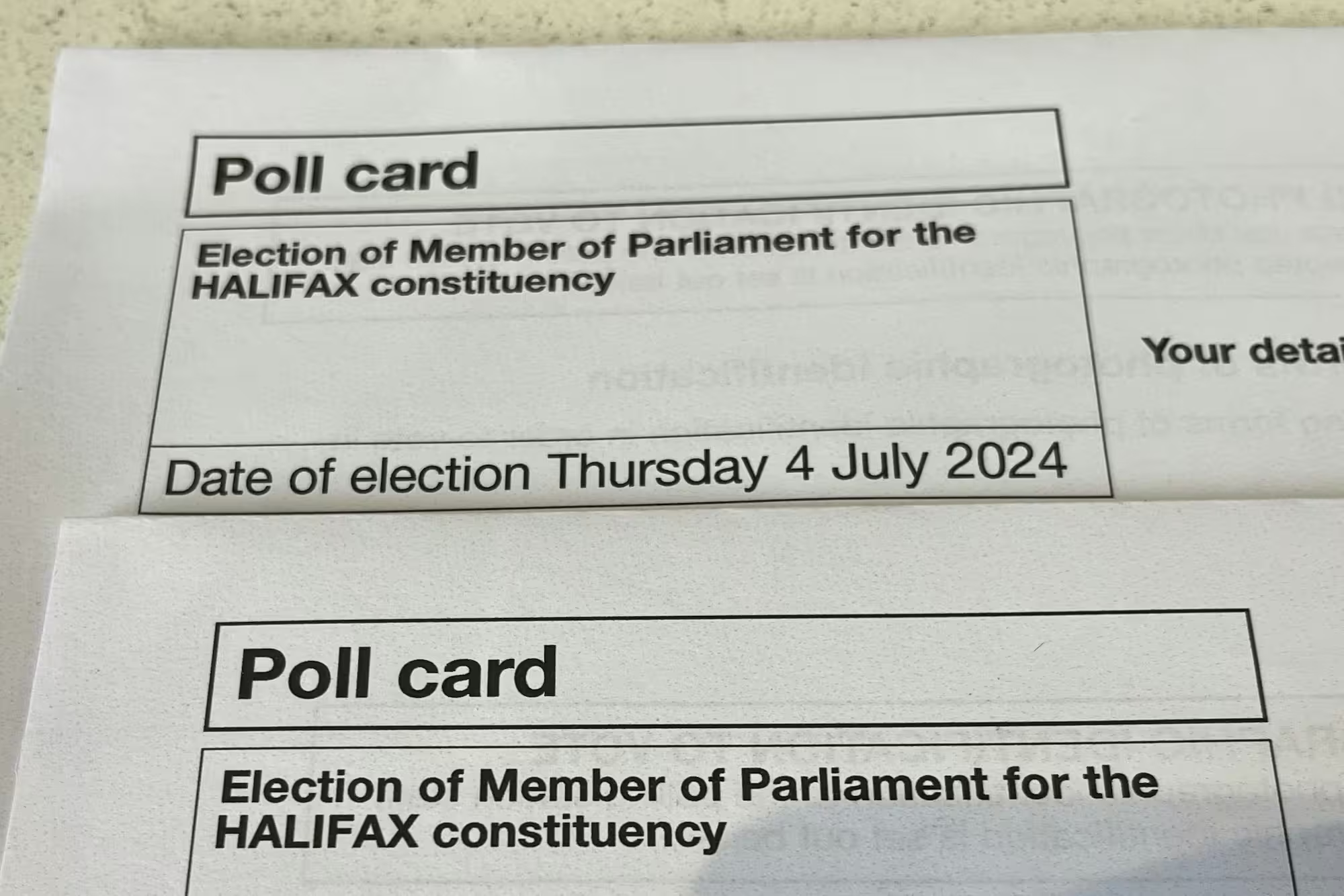
A photo of our polling cards for the Halifax constituency for the General Election

If you’re in Britain, it hopefully hasn’t passed you by that there’s a General Election taking place on the 4th July. It was announced back on the 22 May in a very moist way by our current Prime Minister, Rishi Sunak. Had the Fixed-term Parliaments Act not been repealed, it would have probably coincided with the local and mayoral elections on the 2nd May, but instead we’re being called out for a second election in three months.

We’ve already received our voting cards through the post, but if you haven’t, or you’re not sure if you’re registered to vote, fill out the form now. You have until 23:59 on Tuesday 18th June to register, which is only a few days away.

This will be the sixth general election in which I’ve been eligible to vote. I turned 18 a year after the 2001 general election and so missed it, but I have voted in the 2005, 2010, 2015, 2017 and 2019 elections.

The folks at Democracy Club have a couple of web sites to help you with voting. Where do I vote? tells you where your polling station is, if you’re choosing to vote in person rather than use a postal vote. This information will also be on your polling card, although you don’t need your polling card with you to vote.

Who can I vote for? meanwhile lists the candidates standing in your constituency. There’s a record number of candidates standing this time – a total of 4515 across the 650 constituencies, which averages at almost seven candidates per constituency. Indeed, every constituency has at least five candidates standing, which is a first. As well as the three traditional main parties, the Green Party and Reform UK are fielding candidates in almost every constituency too.

The most is 13 candidates in Richmond and Northallerton, which happens to be where Rishi Sunak is standing. As well as the major parties, Count Binface is there, alongside the Monster Raving Loony Party (who are fielding 22 candidates in total).

In a later blog post, I’ll talk about the seven candidates that I can choose in Halifax, where I live. Although, as I’m a paid-up member of the Labour party, it’s pretty obvious who I’ll be choosing.

Election day

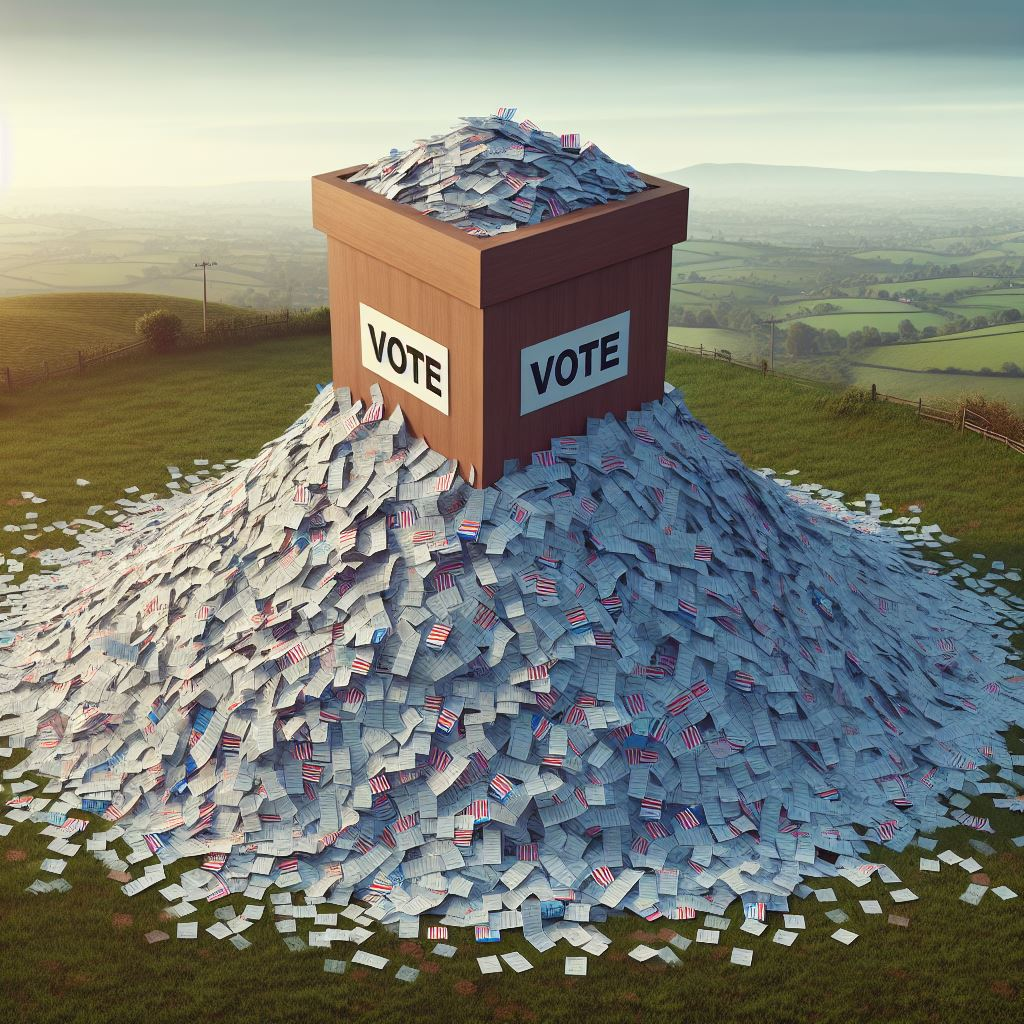
An AI generated image of a ballot box overflowing with election ballots in the countryside

Today is election day for much of the UK. It’s not a general election, as much as I would like it to be; that will be sometime between mid-June and mid-January. But here in Sowerby Bridge, we have two elections taking place:

As I am a card-carrying member of the Labour Party, I’ll be voting for them in both elections. It’s likely that Labour will win both too. Our local authority, Calderdale Council, is already a Labour-controlled council, as are the four other local authorities that make up West Yorkshire. And Tracy Brabin, the incumbent mayor, will almost certainly be re-elected. Although very little local polling has taken place, Labour are polling significantly ahead of all other parties nationally.

If you are voting today, remember that you need to take some photo ID with you. This will be my second election where photo ID has been required, but may be your first. Even though the actual rate of electoral fraud was almost completely insignificant before voter ID rules were introduced.

New mayoralties

Over in York, my parents will be able to vote for an elected mayor of York and North Yorkshire for the first time. This will be a more interesting contest, as York tends to lean towards Labour and the Liberal Democrats, whereas the wider (and more rural) county of North Yorkshire leans Conservative. If David Skaith wins the mayoralty for Labour, it will mean that the Conservatives really are in trouble when they finally call a General Election.

There will also be mayoral elections for the first time in the North East and East Midlands, and the Conservative mayors of Tees Valley and the West Midlands will be hoping to be re-elected. Again, should these mayoralties fall to Labour, it’s a sign that the Conservative party are a spent electoral force.

London mayoral election

And there’s the London mayoral election, where Sadiq Khan will be looking to become the first modern mayor to be elected for a third time. The ULEZ seems to be the key issue here; it was a key part of Khan’s manifesto and most of his rivals want to scrap or curtail it. The exception seems to be Count Binface, who instead wants to expand free parking to electric vehicle users between Vine Street and the Strand. Except for those who drive a Tesla.

We’ll get most of the local council elections tomorrow, with the mayoral election results coming in over the weekend. It certainly promises to be an interesting few days in British politics.

Heat Pump mythbusting

An AI generated image of a heat pump outside a house

Whilst we currently still have a traditional gas boiler for our heating and hot water, should it ever break down or need replacing, we’ll get a heat pump instead. Heat pumps use electricity to provide heat, and are about three times more efficient than even the newest condensing gas boilers.

There’s a really good visual explainer from The Guardian here about how heat pumps work. Basically, they work like fridges in reverse. Heat pumps extract any heat from the ground or air, and pressurise it using a compressor. The pressure heats the air, and the resultant hot air heats up water. This water is then pumped around your central heating system, or into your hot water tank. Using pressure to heat air in this way uses significantly less energy than heating it directly.

But there’s a lot of misinformation out there about heat pumps. This page on CarbonBrief.org lists 18 myths. Of these myths, 12 are outright debunked and the remaining six are in a grey area. And it seems to be an issue largely limited to the UK; in 2021, we had the lowest uptake of heat pumps out of 21 European countries.

Heat pump uptake in Britain

So why is Britain in particular so behind on heat pump uptake? It seems like political lobbying has a role. Boiler manufacturers are trying to push back phase-out dates, presumably as they have huge amounts of stock that would be otherwise worthless.

But also Britain is relatively unique in the world in that we have a privatised gas network. Different private companies each produce the gas, distribute the gas, and bill us for the gas in our homes. The gas producers can sell this gas on the open market, which is why our energy bills rocketed when Russia declared war on Ukraine and the wholesale price went up. Gas is distributed by the privatised National Grid, and in local areas by companies like Cadent and Northern Gas Networks. And then we pay consumer energy companies like British Gas, Octopus, EDF and e-On to get the gas into our homes. In other words, there’s a lot of money to be made from gas, and therefore vested interests in keeping gas supplies going.

Our move away from gas

When we bought our house in 2015, it was very reliant on gas. As well as a 40+ year old gas boiler supplying central heating and hot water, there were two gas fires, a gas oven and gas hob. We got rid of the two gas fires even before we moved in, and replaced the gas boiler with a more efficient condensing boiler. At the same time, we had a Nest smart thermostat fitted. Then in 2022, we got a new kitchen with a dual electric fan ovens and an induction hob. So our boiler is our only remaining gas-using appliance.

I suspect we would have opted for a heat pump instead if they had been more widely available and affordable. As it is, our boiler is only just out of its warranty period and so it’s not worth replacing yet. But when it is time to be replaced, we’ll get a heat pump. After all, we generate our own electricity using solar panels. It would also mean we could have our gas supply turned off, saving us from paying the daily standing charge. This is currently 29p per day, which adds up to over £100 per year.

Sign language on trains

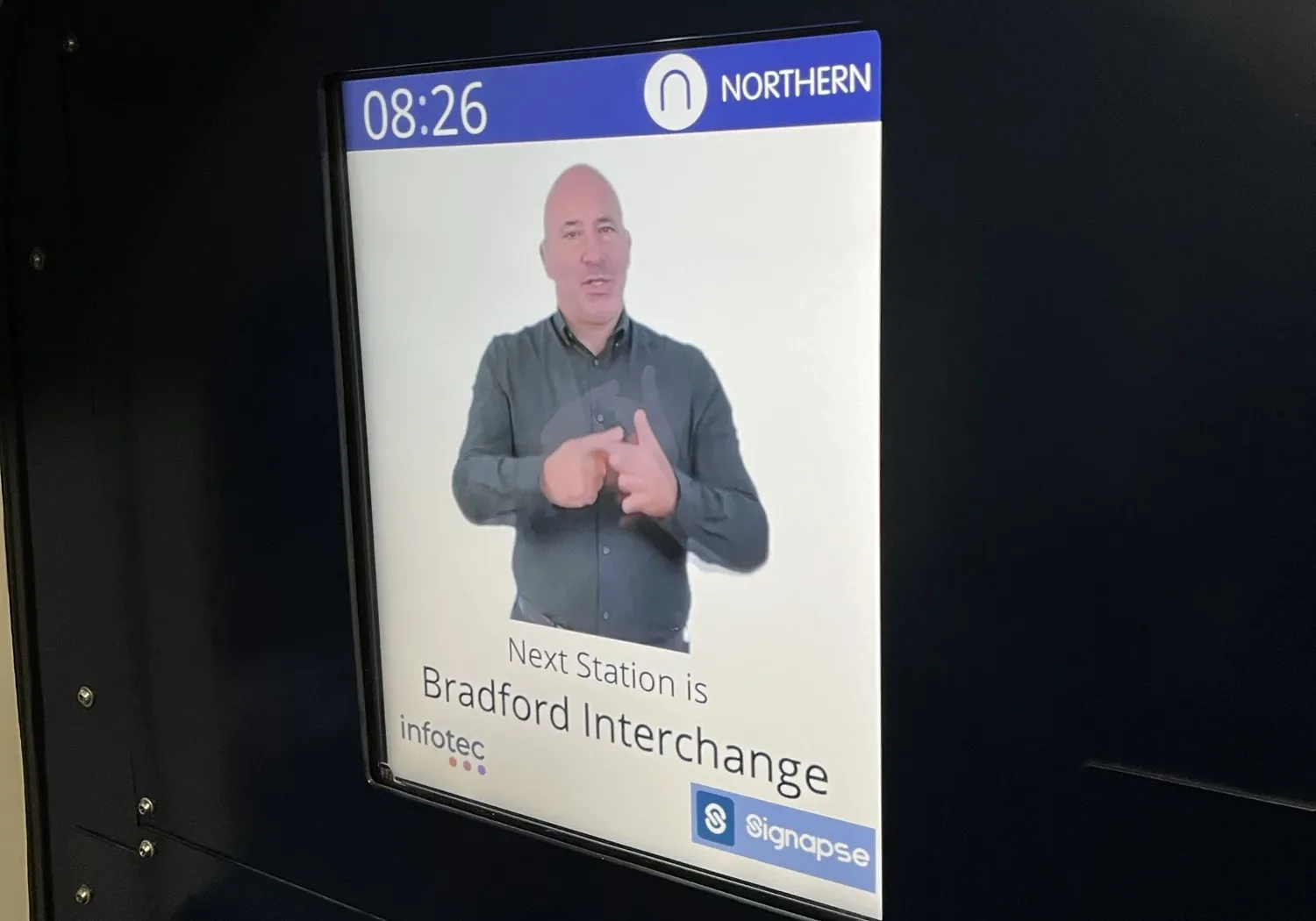
A photo of a screen in a train announcing the next stop is Bradford Interchange, with a video of the announcement in British Sign Language.

Northern Rail has started playing videos with announcements in British Sign Language on some of its trains. It’s a trial at present, and I happened to see one last week.

This is in addition to the existing text-based and audio announcements, and is designed to increase the accessibility of the railways for people with disabilities. Elsewhere in the north, Transpennine Express is rolling out BSL screens at stations.

When I shared this photo on Facebook, it got the usual likes and hearts from friends. But, predictably, there were some comments on the lines of ‘can’t they just read?’. And, recently, over at X/Twitter, its overly impulsive edgelord owner recently asked the same question in a tweet.

I too would have probably asked the same question until recently. However, over Christmas, I read Samantha Baines’ brilliant book ‘Living with Hearing Loss and Deafness’ (sponsored link). Baines’ book helpfully explains that British Sign Language is, well, a language – and it’s distinct from English. Furthermore, some deaf people who have always been deaf will have BSL as their first language and English as their second. If you ever go abroad, to France for example, and have to constantly translate signs into English, it can get tiring after a while. Now imagine that your first language is sign language, and you have to translate written English into the signs that you have learned, all the time.

So that’s why making BSL more widespread in Britain is important. Indeed, it is now a legally-recognised language in England, Wales and Scotland. That means BSL has the same status as British English, Welsh and Scots Gaelic.

As someone who wears hearing aids, learning British Sign Language is something that I plan to do in time. This is because my hearing could continue to deteriorate to the point where hearing aids can’t compensate. Being able to understand BSL may still allow me to communicate with some people should that happen. So whilst these BSL announcements won’t necessarily help me, they will hopefully make trains more accessible for BSL users.

Some predictions for 2024

An AI-generated image of some felt art of a fortune teller with a crystal ball that says 2024 on it

Now that the year has started, I’m going to make some predictions for the rest of 2024. If only because it’ll be interesting to look back in a year’s time to see what actually happens.

Twitter/X won’t become an ‘everything app’

When the overly impulsive billionaire took over Twitter, he announced that it would become an ‘everything app’, like WeChat is in China. Essentially, he’s using his Twitter acquisition to realise his late 1990s dream for x.com, which would offer a huge variety of financial services.

But Musk also has a track record for over-promising and under-delivering. Look at the ‘full self driving’ mode offered on his Tesla cars, which, well, isn’t. His other firms, like The Boring Company, have also scaled down their lofty plans. So I don’t expect X/Twitter to offer much more than it does now by the end of the year.

I expect the core social media aspect of X/Twitter to continue to whither away over the year, thanks to declining user interest and lower advertising revenue. However, I still expect it to be around by the end of 2024 – I don’t think Musk is ready to throw in the towel and shut it down, or sell it at a massive loss.

Labour will win the 2024 General Election

We know that there will be a General Election in the UK this year, although not precisely when it’ll happen. Labour consistently leads in the polls, and has had some unprecedented by-election victories. I don’t think we’re looking at a repeat of 1997, when Labour won by a landslide, but I would expect a comfortable majority. How much change a new Labour government would be able to make partly depends on when the election is, but I’m not expecting the state of the country to massively improve by the end of the year.

Oh, and Sadiq Khan will win a third term as Mayor of London.

There will be a ceasefire in Palestine

Hamas’ deadly attack on Israel on the 8th October has to be condemned, but Israel’s response has been despicable with thousands of innocent civilians losing their lives. I expect Israel to find itself increasingly isolated on the world stage and a ceasefire will be inevitable by the spring of 2024. Unfortunately, I can’t see it being a route to lasting peace in the region, but any reduction in hostilities has to be better than this.

But the war in Ukraine will continue

I’m less optimistic about the war in Ukraine, which has been largely at a stalemate for the whole of 2023. Russia still intends to hang on to the territory that it has seized, including Crimea, whilst Ukraine hasn’t been able to make major advances. Meanwhile political issues in the USA mean that funding for Ukraine to carry on fighting isn’t guaranteed.

Energy prices in the UK will start to fall again

It will be a few days before we get official confirmation from the National Grid, but I’m calling it now: 2023 was the year renewables overtook fossil fuels as the largest contributor to British electricity generation. In the 12 years I’ve been running National Grid: Live at grid.iamkate.com electricity generation from fossil fuels has fallen from an average of 25.1GW to 10.2GW, while renewables have risen from 2.5GW to 10.8GW.

— Kate Morley (@kate) 2023-12-31T12:14:09.211Z

In 2023, the UK generated more electricity from renewable sources than from fossil fuels, for the first time. Whilst UK consumer energy prices went up by 5% on Monday, I anticipate that the cost of electricity will start to fall as more renewable power sources come online. The newly-operational Viking Link Interconnector means that we can trade electricity with Denmark, and the biggest wind farm in Scotland is now online.

That being said, there’s an imbalance in the UK as most wind power is generated in the north of England and Scotland, but the highest demand is in the south of England. And our energy grid doesn’t have capacity to move this, which means that some northern wind turbines have to be turned off and gas-fired power stations turned on – costing money and contributing to climate change. However, there’s been a big up-tick in home solar installations like ours which may help, albeit on a small scale.

The UK will do okay at Eurovision this year

In 2023, the Eurovision song contest was hosted in Liverpool. The 2022 winners Ukraine couldn’t host it safely due to the ongoing war, and the UK came second – our best result for over 20 years. And then despite what I thought was a good song from Mae Muller, we came second-from-bottom.

For 2024, Olly Alexander is representing the UK. As lead singer of Years & Years, I have some high expectations. I doubt we’ll win, but I would disappointed if we’re not mid-table. Of course, we haven’t actually heard the song yet.

Trump won’t win the US Presidential Election

Trump will almost certainly become the Republican Party’s candidate for president, but with two states banning him from their ballots, his campaign isn’t going well. I know Biden isn’t terribly popular, and wish he had stepped aside for someone younger like Kamala Harris, but Trump has made it pretty clear that if he wins (and manages to get a decent Republican Senate and House majority) then he will take the US down a path of authoritarianism that will take a lot of time to unpick. And whilst millions of Americans seem to be okay with this, I doubt it’s the majority.

We also don’t yet know what impact Trump’s legal issues will have, or whether the Federal Supreme Court will overrule Colorado and Maine’s bans. I didn’t think Trump would get elected in 2016, and so I have been wrong about this before, but I hope people’s experiences of 2017-2021 will guide them to vote against him again.

So these are my predictions for 2024. We’ll see at the end of the year whether they happen or not. Meanwhile, have a look at some other predictions from Terence Eden and Diamond Geezer.

Some predictions about the post-Covid-19 ‘new normal’

When there’s effective treatment and we can stop social distancing, what will the world look like?

As I write this in July 2020, we’ve had 4 months of ‘lockdown’ in England where all but the most essential shops have been closed, travelling by public transport has been almost completely discouraged, and all forms of hospitality and nightlife have been suspended, to prevent the spread of Covid-19. Whilst we’re emerging into another ‘temporary normal’, where we can do many of these things again but with social distancing, I wanted to look further into the future.

Let’s assume that the various studies into a vaccine and new treatments are successful in the near future (and this is by no means guaranteed). What will the world be like? And how will it differ from a pre-lockdown world that we enjoyed before March 2020?

I live in England, and so this will mostly focus on what I am most familiar with, but of course some of these ideas are transferable elsewhere.

The old/new normal

To clarify, I’m using the following terms in this piece:

  • The ‘old’ normal is what we experienced before lockdown, i.e. before March 2020
  • The ‘current’ or ‘temporary’ normal is what we’re in now, where we need to socially distance, work at home where possible and wear masks in some situations
  • The ‘new’ normal will be when such restrictions are no longer necessary because the virus has been essentially eradicated from the population, or we can treat it effectively. Arguably, this is where New Zealand is, albeit with strict immigration controls to prevent the virus being re-imported.

Travel

When lockdown began in England, we were told:

  • Don’t leave your home for more than an hour, and only go out for essential journeys or for exercise
  • Avoid public transport unless it is your only option

Over time, this messaging has eased as active Covid-19 cases have fallen. As I write this in July, the public are now being encouraged back onto public transport, albeit with mandatory face masks and needing to sit at least a metre apart, preferably two metres. This may have something to do with the millions of pounds that the government has had to spend over the past few months to prop up Britain’s transport companies so that they can run a minimum service for key workers. But also, as more people return to work, there’s a risk of major congestion on the roads if everyone who can drive decides to, rather than taking a train or a bus.

I suspect it will be several years before the usage levels of public transport return to pre-lockdown levels. People will remain wary of using public transport – especially in places where buses and trains are often full and standing, like London. I also think more people will carry on working at home, and more meetings will take place virtually – points which I will cover in more detail later. So fewer people will need to commute to work every day, and there will be less of a need for long distance and international business travel.

Face masks

At the start of lockdown, the scientific evidence behind the effectiveness of mask-wearing to prevent infections seemed unclear. In many cases, recommendations were made that the public not wear masks, as doing so improperly would be ineffective and may give a false sense of protection.

But the advice evolved, and soon face masks became mandatory on public transport in England. Later in July, it’ll also become mandatory to wear a face covering in shops, or risk a financial penalty. Having a mask on means that the advice to keep two metres apart from anyone outside of your household can be relaxed to one metre, without substantially increasing the risk of infection – provided that everyone complies, of course.

In future, even when not mandatory to do so, I can see it being more socially acceptable to wear face masks in public. Prior to 2020, people in some far eastern countries would wear masks in public, to avoid catching airborne diseases or spreading their own minor infections. I would expect this to be more common in western cultures as well – especially amongst those who have invested in reusable cloth masks. It would be interesting to see if, long term, this would have an effect on reducing transmission rates of infectious diseases.

Working at home

Like many people, back in March I was sent to work from home for the foreseeable future. This wasn’t something that employees of the organisation I worked for often got to do in the past – whilst the option was there, there was the expectation that you would be less productive and doing so was generally the exception.

Once we were forced to do so, it turned out that, for many of us, we could be just as productive at home. I’m fortunate that the organisation had invested in IT systems that allowed off-site access to many of our services and platforms, so we could do the vast majority of our work at home and retain access to telephony and database systems remotely.

Office workers can begin to return to on-site work from August in England and I expect some will be keen to get at least some of their employees back in the office as soon as possible. But some big organisations like Twitter have already decided that, even when the situation improves, employees can continue to work remotely indefinitely. Companies like Automattic and AgileBits had, prior to 2020, embraced remote work, but many others were reluctant to do so until forced to, and will now be changing their attitudes.

I expect more companies will include the availability of remote work in their job adverts, and this could have a knock-on effect on where people choose to live. If you no longer need to commute to central London to work, then theoretically you can live anywhere with a good internet connection. That could have a noticeable effect on commuting into London, and demand for property. That being said, if people start living further away from work, then it’s important that mid-distance travel remains available, and therefore we will still need schemes like HS2 which will enable more capacity for such journeys.

My personal preference would be for a mixed mode – say, three days a week in the office and two at home, with the flexibility to adjust this based on the need to attend meetings, or be home to look after ill children, receive deliveries or have work done in the house. I used to work extra hours to bank up flexi-time to take as and when our four-year-old was ill; in future, I may be able to work from home instead, and not feel like I constantly had to take shorter lunch breaks. And hopefully the days of booking a whole day off work for a plumber who turns up at 16:55 will be over, as I would be able to work from home during the day.

Online meetings

Whilst videoconferencing technologies have been around in some shape or form for years, they reached a point of maturity just at the right time. I had only heard of Zoom last year – and now everyone uses it. Back in October, myself and a colleague went to a meeting with a client in Coventry, which involved booking a hire car and travelling over five hours there and back. The meeting took all of a couple of hours, with lunch – and really, there was nothing that couldn’t have been done over a video call.

I strongly suspect such meetings are a thing of the past – a two hour Zoom call would’ve been a lot cheaper and had less of an impact on the day. For some of the meetings I attend, I’m only needed for parts of it – being online, I can carry on working whilst listening in and then contributing when needed.

I think this will have an impact on the demand for international travel – I’ve heard stories of creatives who have flown to Los Angeles literally just for a two hour meeting. I can’t see those being common in the new normal.

Decline in air travel

Air travel is pretty bad for the environment, and even before lockdown some people were vowing to cut down their use of planes. Sleeper trains, which were at risk of being completely eradicated across Europe, were starting to launch new routes or re-established services that had been cancelled.

There will be a fall in international business travel, as online meetings are seen as a suitable alternative. And I expect some airlines will simply go bust, along with some smaller airports. I would be very surprised if the controversial third runway at Heathrow Airport ever gets built now. High speed rail will hopefully attract more people away for the journeys that remain necessary – especially if they can offer good quality internet connections during the journey.

The importance of good internet

One policy of the Labour Party in the run-up to the General Election in 2019 was of universal broadband provision – and internet access being treated as an essential utility along with water and electricity. It was laughed off by some at the time, and yet the only way that many companies have been able to continue business over the past few months is because their employees have had good internet connections at home. Every property in the UK should be able to access some kind of broadband internet connection; ideally, we would have fibre connections rolled out to every home and office, but there is a role for mobile internet services as well. 5G connections will help where a fixed line connection isn’t possible or practical.

I’ve been fortunate that, despite us only having an ADSL line, it’s enough bandwidth for streaming Netflix (for our ten-year-old), a video call and access to work systems at the same time. For families struggling with just one pre-pay mobile handset between several kids, the last few months must have been very hard.

When it comes to buying or renting property, those buildings with poor internet access are not going to be able to command such a high price in future.

Patience and planning

This is something less tangible, but we’ve had to get used to waiting for things and planning ahead as lockdown has eased. We’ve had to queue for shops, so that they can manage the numbers of people inside and maintain social distancing. Similarly, for days out, many places have moved to pre-booking only. There aren’t many places that you can go to on a whim anymore; and popular attractions tend to be booked up weeks in advance.

The decline of cash

So far this year, I think I have withdrawn cash from an ATM approximately three times. The shift to purchasing goods online and shops preferring customers to use contactless forms of payment means that I just haven’t needed to have coins and notes available to pay for goods, most of the time. There will always be a need for cash but I wouldn’t be surprised if more shops and venues become card-only.

The rise of online learning

Schools and universities had to very quickly adapt to a model where students could not physically be on campus. Some universities have begun to offer some programmes by distance learning, but for most courses there was an expectation that you will take at least a year out to study full-time for a qualification. In future, I expect more universities to offer completely online programmes, including online tests, or adopt a more blended approach where students are not required to be on campus as much. Many people will have lost their jobs as a result of the economic crash; offering flexible and online degree courses will be one way that universities can encourage people to up-skill whilst they wait for the job market to improve. Similarly, international students will be less willing, or indeed able to travel across the world to study, so offering courses that they can take in their own countries would replace the lost income from international students.

These online courses need to be proper courses, with assessments – whilst MOOCs (massively open online courses) have been popular, they are not a replacement for a full degree.

Takeaway delivery and online shops

Faced with being unable to open for weeks and months, restaurants and shops pivoted to online sales, and delivering takeaways. Many restaurants near us that had never offered takeaways, never mind deliveries, suddenly started appearing on services like Just Eat and Deliveroo. Whilst these places can now re-open, I expect that many will carry on offering food for delivery, and shops will continue to sell online where they perhaps wouldn’t before. Of course, this may have a knock-0n effect on footfall on high streets and in shopping centres – and with one of Britain’s largest shopping centre owners going into administration, I wouldn’t be surprised if at least one closes down in the coming years.

These are some of the things that I think will change, when compared to the ‘normal’ that we knew before March 2020. I’m mostly writing this down as a way of recording what we accepted for normal now, and what I hope or expect will come about. I may be completely wrong and things will largely go back to how they were, but for many, ‘how things were’ wasn’t ideal. The Covid-19 crisis has been awful for everyone – I lost a friend and former colleague to the disease – but it’s also an opportunity for society to reset, and challenge the norms and expectations that we had before the crisis. I hope that, once we’re in the ‘new’ normal, we’ll be able to embrace technology for remote and flexible work and study, be more patient and understanding, and stop doing the things that are destroying our planet. We’ll see what happens.

This was originally posted on Medium.
Some collected thoughts about today’s London tube bomb

This morning, what appears to be an improvised explosive device detonated on a London Underground train at Parson’s Green station. At the time of writing, we know that:

  • 18 people have received non-serious injuries, mostly burns
  • There are no confirmed fatalities
  • It is being treated as a terrorist incident.

I’m basing what I know purely on what I’ve read on the BBC, as I trust them to report accurately and to verify their statements. I will be making some assumptions, and these are based on my 30+ years of living in the UK. I’m not a terrorism expert (although colleagues of mine are) — I am just a regular person who follows the news.

1. We don’t know who did it

Naturally I’ve seen some people jump to conclusions that this is an attack by Islamic fundamentalists groups, possibly linked to Islamic State. We don’t know this.

Notably, this did not appear to be a suicide bomb. Most of the recent attacks, especially the Manchester Arena attack in May this year, were caused by suicide bombers. This appeared to be an abandoned object.

Leaving suspicious bags or packages behind was a tactic more commonly used by the IRA, the Irish terrorist group. It has been a long time since there was an attack by an Irish group, thanks to the peace process in Northern Ireland. And I would be surprised if this marked a resurgence.

2. It looked like a bomb

It’s rare that we get to see the remains of what exploded. In this case, it appeared to be a large plastic tub contained inside a plastic bag from a well-known German supermarket (I feel sorry for their PR team). Photos and videos of the smouldering remains also seemed to show wires, and the BBC report that the remains of a timer were recovered.

This, in my mind, rules out this being an accident. My view is that this was an incendiary device that was deliberately planted.

3. It didn’t do what it was supposed to do

The device did explode, but appears to have caused minor injury. Again, from the BBC news report, it seems to me that more people were injured trying to evacuate from the scene, than by the explosion itself.

Because we have been able to see photo and videos of the device, we have also been able to see how little damage has been caused to tube train. And whilst I have sympathy for the victims of the attack, I am also pleased that the injuries were minor.

This bomb did not managed to cause the devastation brought on by the bomb at the Manchester Arena, nor the tube bombings of July 2005.

4. It may be some time before a terrorist group claims responsibility

Because it wasn’t a large explosion, and hasn’t resulted in fatalities, I don’t think that any of the major terrorist groups will rush to claim responsibility for it. If anything, this may be viewed as a failure; I expect that services on that part of the District Line will be disrupted for a few days, but it won’t cause widespread panic or disruption.

5. London remains open

I think we’ll see the usual responses following a terrorist attack: a potential raising of the overall threat level, more police on the streets and so on. But it hasn’t — and probably won’t — send large parts of London into lockdown.

Indeed, London Underground is still running a reasonably good service on most other lines, as I write this a few hours after the explosion. Parson’s Green is on the Wimbledon branch of the District Line and so this is, of course, closed. The rest of the Wimbledon branch between Earl’s Court and Edgware Road is also experiencing delays, which is understandable, and there are some delays on the Piccadilly Line.

But the rest of the Tube is fine. London is a resilient city that has seen more than its fair share of attempts to terrify its residents. I think most Londoners will see the events of today as something of an inconvenience, rather than a concern.

As I said before, I’m not an expert — this is mostly a collection of my thoughts. I wish the victims a speedy recovery, and await the outcome of the full investigation into what happened. I also hope that this isn’t used as another attack on the vast majority of peaceful Muslims (especially if it turns out that this wasn’t an Islamist attack).

This post originally appeared on Medium.

Creative Commons License
Except where otherwise noted, the content on this site is licensed under a Creative Commons Attribution-ShareAlike 4.0 International License.