Some thoughts on the state of public electric car charging in 2025

A photo of my Nissan Leaf, with the car charging port open and a Type 2 cable plugged in.

So we’re about a month into owning an electric car, and in that time we’ve taken it on two long distance trips – our holiday in Wales, and to the Midlands and Oxfordshire for a family birthday. As our Nissan Leaf only has a 150 mile range on a full charge, we were therefore reliant on public chargers to be able to continue our journeys. This post is therefore some collected thoughts on our experiences, in case you are thinking about switching to an electric car.

Availability of charging bays

Across the UK, there are almost 42,000 places you can charge an electric car, according to ZapMap, with each location offering an average of two chargers and three connectors. However, sometimes you would encounter a charger with two bays, for two cars – but the charging machine could only charge one car at a time. This was a particular problem with the faster ‘Rapid’ chargers. There were a couple of occasions where we arrived at a charger, and could plug in a cable, but would have to wait because another vehicle was already charging.

Other times, we would get there and all the chargers would have been taken. On the way back from Wales, we visited Chester Zoo, which I’ll blog about later in the summer. There are 26 charging bays available, but on a summer Saturday in August, all were taken by the time we arrived at 10:30am. Thankfully, I could check their availability on an app, and was able to move our car around when one had become free around lunchtime.

There is a degree of etiquette when it comes to charging a car. For example, if your car has finished charging, then, if you can, it’s best to go back to it and move it to a standard space to free it up for someone else to use. Also, don’t hog a rapid charger if there’s a slower charger available that you have the time to use.

So far, we’ve not encountered a charging bay being ‘iced’, as in occupied by a standard petrol or diesel car with an internal combustion engine (ICE).

Only slower chargers available

Many public chargers are 7 kW ‘medium’ speed chargers. A full charge on one of these would take about six hours for our Nissan Leaf, and likely much longer for those with much bigger batteries. These chargers are fine for ‘destination charging’ – for example, at Portmeirion, where we were intending to stay for the whole day anyway. But they’re no good for a quick charge to continue a journey.

This problem will get better in time as more rapid and ‘ultra-rapid’ DC chargers are installed.

CHAdeMO, or the lack thereof

Our Nissan Leaf can charge from three types of plug:

  • Standard 3 pin plugs at around 2 kW for a slow charge
  • Type 2 plugs at around 7 kW for a medium charge
  • CHAdeMO plugs, for a rapid charge of around 40 kW

CHAdeMO is a Japanese standard, and a number of Japanese cars of a similar age to our Nissan Leaf were built with these sockets and sold worldwide. But it’s not the European standard for fast charging, which is CCS2. CCS2 looks similar to the type 2 socket, but with an extra bit on, and it’s DC rather than AC. We can’t use CCS2 chargers without buying a converter, and they’re expensive – at least £600.

A lot of rapid chargers will just have one or two CHAdeMO plugs. A good example was Northampton services on the M1, where a bank of 12 rapid CCS2 chargers have been installed, but only one CHAdeMO charger. Which, predictably, was already occupied by another Nissan Leaf. Thankfully, we managed to find somewhere else to charge.

I get the point that barely any new electric vehicles are being built with CHAdeMO connectors, but for those of us with such cars, it can be a pain when they’re not available.

All the apps

Public car charging apps are a bit like car parking apps, in that you may well end up with several of them installed. Early on, many public chargers could only be used using an app – I remember talking to someone who was a very early electric vehicle adopter, who said that having all the apps was the worst thing about it. Thankfully, many public chargers offer contactless payments with a credit card, which is much easier. And some accept an RFID card, which you can order from several places that you then link to a payment method. We’ve got one from Octopus Energy, which works most of the time, but not always.

But some still require you to download an app, sign up for an account, link a payment method and then start charging. The worst of these, in my view, is Pod Point, where you also have to top-up a balance before you charge. That means estimating how much you’re going to need to pay before charging, and then having any money left over held in a Pod Point account. Unfortunately, Pod Point are one of the bigger operators, having partnered with Tesco.

The other issue with apps is phone reception. We managed in Wales, but had we not had a signal, there would have been some places where we wouldn’t have been able to use the chargers.

No chargers where you need them

I mentioned ‘destination charging’ above, giving good examples of Portmeirion and Chester Zoo that allow visitors to charge whilst they’re there. This is one of the key advantages of having an electric car, in that you can charge at somewhere you were planning to stop at anyway, rather than taking a detour to a petrol station.

But not all ‘destinations’ have charging. Whilst in the Midlands, we visited Cadbury World, which doesn’t yet allow its visitors to charge their cars. Which was a shame, although we did find a rapid public charger at an art-deco McDonald’s in King’s Norton.

Thankfully, it looks like more places are investing in charging infrastructure for their visitors. The National Trust, where possible, is installing chargers at many of its properties. And they’re potentially another income source for these attractions. Whilst some may offer free charging, as an incentive, most electric car drivers do expect to pay to charge. So whilst there is the upfront cost of installing electric car charging infrastructure, and then maintaining it, in the long run it could make a good return on investment.

Broken infrastructre

At home, our nearest rapid charger is a short walk away. But it’s been out of order for months, and we’ve seen a number of public chargers that were broken on our travels. This particular charger is in a local authority car park, and I understand that the council got funding to install it, but not maintain it. And last weekend, when we needed to use a rapid charger in Congleton in Cheshire, all of them across the whole town were faulty.

I wouldn’t say faulty chargers are a widespread problem, and most mapping tools for finding public chargers will indicate whether chargers are faulty if they have this data. That should reduce the risk of arriving at a charger with only a few watt-hours to spare, to find it’s out of order.

Charging at home is (almost) always cheaper

Electric cars make the most sense when you can charge them at home. Your home electric supply will (almost) always be cheaper than using a public charger. We’re on a fixed electricity tariff with Octopus, where we pay 20p per kWh. And that assumes that we’re charging overnight, without any contribution from our solar panels.

By contrast, even the cheapest public chargers are usually more than double that. Rapid chargers, especially those at motorway service stations, cost even more – typically 88p per kWh, so more than four times more expensive than charging at home. Part of the reason for this is that public chargers must charge you a higher rate of VAT. At home, your electicity bill has VAT at 5%, but public chargers have to charge 20% VAT.

If you need to use a public charger to top up your charge to get home, then it’s worth calculating how much you need to charge to get home. That way, you only need to charge your car by that much (plus maybe a bit extra) to get home, where the rest of the charge can be done more cheaply.

I say ‘almost’ always cheaper because you may get lucky, and find a free public charger. There aren’t many, but we came across two in Wales. Admittedly, one was a 3-pin plug, offering a very slow charge, and the other was a medium speed 7 kW charger. But still, it’s free electricity, and as we were away and reliant on public chargers, it was very welcome.
Hello to our new electric car

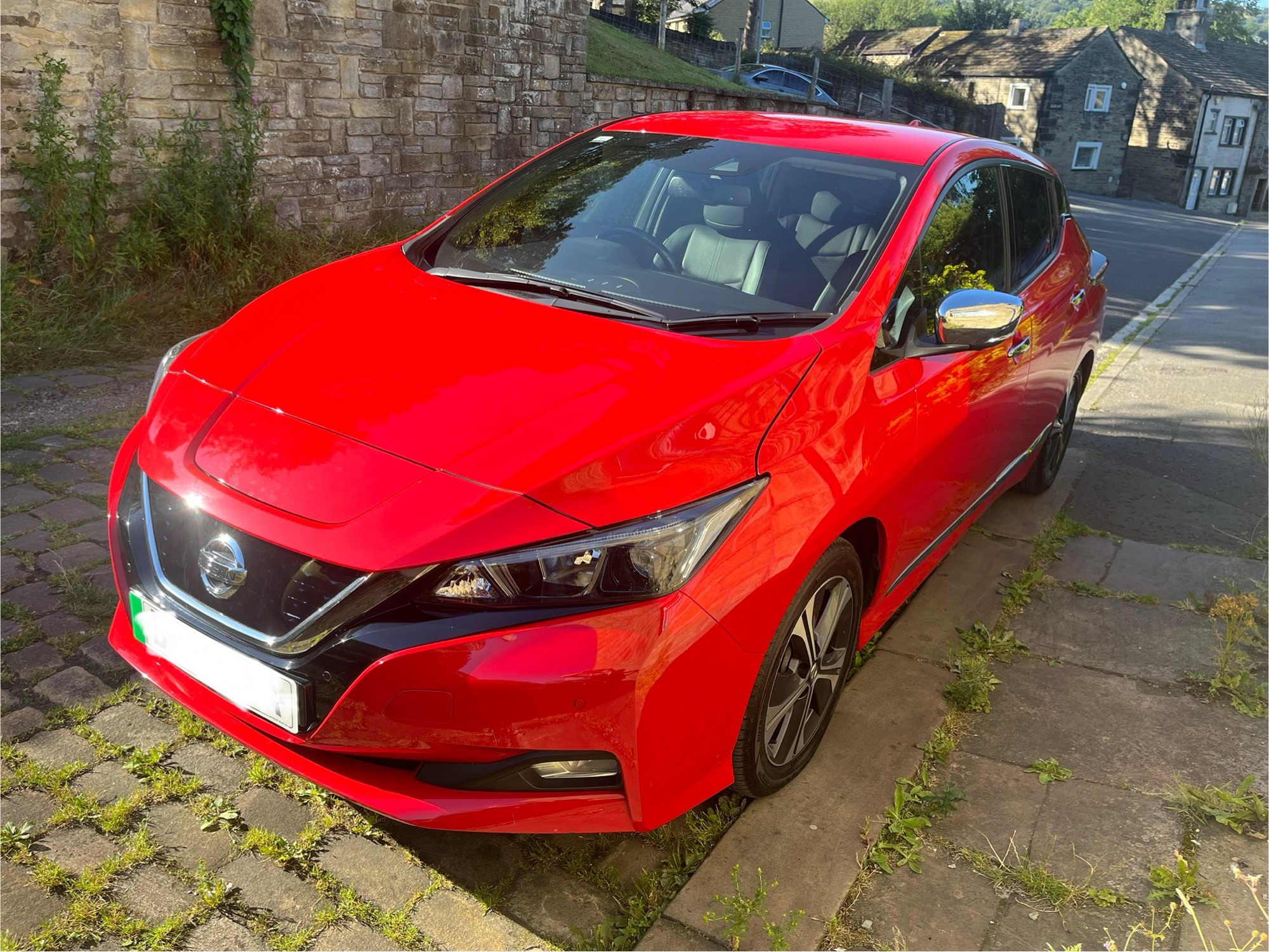
A photo of a red Nissan Leaf

Well, our journey towards an electric car is complete, as on Friday, we bought a new (to us) Nissan Leaf. It’s a second generation model, built in 2021, and replaces our diesel Peugeot 3008. It’s also our second Nissan, having previously owned a Nissan Note from 2015 to 2019.

Both of our previous cars have been around 6 years old when we’ve bought them, whereas this Nissan Leaf is less than four years old. It’s the ‘n-Connecta’ trim, so a mid-range model with a similar level of features to our Peugeot. Our local dealership also had a cheaper model with the ‘Accenta’ trim level, but we decided to pay more for the additional features that we were used to with the Peugeot.

Driving the Nissan Leaf

Like almost all electric cars, the Nissan Leaf just has one gear, so it drives like an automatic. I’ve only ever driven cars with a manual transmission before, and so this took a little getting used to. In particular, one quirk of the Nissan Leaf is the parking brake (i.e. handbrake) is foot operated, roughly where the clutch would be on a manual car.

The car has three driving modes: standard, eco, and e-pedal. Standard is best for motorway driving, giving you better acceleration at the cost of higher power usage. Eco is fine for day-to-day driving, but turning on e-pedal enables single pedal driving. That means that you press the accelerator pedal to go, and take your foot completely off the pedal to slow to a stop. As it the car brakes, the energy generated is then recovered to the battery – known as regenerative braking. As well as meaning you only need to keep your foot on one pedal most of the time, it’s also the most energy efficient way of driving.

Compared to the Peugeot, the steering is much lighter, and even in Eco mode, it’s got good acceleration. But most electric cars will accelerate faster than an equivalent car with an internal combustion engine.

In common with the Nissan Note, the legroom isn’t great when driving, but Christine finds it more comfortable to drive than the Peugeot.

Energy use

We’ve only had the car a couple of days, and have used around 40% of its charge across around two and a half hours of driving. This equates to about 40 miles. The Lithium-Ion batteries in most electric cars are less efficient in really hot weather, like what we’re currently experiencing in the UK as I write this. Therefore, you should keep your EV below 80% charged in hot weather (if you can). Indeed, when I picked the car up on Friday, the dealership had charged it to this level.

The maximum stated range of the Nissan Leaf is around 150 miles. That’s quite a bit less than our Peugeot, which could do around 400 miles on a full tank. And, of course, a key disadvantage of electric cars is that even a quick charge takes longer than fuelling a car with petrol or diesel. We’ll have to plan our longer journeys with recharge stops, although most motorway service stations include several quick charge points now. That being said, a quick charge should mostly recharge our Nissan Leaf’s battery in about 40 minutes.

Size

We deliberately decided to buy a smaller car than our previous Peugeot 3008. There are a couple of occasions each year, when the Peugeot’s extra capacity would be helpful, like holidays. But for 95% of the time, we were driving around a car that was bigger than we needed it to be. That’s a waste of fuel, and also makes it more difficult to park in narrow space.

Compared to the Peugeot 2008, the Nissan Leaf is around 5 cm (two inches) narrower, so parking should be a little easier. It’s also shorter in height, by around 10 cm (four inches). However, weirdly, it is actually longer – by around 30 cm (6 inches). It doesn’t look like it should be longer, but it is.

As such, the actual amount of space inside the Nissan Leaf is only slightly less than in the Peugeot. And on the few occasions that we may need extra space, we’ll considering hiring a roof box, which will also be easier to reach with the lower roof.

Charging

So far, I’ve only charged the car at home, using our dedicated Rolec EVO car charger. The previous owner of our car had set it to charge on an overnight schedule, so by default, it won’t start charging as soon as it’s plugged in. However, there is a dashboard button to over-ride this to start an immediate charge. Three lights appear on the dashboard, visible from outside the car, to show how charged the battery is.

On a ‘slow’ 7 KW home charger, expect a full charge to take around 6 hours. At present, I’ve knocked the current down to 16 Amps, so a full charge would probably take closer to 14 hours at this rate. This is where the equation to calculate power, voltage and current that you learned for GCSE Science comes in.

The Nissan Leaf supports two charging sockets. There’s a standard ‘Type 2’ socket, which only supports ‘slow’ chargers up to 7 KW, like our Rolex EVO. Then there’s a second ‘CHAdeMO’ socket, for use with supported fast chargers. Type 2 is essentially the European standard, and some public charge points only offer type 2 sockets, even for fast charging. Therefore, if we need to use a fast charger, we’ll need to find one that offers a CHAdeMO socket. Many do, but not all.

All the extra fancy gubbins

Being nine years newer than our previous car, our Nissan Leaf has lots of additional features:

  • Adaptive cruise control. I used cruise control extensively on the Peugeot and so pleased to have it on here. Combined with no need for gear changes, I can drive for longer without using any of the pedals with this on. ‘Adaptive’ means that it will slow down to match the speed of the car in front if needed, which I didn’t have before.
  • Built-in Apple CarPlay and Android Auto. Our Peugeot had the most basic entertainment system without a colour screen, so it’s nice to have these built-in. However, it only supports these over USB – if you want to use either CarPlay or Android Auto wirelessly, you need to buy a separate USB adaptor (sponsored link).
  • Heated seats and steering wheel. I suppose these will be useful in winter. Our nine-year-old seemed very keen on the idea of heated seats, until we pointed out that they still need to use a car seat until they’ve grown a bit more.
  • Remote start air conditioning and heating. Whilst the car is plugged in, you can use the Nissan app to remotely start the air conditioning or heating systems, so that your car is the right temperature before you set off. This also reduces the load on the battery.
  • Forward, rear and around view cameras. Our Nissan Note had no parking sensors whatsoever, whilst our Peugeot 3008 had standard rear parking sensors. The Nissan Leaf, meanwhile, offers a reversing camera, a forward camera, and ‘around view’ cameras. The around view gives you a top-down, ‘bird’s eye’ view of your car whilst reversing. This makes it much easier to park straight, especially if there are no white lines marking out the space. There’s also moving object detection.
  • Blind spot alerts. A small red light flashes on your wing mirror, along with an audible warning, if there’s something in your blind spot.

There’s a higher level of trim called ‘Tekna’ which adds a self-parking feature. That would have been lovely to have, but as we were buying used, we were limited to what was available at the dealership.

Compared to the Peugeot, the only things that I’m missing so far are:

  • The large storage box between the front seats (the Nissan Leaf has a smaller one)
  • The head up display, which showed the current speed and whether cruise control or the speed limiter was enabled.

The Nissan Connect app

The Nissan Connect mobile app allows you to control aspects of your car remotely, like checking its charge status or starting the heating or air conditioning. Alas, although I’ve downloaded the app, I can’t use it yet. The previous owner of my Nissan Leaf didn’t unlink the car from their account, and so I’m waiting for someone at Nissan to un-link it. Thankfully, the dealership gave me a copy of the DVLA ownership change confirmation and so hopefully that’ll be enough evidence.

Overall, we’re really happy with the Nissan Leaf. It’s easier to drive, easier to park, and should be much cheaper to run. I suppose it’s major test will be when we need to drive longer distances – like when we go on holiday next week.

Farewell to our old car

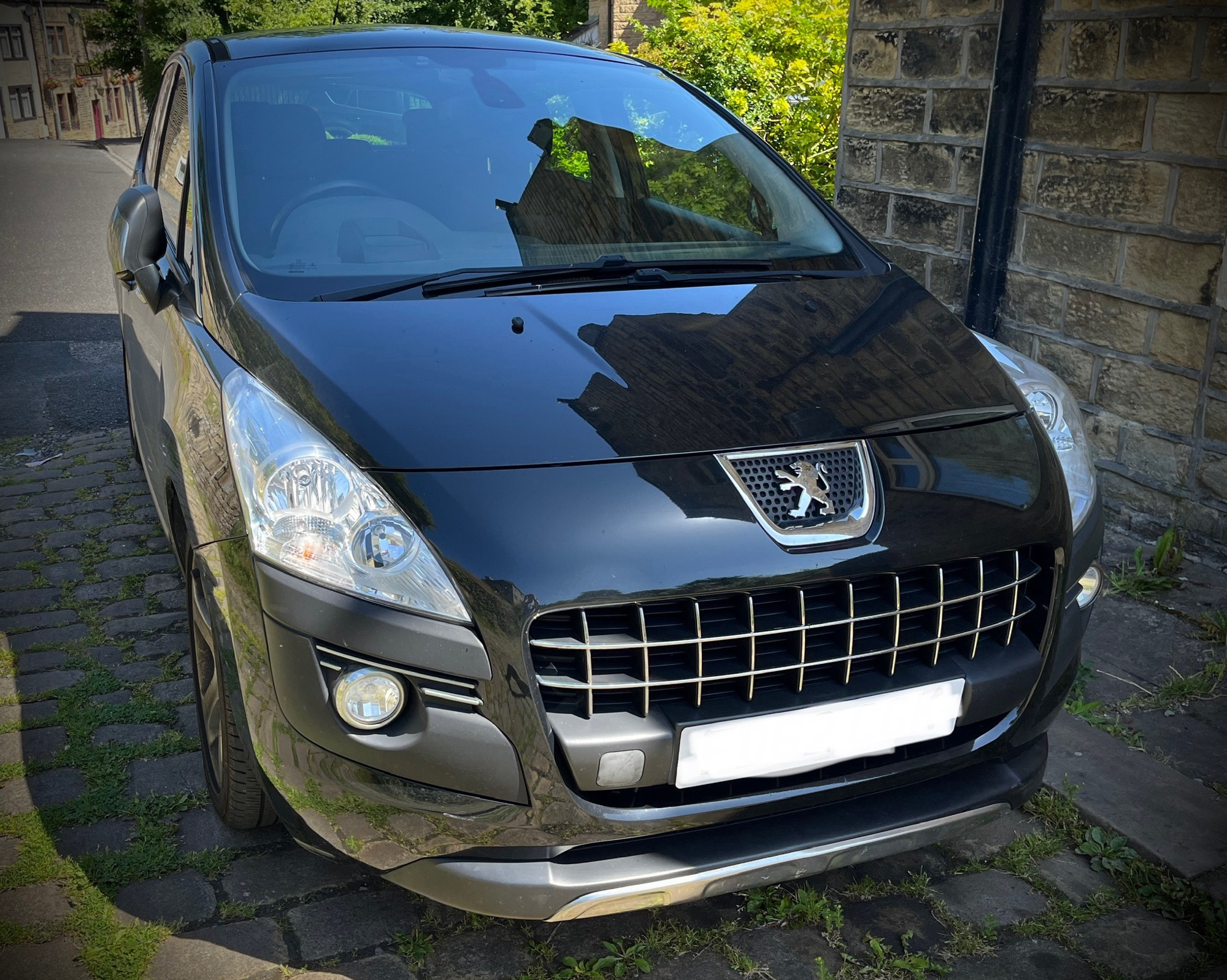
A photo of a black Peugeot 3008.

By the time you read this, we’ll have got ridden of our previous car, a black Peugeot 3008, after six years. We’ll have picked up our new electric car and I’ll write about that in future blog posts.

The Peugeot 3008 was our second car, and we bought it in 2019. It was not a planned purchase, but was necessitated by our previous car being written off in France. That car was a Nissan Note, bought in 2015 shortly after I passed my driving test. We were therefore limited by what we could get locally, and at short notice.

Trim and spec

As it was, the Peugeot 3008 has served us well. When we bought it, it was six years old and had clocked up around 80,000 miles in that time, which probably meant that it was cheaper than it would’ve been with a lower mileage. We didn’t expect to be able to buy such a large car within our price range.

In terms of trim, it was an ‘Allure’ model, which meant that it had some additional features. These included a transparent head up display showing your current speed, cruise control with distance alerts and dual zone climate control. However, it also had the most basic stereo system, with just a CD player, 3.5mm auxiliary port, FM radio and a single USB port which could be used as an iPod Dock Connector. It didn’t support Bluetooth at all. A couple of years ago, we added a free-standing CarPlay and Android Auto screen which helped, but also meant having various wires trailing across the interior.

Dirty diesel

The other big disadvantage of the Peugeot 3008 was that it was a diesel. At the time we bought the car, dieselgate was thought to just apply to Volkswagen vehicles, but it may well be that our car was affected. We’ll see what happens when the case against Peugeot finally makes it to court.

Its emissions mean that we would have to pay to access certain clean air zones, such as London’s ULEZ and the clean air zone in Birmingham. As it is, we’ve not needed to enter those zones whilst we have the car, but will be taking our new electric car into Birmingham’s clean air zone next month. Ironically, our previous Nissan Note would’ve been fine in the ULEZ with its petrol engine, despite being an older car.

That being said, it did have a six speed (manual) gearbox, and that sixth gear was great for motorway driving.

Getting expensive

I wrote last year about how keeping our car roadworthy was getting expensive. It had been in the garage for repairs four times in as many months, and would be back in again within a month.

What proved to be the turning point was finding a patch of rust on one of the doors. Getting this fixed would have cost a lot of money, and with the car’s mileage continuing to increase, we decided it would be beyond economic repair. There’s also a laundry list of other issues:

  • The tyre pressure monitor on one of the wheels has never worked in the six years we’ve owned it, and so the car beeps loudly at you after around 10 minutes of driving to tell you this.
  • Various squeaks and knocking noises, suggesting bits of the car are working loose.
  • The air conditioning hasn’t really worked in well over a year, despite being recharged.
  • It seems to burn out headlight bulbs quicker than it should do.
  • It’s always leaked very small amounts of oil, but it’s never been clear where it’s leaking from.

I spent about an hour yesterday getting our personal effects out of the car, which included £3.04 in change that had ended up in various nooks and crannies.

Trading it in

We are doing a part-exchange, so the value of the old Peugeot 3008 will be used as a discount on the new car. However, with our car now having almost 130,000 miles on the clock, it’s worth less than £1000. Indeed, the part exchange quote we got was about 10% what we spent on it six years ago.

It’s probable that the car will be sold at auction. After which, who knows. I wouldn’t be surprised if it’s stripped for useful parts and scrapped. It would be a shame, as it’s been a good car for us. It got us through the pandemic, and we’ve taken it on three holidays, including two in France. But unless someone is able to repair it cheaply, I doubt it’s worth much to anyone.

Incidentally, our old Nissan Note is still on the road, as far as we can tell. After we left it behind in France, the insurance company arranged for it to be collected and sold it to a car breakers. However, it looks like they fixed it up and got it back on the road, and it passed an MOT as recently as this May. I can only assume the breakage firm had enough spare parts to patch it up and sell it on.

Our journey towards an electric car – part IV

A photo of a Rolec EVO electric car charger mounted on a Yorkshire stone wall

Time for the fourth post about our journey towards an electric car. Part one, in May, introduced the series, and part two last month answered the questions ‘why’ and ‘why now’. Meanwhile, part three talked about choosing a home electric car charger. Today, I’m going to talk about the charger that we had fitted.

We decided to buy our car charger first, before buying an electric car, so that we would be able to charge it at home from day one. So, back in May, we had a new Rolec EVO charger installed on the outside of our house, by a local electrical firm.

It’s an untethered charger, as the charger is located in quite an exposed place. That means that we can put the cable away when not in use, and it’s at less risk of being stolen. It connects over Wi-Fi and Bluetooth; we chose a Wi-Fi model as it’s (just) in signal range of our router.

Around the charger socket is a ring light, which changes colour based on its status. As there’s no car plugged in, but it’s ready to charge, it’s flashing blue. It’ll turn green once a car is plugged in and charging.

The Rolec EVO app and OCPP

A screenshot of the Rolec Evo charging app on iOS

By default, the Rolec EVO uses its own app, which is fine. Within the app, you can start and stop charging sessions, and select the level of current to charge slower or faster. There are also the ‘Eco’ charging modes, which I’ll explain further down.

You can manage the Wi-Fi network that the charger is connected to (whilst connected via Bluetooth of course) and perform firmware updates – since we had this installed in May, there’s been a couple of updates released.

The Rolec EVO also supports OCPP, and so I could switch it over to a different platform. For older Rolec devices, the default platform is Monta (there’s a guide here) but others are available.

I may well consider switching to Monta, as there’s a Monta integration in HACS for Home Assistant. As yet, the backend for the Rolec EVO app doesn’t appear to have a public API. That means it’s not currently possible to add it to Home Assistant, other smart home platforms, or other electric car charging apps, unless you change to Monta.

Eco modes and schedules

As well as the big chonky electric cable that runs from your charger to your consumer unit (what most people call a fusebox), there’s a smaller cable attached. This connects to a CT clamp, that monitors your household electricity usage. If you put the charger in ‘Eco’ mode, then it’ll adjust the charging rate depending on how much power is being used elsewhere in the home. For example, if your oven is on, it might lower the current.

Eco+ mode is there for solar panel users, and so ensures that charging takes place when the sun is shining. That should save you money over using grid energy.

You can also set a charging schedule. This is helpful if you have an EV electricity tariff, which offers lower energy prices at set times of the day. That way, you can plug your car in, and then it’ll wait until the cheaper times kick in before it starts charging. We’re with Octopus (here’s my referral link), and they have two dedicated EV tariffs. One, ‘Intelligent Octopus Go’ requires you to have a certain model of car and a certain charger. It supports a lot of chargers, including other, older Rolec chargers, but not the newer EVO model that we have. The other, Octopus Go, simply offers cheaper electricity in the early hours of the morning. We’ll need to look into these once our smart meter is working again – you’ll need a working smart meter for both tariffs.

Future-proofing

I’ve mentioned that the Rolec EVO charger supports OCPP, so I can change to a different back-end system or run my own OCPP server. But it looks like it uses an Espressif ESP chip for Wi-Fi and Bluetooth, based on how it presents itself to my router. So it might be possible to put custom firmware on it in future. Having spent a four figure sum getting installed, I don’t think I’ll be looking at this anytime soon, but it should mean I’m in a good place if Rolec were ever to go out of business.

We just need a car now

So that’s the charger that we’ve had installed. Now we just need a car to plug into it. The good news is that we put a deposit down on a new electric car on Saturday, and will be picking it up at the end of the week. I’ll conclude the series once we’ve got it.

Our journey towards an electric car – part III

Time for part three of my series of posts about our journey towards buying an electric car. Part one, in May, introduced the series, and part two earlier this month answered the questions ‘why’ and ‘why now’.

Today, I’m going to focus more on point one from my ‘why’ post – being able to charge a car at home.

Granny chargers

When you buy an electric car, it’ll probably come with what is colloquially known as a ‘granny charger‘. This allows you to charge your car from a standard 3-pin socket, and gets its name for when you’re visiting your grandma’s house – the implication being that she doesn’t have a proper electric car charge at her house.

Granny chargers are okay to use occasionally when there’s no better option, but there are good reasons not to use them regularly:

  • The maximum power output is about 2.3 kW, which means your car will charge very slowly.
  • They must be plugged directly into a wall socket without using an extension lead, which may be awkward if you don’t have a plug within reach of your car. You may also need to have a window open to get the cable outside.
  • I’ve seen photos of plug sockets that have melted due to continual use with a granny charger.

Waterproof outdoor 3 pin sockets

You can alleviate some of these issues by having a waterproof outdoor 3 pin plug socket installed, which you can also then use for powering lawnmowers, for example. If installed correctly, and in the right place, there shouldn’t be any risks of melting/fire or the cables not being long enough. Indeed, my neighbour has chosen to go down this route for their hybrid car. Make sure that you get the socket professionally installed, of course.

However, this solution doesn’t alleviate the first issue, which is the slow charging. If you’re going to regularly charge an electric car at home, then you should invest in a dedicated electric car charging socket.

Electric car chargers

If you want to be able to charge your car more quickly and safely, then you’ll need to get an electric car charger socket installed. This is a box fitted to the outside of your home, that has a cable that you can plug into your car to charge it. Where it differs to a 3 pin socket is that it will have its own fuse in your consumer unit (fusebox) and will be rated for much higher energy use – up to around 7 kW. That means your car will charge more than three times faster with a dedicated home charger, than using a 3 pin socket. It’ll still be slower than some of the fast public chargers, but it will be cheaper.

Getting an electric car charger fitted can be quite expensive. When I’ve looked, the cheapest prices have been around £800, with £1000 to £1300 being the typical cost. This includes the cost of the charger unit and installation.

What to look for in an electric car charger

There are a number of different chargers available, from companies like Rolec, Ohme, Myenergi and Hypervolt that you may not have previously heard of. I’m not going to recommend one particular manufacturer, but here are a few points that I considered when choosing one:

Tethered or untethered

Some chargers are ‘tethered’ – in other words, they come with a permanently connected charger cable that you can coil up out of the way when not in use. The advantage of this is that the cable is included in the cost of the charger, and you don’t need to store it somewhere.

Untethered chargers have a socket for you to plug in your own cable, which typically isn’t provided and needs to be purchased at an extra cost. However, this does mean that you can put the cable away securely when not in use – I’ve heard of a couple of instances where tethered cables have been cut and stolen. If your charger will be in a more exposed place, maybe consider an untethered charger.

Wi-Fi or mobile data

Just about all electric car chargers include an app to manage charging. This allows you to monitor the charging process, and authenticate cars that are plugged in. After all, you probably don’t want any random car charging using your electricity that you pay for.

This means that the charger needs to connect to the internet. If your charger will be located some way away from your house, then you may wish to consider one that includes a mobile data SIM to connect to a cloud service. Otherwise, you can have one that connects to your home Wi-Fi network – but make sure that it’ll have a good signal before it’s installed. Some also come with Ethernet, if you have this available and want a physical network connection.

Some chargers also work via Bluetooth, which is fine over a short range, but not the most convenient.

OCPP compliance

I would recommend buying a charger that supports the Open Charge Point Protocol (OCPP). This is a common protocol for communicating between your charger and the cloud API. It’s an open standard, and means that you can potentially connect to different back-end servers if the one provided by your charger’s manufacturer is no longer available. Considering that chargers typically cost a low four figure sum and need to be professionally installed, you don’t want to be in a position where you have to replace a perfectly good charger simply because its manufacturer has gone bust.

You can, if you wish, host your own OCPP server – Home Assistant users can install one from HACS. That way, you’re not at all reliant on a cloud service for managing your charger.

Variable rate charging

I know I bang on about having solar panels, but it’s a key reason why we’re considering an electric car, as it’ll essentially allow us to charge for free at home. However, the maximum output of our solar panels is 4.8 kW, which is less than the maximum output of a typical charger. So ideally, you want one where you can set it to charge more slowly, so that you only use your own solar energy and not additional electricity from the grid that you have to pay for.

Some chargers will also use a CT clamp to measure home energy use and vary the rate of charging to match. If there are lots of high load devices running, such as ovens or electric showers, then the car charger can automatically lower the power draw and charge more slowly.

Chargers for on-street parking

If your house has a drive, where you can park your car away from a public road, then you shouldn’t have any issues getting a charger installed at home. If you don’t, and you park your car on a public road, then you’ll need to check with your local authority regarding their rules. Some may insist on a groove being cut in the pavement to fit the cable in, so that it isn’t a trip hazard. Others will flat out refuse, and insist that you use public charging points.

Companies like Edion will sell you a cable protector for around £50 which should ensure that your cable isn’t a trip hazard, and there are also plenty available from Amazon (sponsored link) too. As someone who is quite passionate about accessibility, I would urge you to consider one of these if you have to lay a cable across a public right of way.

Our journey towards an electric car – part II

Time for a second post in this series about our journey towards an electric car – part one was last week. This time I’m going to focus on the ‘why’ and the ‘why now’.

Why an electric car?

In less than five years, unless something changes, it won’t be possible to buy a new car solely powered by an internal combustion engine in the UK. From 2030, sales of new petrol and diesel cars will be phased out; there will then be a five year period where new cars must be fully electric, or hybrids. Then, from 2035, sales of hybrid cars will end too – so in ten years time, if you want to buy a new car, it will need to be electric. Or some other form of zero emissions vehicle that isn’t yet on the market.

Last year, around 20% of new UK car registrations were for electric cars. And, more and more public chargers are becoming available for electric car owners to use.

That’s the wider context. For us personally, an electric car makes sense for the following reasons:

  1. We’ll be able to charge it at home. Being able to charge an electric car from your own electricity supply is pretty cheap – especially if you have a tariff that gives you cheaper overnight charging for example. Currently, I work at home 2-3 days per week, and so we can have our car plugged in for long periods to charge up if needed. And we generate our own electricity from our solar panels.
  2. Most of our usage is short distance. Whilst we occasionally drive longer distances, most of our usage is for short journeys, and so we don’t necessarily need a car with a massive fuel tank or battery.
  3. It’ll be better for the environment. Electric cars aren’t totally emissions free – you still get particulate matter from the brakes and tyres emitted into the air. But you’re not burning a fossil fuel, and the UK electricity grid is become more sustainable all the time.
  4. It’ll be better for air quality. Where we live, in Sowerby Bridge, is a hotspot for poor air quality due to being in a narrow valley. By driving an electric car, we’d be no longer contributing to this.
  5. It’ll be quieter. Traffic noise isn’t a major issue for us, but just imagine how much quieter the roads would be without noisy engines. Also, as I have issues with hearing loss, less noise inside the car should make it a nicer driving experience.
  6. It’ll cost less to service. Compared to cars with an international combustion engine (whether on its own or as a hybrid vehicle), electric cars have fewer moving parts and consequently require fewer repairs.
  7. We won’t have to pay the ULEZ. I’m not planning to drive in or near London any time soon, but our current car would incur a charge under the Ultra Low Emissions Zone. Whilst many petrol cars are exempt, an electric car is likely to remain so if the criteria change. It used to be that electric cars were also exempt from vehicle tax, but that’s no longer the case.
  8. No gear changes. Compared to other nations, especially the US, us Brits have a weird obsession with buying new cars with a manual transmission, rather than automatic, and that trickles down to the used car market. Meanwhile, almost all electric cars only have one gear – electric motors work differently and so don’t need to have gears. Therefore, no gear changes. I think Christine was a bit cheesed off when she found out that she could’ve learnt to drive in an automatic instead, but at least it means she can drive our current car until we change it.

Why now?

As for why now, the key reason is that we need a new car soon. Our current car has lots of minor niggles that are starting to get annoying, and are likely to be costly to repair.

But also, more electric cars are starting become available on the used car market. We can’t really afford to buy a new car, but there’s a reasonable number of electric cars available in our price range. Whilst the capacity of the batteries does go down over time, we’re still happy to consider a used electric car.

Our journey towards an electric car – part I

Christine and I have decided that we’re going to get a new (or rather new to us) care in the next few months, and we’ve decided that it’ll most likely be an electric car.

Last March, I talked about how our current car was starting to get expensive. It had been in the garage four times in as many months, and April made it the fifth consecutive month to clear the particulate filter. Since then, it’s been behaving itself a little better – so far, it’s only been in the garage twice this year. But there are still some issues. There’s various squeaks and knocks that, whilst not seemingly affecting our ability to drive it, are starting to get annoying. The air conditioning system doesn’t work any more – on a hot day, it just emits hot air. And, throughout the whole six years we’ve owned it, the tyre pressure monitor hasn’t worked properly.

More recently, we’ve noticed a patch of rust on one of the doors. Getting that fixed is likely to be expensive, and it’s getting to the point where I don’t want to throw more money at the car. I’d rather save it, and use that money towards buying a newer car.

Going electric

I’ve deliberately made this ‘part one’ of a series, as I have a few blog posts in mind between now and after we finally get a new car. When I say ‘new’, I mean ‘new to us’ – I doubt we’ll be buying a brand new car. We also haven’t decided on a particular make and model, but what we have agreed is essentially the following:

  • It’ll be roughly the same size, or smaller than our current car.
  • It’ll be electric, or a plug-in hybrid.

We want a smaller car, because our current car (a first-generation Peugeot 3008) can be a pain to park sometimes. And 95% of the time, we don’t need such a big car – we’re just burning extra diesel to carry excess air around. For the times when we do need more space, we’ll look at buying a roof box instead.

We’ve also decided that it’s about time we made the jump to an electric vehicle. We have the ability to charge one at home (more in that in a future blog post in the series) and, as we have solar panels, we’ll be able to do so very cheaply. Plus, more electric vehicles are becoming available on the second-hand market, so we’re more likely to be able to afford to buy one.

Like I said, I’ll be posting more about this in future blog posts over the summer – especially once we’ve bought the car.

Six port car charger review

A photo of a six port car charger in my car

With us having guests in the car for a long journey, I’ve recently bought a new USB car charger to go in the back of our car. Unlike others that I’ve bought in the past, which offer 2 or 3 USB ports, this offers six.

It’s currently on sale on Amazon for £13 (sponsored link), but I picked mine up cheaper elsewhere. There are two USB-C ports with Power Delivery, and then four USB-A ports. Of these four, there are two standard ports which offer 3 amps, and then a green one and an orange one, which support various proprietary quick charge specifications. I’m already using one of the USB-C ports for my CarPlay unit in the front, on a long cable.

Above the ports is a three digit display, which shows the current voltage coming in to the charger. This should nominally be 12 volts, but as you can see in my photo it’s higher at 14.4 volts. Should it go higher than 14.8, or below 11.6, that would be a cause for concern. The whole thing also glows blue when the engine is on and it has power.

Apparently you can’t use all six ports at once – the maximum is five. However, it’s apparently capable of quite high wattages. Whilst I’ve always known it as a ‘cigarette lighter socket’, the official name is the Automobile auxiliary power outlet, and the maximum current can be as high as 10 Amps. As such, 120 Watts is possible, assuming a 12 volt supply (see, I remember what I learned in GCSE Science). In practice, the maximum power from any one port will be around 60 Watts, but that’s still enough to charge a laptop.

For what it’s worth, I haven’t found any chargers offering more than six ports, so this seems to be the maximum. In the front of our car, we have a much smaller two port USB car charger, with one USB-A and one USB-C port. The location of the auxiliary power outlet, which is right next to the gear stick on the driver’s side, means that I prefer a smaller, low profile charger that doesn’t get in the way. Still, this means we have 3 USB-C and five USB-A ports available in the car.

Our car dates from 2012 and so it only came with one USB-A port built-in – I haven’t included it as it’s a 0.5A port and therefore a bit useless for charging. Also, if I plug my iPhone into it, the car stereo instantly starts playing the first song in my iTunes library, which is ‘Nothing’ by A. More modern cars presumably have many more USB ports, and I can see the cigarette lighter sockets becoming less common. Not least because it’s illegal to smoke cigarettes in a car with children in it in the UK, and barely anyone smokes nowadays anyway.

Cheques, postal orders and the DVLA

If you want to change your name and photo on your GB driving license at the same time, then, as I write this in November 2024, you have to pay the DVLA by cheque or postal order. You can’t pay online using a credit or debit card.

Indeed, there’s a number of reasons that you may need to pay money to the DVLA, and can currently only do so by posting a cheque or postal order. You may have passed your driving test in another European country, and now want a GB driving license. Or, you may need to get your license back after being disqualified from driving (for the absolute avoidance of doubt, no, I have never been banned from driving and have a full clean license). In all of these situations, it’s not possible to pay online.

As I mentioned in my blog post a couple of months ago, frustratingly there’s still a need for paper bank statements, and, it seems, cheques. Sure, almost every bank, including online-only ones like Starling, Chase and Monzo let you pay in cheques by scanning them into their apps using your phone. But what if you need to write a cheque for someone else? Online-only accounts do not seem to offer any way for their customers to pay by cheque.

It’s not a much better situation even if you do bank with a ‘traditional’ high street bank. I switched to a new bank account earlier this year, and whilst I got a new debit card through the post, I wasn’t issued with a chequebook as standard. And that should be fine – the last time I remember writing a cheque myself was about nine years ago. Most places accept bank transfers by BACS if they don’t accept credit/debit cards or cash. Sure, I can request a chequebook, but then the bank will need to print and dispatch it to me by post.

Postal orders

Thankfully, the DVLA also accept postal orders. In my 22 years of adulthood, I have never needed to request or send a postal order, but they have been around for years. Originally, they were a way for people without bank accounts to send money by post, in a way that means that only the named payee can use it.

To get a postal order, you go along to a local post office, tell them who you are paying and how much the postal order is for, and then pay cash, plus a fee. For £10-£99, there’s a 12.5% fee, and a fixed fee of £12.50 for postal orders of £100-£250. They’ll then print you a postal order which you can pop in your envelope to the DVLA, or whoever else you need to pay.

It’s certainly a solution if you don’t have a chequebook, but, as mentioned, you have to pay an extra fee on top which you wouldn’t pay using a cheque. Plus there’s the cost of getting to a Post Office if one isn’t local to you.

Ideally, the DVLA will drag itself fully into the 21st century, and enable more tasks to be completed online with card payments. But until then, some of us are stuck using cheques and postal orders.

How many parking apps do you have?

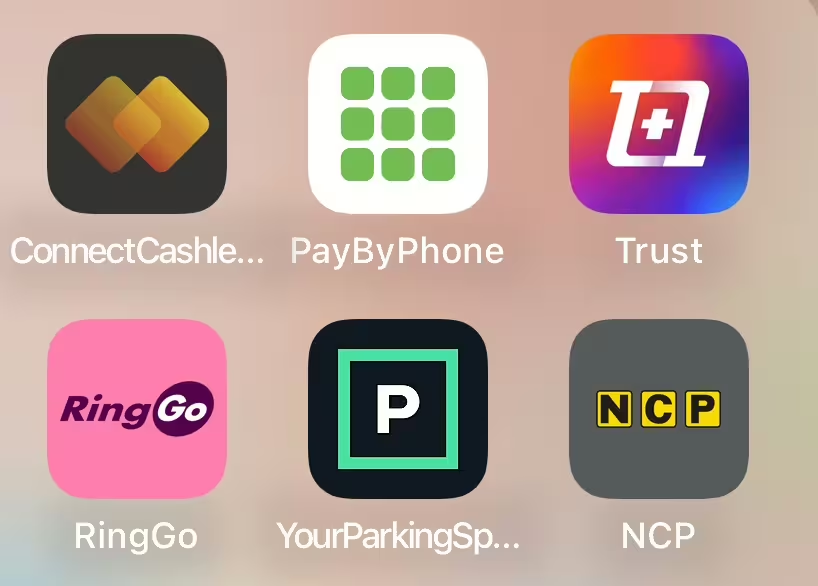
A screenshot showing the icons for six different iOS apps used for parking.

I was chatting to a friend last week as he downloaded and installed yet another app to pay for parking his car. He already had eight different apps to pay for parking on his phone, and yet the one used by this car park wasn’t one of them. So now, he had nine different apps installed to pay for parking.

I had a look at my own phone and counted six parking apps: Connect Cashless Parking, PayByPhone, Trust, RingGo, YourParkingSpace and NCP. And, from memory, I’ve used five out of the six over the past month; NCP is the only one that I don’t use regularly.

Then there are those that I’ve uninstalled – Flowbird, AppyParking and APCOA Connect. APCOA Connect seems to use the same database as Connect Cashless Parking thankfully, and I’ve only had to use the Flowbird app once for one specific car park. AppyParking was used by our local authority for a while but has been replaced with APCOA Connect/Connect Cashless Parking, and I haven’t needed to re-install it.

The convenience of parking apps

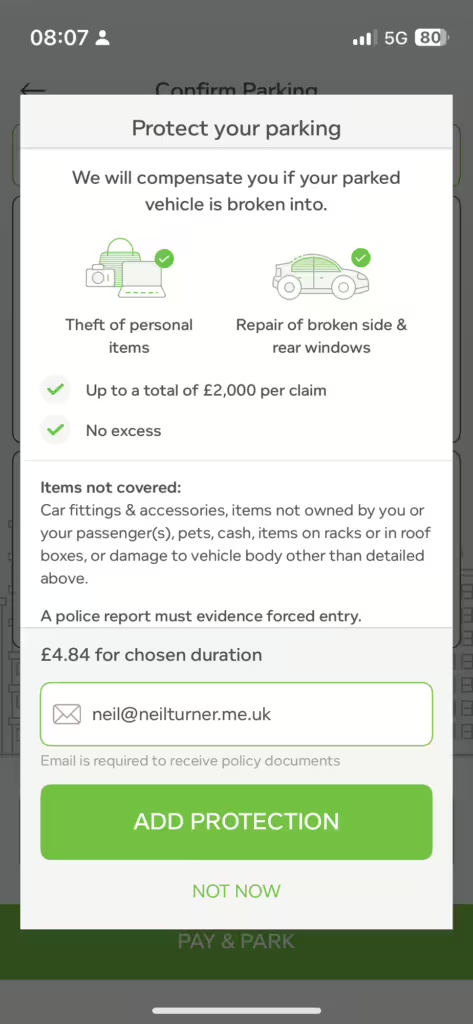
A screenshot from the PayByPhone app offering additional insurance for £4.84 as an upsell.

Parking apps are a convenience. I tend to carry very little cash around, and frequently have no change for a ticket machine, so the apps allow me to make a card payment. They also remember your details, such as your car’s registration number, and so they can be quicker than using a machine.

Some apps, like Trust and MyParkingSpace, offer automatic payments in supported car parks. Automatic Numberplate Recognition (ANPR) cameras record entries and exits, and I get emailed a receipt based on the time spent there. It’s not widespread but it’s useful where it’s available.

Parking apps headaches

But the fact that there are so many of them, with different interfaces, is a faff. You have to register an account with each one, and not all of them support Apple Pay or Google Pay so you need to enter your card details each time. And there’s usually a ‘convenience fee’ thrown in; sometimes, as little as 8p but one car park I use regularly adds a 15% fee on top of the parking price for using the app.

There’s also the upsells – what Cory Doctorow may call ‘Enshittification‘. Every time I use the PayByPhone app, which is typically 2-3 times a week on the way to work, I have to decline additional insurance to cover my car whilst it’s parked. What’s worse is that the parking itself only costs £2 – the insurance is a 250% mark-up. I guess some people could find it useful as there’s no excess and it could avoid claiming on your own car insurance, but there’s no way to disable these prompts in the app. You have to opt out every time you park, and of course, the ‘not now’ button is smaller and less prominent. Meanwhile YourParkingSpace flogs a load of offers at you after you’ve parked.

And there’s the issue of how big these apps are. The Flowbird app is almost 200 MB, which could be 20% of someone’s monthly data allowance if they had to download it on mobile data.

Consolidation

I mentioned that Connect Cashless Parking and APCOA Connect use the same database and are therefore interchangeable, but every other app only works with certain car parks. Annoyingly, this is even the case where there’s a common parent company. Connect Cashless Parking, for example, is owned by PayByPhone, but you can’t use the PayByPhone app to pay for parking at APCOA Connect locations. Similarly, MyParkingSpace was taken over by Flowbird two years ago, but there’s been no integration of the databases and so you may need both apps.

This is why this blog post isn’t ‘which is the best parking app?’ because, as consumers, we don’t get to choose. The choice is made for us, by whoever owns or operates individual car parks. Right now, those owners and operators have plenty of parking apps to choose from, but whatever choice they make is then imposed on their users.

One parking app to rule them all?

Whilst I’m sure it would be very low down on the new government’s priorities, it would be great if there was just one, national app that we could all use. To encourage adoption, there could be new legislation mandating local authorities to use it once their existing contracts have finished. It could also offer onward travel options, such as bike hire, or even public transport to encourage park and ride schemes. And there could be an open API to allow some of the third party apps to continue to use it, with some kind of payment reconciliation for private car park owners.

That way, you could view all of your parking receipts in one place – great for people who may need to claim expenses – and not have to faff around with downloading a new app each time you park up. Hopefully, such an app would also be designed with best practice in mind, and not offer annoying upsells each time. I know this is very much a first-world problem, but we can dream, can’t we?

Creative Commons License
Except where otherwise noted, the content on this site is licensed under a Creative Commons Attribution-ShareAlike 4.0 International License.