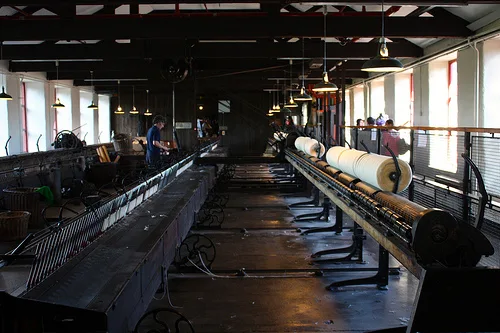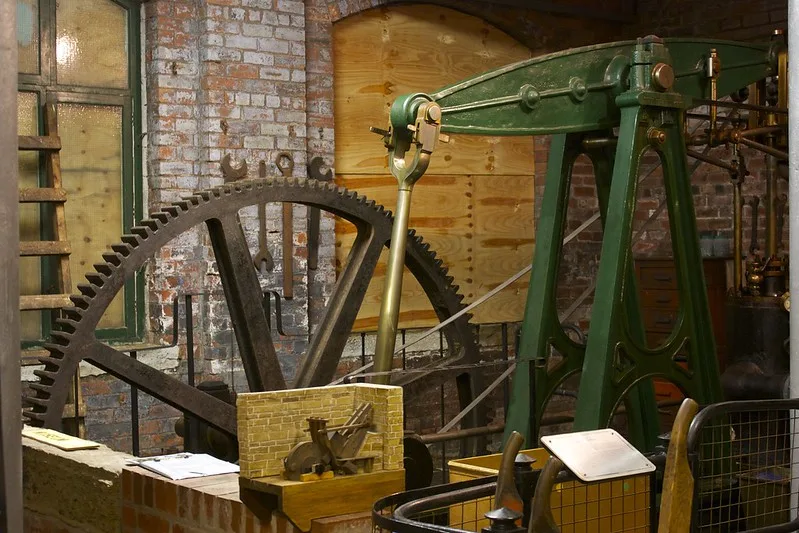
Visiting Harrogate

Harrogate Royal Pump Rooms Museum

Today Christine and I took advantage of the fact that we both had annual leave and went on a day trip to Harrogate. Unfortunately it was rather cold, wet and very windy, so it wasn’t the most enjoyable visit.

We visited the Royal Pump Room Museum, which is built above two of Harrogate’s famous wells and charts the history of the town. It’s a nice little museum in an interesting building, which takes around an hour to get around. Oddly there’s also a small exhibition of Egyptian artefacts there as well.

No visit to Harrogate would be complete without a visit to Betty’s. Admittedly Betty’s isn’t unique to Harrogate; there’s two in York, one in Ilkley one in Northallerton and a second tea room and tea house at RHS Harlow Carr, but unlike the team rooms in York the queue for lunch isn’t usually snaking out of the door and around the block. In fact, we could pretty much walk straight in when we visited at midday today, although it was, of course, a Monday in February – not exactly peak tourist season.

I like Harrogate because it has character, and many of its Edwardian and Victorian buildings have been well-preserved. We don’t go there very often, as it takes a good two hours to get there by train from Sowerby Bridge, but it’s a nice day out.

Some of the photos that I took are already on Flickr. I also uploaded several from our last visit in May 2010, as apparently I didn’t upload those at the time. Which makes me wonder what else I haven’t uploaded to Flickr over the years.

People’s History Museum

People's History Museum

Today we took the time to visit the People’s History Museum in Manchester. I actually hadn’t heard of it until yesterday, when we were looking for something to do as a couple having spent all of yesterday playing games (me, World of Warcraft; Christine, Guild Wars) and not really spending much quality time together.

The museum has been around since 1990, and was originally called the National Museum of Labour History. Indeed, there is a large focus on the history of workers’ rights, the rise of trade unions and the foundations of the Parliamentary Labour Party. That being said, it covers a wide range of subjects, especially the history of democracy in the UK. And Manchester is an ideal place for it, as it was the scene of the 1819 Peterloo Massacre, and the historic home of the Co-operative movement is nearby in Rochdale.

It sits in two buildings: the first is a modern extension, opened in 2010 and housing the main body of the museum. The other is the older Pump House building which was one of the three pump houses for Manchester’s Hydraulic Power system, for which there is an exhibition at MOSI about it. The Pump House holds the two temporary exhibition spaces, and when we visited there was a photography exhibition about the Oldham Road, and a special exhibition about the Temperance movement – again, a political ideology with strong northern roots. Pleasingly, the museum’s café stocks a range of temperance drinks, albeit alongside beer.

I found it really interesting, although it does have a rather left-wing political agenda. To me that’s not a bad thing but I could imagine some Tories feeling uncomfortable there. I actually learned a surprising amount of things that I wish I’d been taught at school, about this country’s history.

The museum is free to enter (donations welcomed) and is open most days of the year, although I’d advise against visiting next week as one of the permanent galleries is closed to rotate some of the exhibits. For once, I’ve already uploaded the photos to Flickr, as well as others that I took elsewhere in Manchester today.

Bicester Village

Bicester Village

Today we went to Bicester Village, an outlet shopping centre in Bicester, Oxfordshire, whilst visiting relatives. It’s one of a number of outlet shopping centres, where shops sell off old, excess or seconds stock at discount prices. However, Bicester Village is somewhat posher than others.

By this, I mean it has shops from the likes of Gucci, Alexander McQueen, D&G, various Saville Row tailors, and other luxury brands that are normally the preserve of the ’1%’ who can actually afford these. If you’re happy with buying something that isn’t quite perfect, or from last season, then you can bag a significant discount.

Of course, despite these discounts, pretty much everything was still well out of our price range. Hooded jumpers for over £300 for example – and that’s a reduced price. In the end, we just bought some cheese and pasta from Carluccio’s and retreated to Starbucks for a coffee to warm up.

Visiting on a Sunday in the run up to Christmas meant it was very, very busy, although we got there before 11am so there were still a few parking spaces (top tip – use the car park next to Bicester Town railway station as it’s quieter). Sunday trading laws meant that some of the larger shops couldn’t open until 12pm, and when we went past just before then there was a queue of at least 100 people waiting to get into the Polo Ralph Lauren shop. This is despite it being one of three shops in the centre, and not the only brand to have multiple outlets – there were a couple of Calvin Klein shops as well, amongst others.

Also notable was that many of the signs were both in English and Chinese, and that UnionPay, a major card system in China akin to Visa and MasterCard, was accepted by many of the shops there. Hence there were many Chinese tourists shopping when we visited, although we heard a number of other foreign languages being spoken, and there was a wide variety of left hand drive luxury cars in the car park.

As a Northerner who doesn’t have a huge disposable income, coming to a place like this was profoundly weird, and from a social anthropology perspective it shows just how wide the gulf between the ‘haves’ and ‘have nots’ is in this country. Many shops did not have anything for sale under £100 per item, and yet neither me nor most people I know would pay those sorts of prices, even though they’re already discounted. Whilst this sort of place isn’t quite for the ’1%’, it’s certainly aimed at those in the 99th percentile. I’ll stick with my Marks & Spencers clothes.

Rushbearing in Sowerby Bridge

Sowerby Bridge Rushbearing 2012

This weekend, like every first weekend in September, is the annual Rushbearing festival in my adopted home town of Sowerby Bridge. It’s a modern revival of a tradition which originally saw freshly harvested rushes being delivered to churches in the area to cover the floors. Although it died out in the 19th century, it was revived in 1977 to celebrate the Queen’s Silver Jubilee. 35 years later, in the Queen’s Diamond Jubilee year, it is still going.

The modern event takes place over two days – the Saturday and Sunday of the first weekend in September. It involves local men pulling a one (imperial) ton cart around the town to deliver a token rush to each of the town’s churches. The cart also calls at most of the town’s pubs, of which there are a lot – 14 just in the town centre itself. Essentially, this makes the rushbearing a large and very glorified pub crawl, and indeed many of the participants carry a tankard. In fact, there are even several tankards attached to the cart itself.

The same cart is used every year, and this one was built in 1984. A ‘cart maiden’, usually an 18-year-old girl, sits atop the cart and waves at people. Behind the cart is usually a marching brass band and several traditional British dancing groups – usually Morris Dancers, but in various different forms.

Last year we missed the Rushbearing as it was the same weekend as Bingley Music Live. But with the somewhat lacklustre line-up, increased ticket prices, and the need to save money for our forthcoming nuptials, we decided not to go this year. This gave us chance to experience a rather different festival closer to home. Although I’m sure the nice weather helped, it was well-attended with many people turning out to line the streets, and patronise the various drinking establishments that the cart called at en route.

Modern-day rushbearing isn’t unique to Sowerby Bridge and it does take place at other northern towns and villages, although these are all in Greater Manchester, Lancashire or Cumbria; Sowerby Bridge is the only Yorkshire town to retain this custom. For a town that is home to yuppie commuters like ourselves, it’s nice to see it keeping in touch with some traditions.

There’s more about the tradition of rushbearing on Wikipedia, and a more detailed history of Sowerby Bridge’s festival on the official web site. And you can view my photos of the event on Flickr.

Creswell Crags

DSCF0264.JPG
Photo by branestawm2002, released under a Creative Commons License. My own photos will follow later…

Last weekend Christine and I visited Creswell Crags on the border of Nottinghamshire and Derbyshire. It is a limestone gorge with various caves along the sides, in which evidence for occupation by human ancestors during the ice age has been found. They are also the only caves in the UK to have cave art on the walls, which was only formally discovered in 2003.

The gorge itself was a beauty spot in Victorian times, and various archaeological excavations have taken place since then. Many of the finds are now in a museum and visitor centre, to the north of the site, which we also visited, and this organises tours of two of the more interesting caves. The caves are normally closed to the public, so it is only by going on the tours that you can see the cave art, which are simple animal depictions carved into the rocky walls of the caves. There’s possible evidence that these were painted at one time, like in other caves in continental Europe (I visited Lascaux, or rather the mock-up at Lascaux II, back in the 1990s), but nowadays just the carvings are visible.

It’s a very interesting site, and the museum explains how the area was in different periods in time – before the last ice age, there would have been hippos in the water and hyenas hunting. The museum was opened in 2009 and is an interesting piece of architecture in itself, and has the ubiquitous café and gift shop.

It’s worth a visit – you can wander around the gorge itself for free, but the tours inside the caves and the museum cost money – up to £13 for adults to do both tours, although this is valid for a year for any repeat visits. There’s a picnic area if it’s a nice day, and the gorge is very pretty.

Newby Hall

Newby Hall

Over the Mayday weekend, Christine and I went to Newby Hall with my parents. It’s a privately owned manor house, which, along with its extensive gardens, is open to the public. I used to go there a lot when I was younger as there’s a brilliant adventure playground for kids, but this was my first visit there in a long time.

I’ve uploaded the photos that I took to Flickr. There’s a miniature railway with a train in the colours of UK train operator Grand Central, which was a little amusing, and at this time of year there are plenty of gorgeous flowers. Plus there’s a very nice farm shop as well.

It’s not quite as impressive as Chatsworth, but it’s still a good day out, and caters for almost everyone.

RailFest 2012

Sir Nigel Gresley and Tornado

I went to RailFest 2012 at the National Railway Museum yesterday. As it’s still on until Sunday, I’ve decided to write about it now, just in case you have time to go and visit.

Firstly, if you’re not normally interested in trains, then, to be frank, RailFest probably isn’t for you. In essence, you have several items of the NRM’s own collection, mixed in with some visiting trains, both old and new. This is great for train geeks like me, but not so great for those without a passion for rail travel, like Christine, who did not accompany me on this occasion.

You can go onto the footplate, or into the drivers cab of many of the trains on show, and there are plenty of volunteers around to talk with you about the train. Plus, every train on show has an information board, with many answering the question ‘Why is this here?’ as some locomotives are notable. There’s Sarah Siddons, a Metropolitan Railway locomotive preserved by London Underground which is now Britain’s oldest working electric locomotive. Or a class 43 High Speed Train locomotive called 43159, which was part of a pair of locomotives that set the official world speed record for a diesel locomotive, and which is still in regular revenue service with First Great Western. And next to it is 41001, the sole remaining prototype locomotive for the High Speed Train which has just commenced restoration. And then there are the more well-known locomotives – both Mallard and Sir Nigel Gresley were available for footplate talks, as was Tornado, a steam locomotive built in 2008 to original LNER designs.

But in a way it was nice to be able to get up close to some of the trains that we see every day, or look behind the scenes in places where passengers don’t normally go, like the drivers cab. It was particularly interesting comparing the cab of 41001, which dates from 1972, with the cab of one of the Class 395 Hitachi trains which operate on High Speed 1 for Southeastern’s domestic high speed services (and the Javelin services for the upcoming Olympics) which were introduced 37 years later in 2009. Both seem to have a similar number of buttons and controls but the latter could do so much more.

There were also a number of train rides available on standard, narrow and miniature gauge trains, although I didn’t take this up even though they were included with the entry price – £13 for all day if bought in advance online. The site was quite busy, especially in the afternoon, and, unsurprisingly, most visitors were older men with cameras and excitable young boys. The museum itself is open as usual, and remains free to those who aren’t interested in RailFest.

If you are going, allow at least 3 hours for RailFest alone, on top of any time you want to spend in the rest of the museum. I’d also advise bringing your own food as the catering on the RailFest site is extortionate (best part of £10 for a cheeseburger, chips and a bottle of cola). And also think of lots of questions to ask, as the volunteers are more than happy to answer them. It’s well worth the visit.

Being a tourist

Helmsley Castle

I spent the weekend being a tourist, twice in my home town of York. York is a city that, since I no longer live there, I have actually come to appreciate more. Whilst growing up there you took the historic buildings for granted, and the hordes of guided tours just got in your way. But now I see the city in a very different light.

On Friday afternoon, we spent a bit of time at the National Railway Museum – one of my favourite museums as a child, but my last visit was in 2007 (although I blogged about it last year). The main attraction is the return of Mallard, which spent many years in the main hall at the museum but was recently sent to the Shildon Locomotion Museum in County Durham; however, it’s in York on a brief visit and presently takes pride of place on the main turntable. The museum is undergoing a lot of renovation at present, which includes a new entrance hall, so there are fewer attractions than normal – the station hall in particular was rather sparse, which was a shame.

On Saturday, we eschewed York and headed up to the small market town of Helmsley, on the edge of the North York Moors National Park. In particular, we visited Helmsley Castle, parts of which date from the 12th century but has been mostly ruined since the British Civil War in the 1600s. It’s now looked after by English Heritage, and for a little under a fiver each for adults you can spend a couple of hours wandering around. There’s also a museum section, which shows some of the finds that have been excavated as well as information about the castle’s history and how it would have looked over various key periods in its history.

Finally on Sunday we went back into York city centre, partly for some sightseeing but mostly for shopping, for which York is very good. Whilst there aren’t many large branches of chain stores (with the exception of a large Marks & Spencer, split across two sites), there are plenty of smaller shops and thankfully most don’t sell tourist tat. There’s now a sausage shop on The Shambles, and we also called in at Betty’s for some of their fondant cakes which change regularly. We were hoping to go to the Jorvik Viking Centre – again, despite living in York I haven’t visited this in nearly 20 years – but it’s rather expensive unless you make a day of it and go to the other museums (DIG, Barley Hall and Micklegate Bar Museum) – a £16 ticket lets you into all four.

In a way, it’s refreshing to be a tourist in your home town. You can take time to go to the places that you walk past every day, and maybe discover things that you never knew existed. At the same time, you have the advantage of knowing your way around and knowing the best places to eat, or what to avoid. Whilst not every town is set up for tourism, if yours is, give it a try. You can even do it in places like Bradford.

Wakefield and the Hepworth Gallery

Hepworth Gallery

On Saturday, Christine and I went to Wakefield, to visit the Hepworth Gallery, a new art gallery and museum built to house the collections of Barbara Hepworth, along with some works by other artists and sculptors inspired by her. The gallery is located next to the River Calder and is in easy walking distance from Wakefield Kirkgate station. Despite costing £35million to build, entry is free, and you can easily spend a couple of hours here.

The architecture of the building is interesting – it’s a thick concrete shell in the 1960s brutalist style, but with a clever use of windows to let in a reasonable amount of light. Of course, the thick concrete walls mean that you probably won’t have a working mobile phone in here.

I didn’t take any pictures inside as photography isn’t allowed (being modern art, most of the works are still under copyright restrictions) but I did take plenty out and around the gallery. It’s sited in an area of Wakefield that is in need of regeneration, so hopefully this will act as a catalyst to get people and businesses into the area.

Chantry Chapel of St Mary the Virgin

Across the road is Wakefield Bridge and the Chantry Chapel of St Mary the Virgin, a 14th century chapel on the bridge itself – one of only four in such a location and the oldest surviving example. Although it’s around 650 years old, it is still regularly used for church services. Certainly worth a look if you’re about.

Although I’ve lived in Yorkshire all my life, this is the first time I’ve been to Wakefield, bar passing through on the train, and so we went into the town to have a look around. Parts of the city centre are very run down, although work is going on to regenerate it, including the new Trinity Walk shopping plaza which, like the Hepworth Gallery, opened a few weeks ago. It ties in with a refurbished market, with a striking overall roof.

The city, which is the smallest of the three in West Yorkshire, still has some way to go before it’s looking as nice as Leeds city centre. In particular, the smallest of its two railway stations, Wakefield Kirkgate, was described by the previous secretary of state for transport Lord Adonis as probably the worst ‘medium-large’ station I have seen in Britain[source], and having seen it for myself I can see why – those buildings that are still standing are boarded up, it’s dirty, there’s no staff around, there’s paint peeling off the walls and just looks generally dilapidated. Not a nice welcome to the city. The other station, Wakefield Westgate, whilst not the most pleasant of stations, at least has some amenities and a staff presence.

It’ll be interesting to go back to Wakefield again in a couple of years, once some of the regeneration projects have progressed further. We also didn’t visit the cathedral or the Wakefield Museum, so they’re there for a future visit.

Leventhorpe Vineyard

Leventhorpe Vineyard

At the weekend Christine, I and a couple of friends visited Leventhorpe Vineyard near Leeds. It’s one of only a few in the UK, and one of the most northerly vineyards in Europe. It’s around 5 acres, so while it’s large enough to produce a reasonably big quantity of wine each year it’s not as large as some vineyards elsewhere.

5 wines are produced at present – 3 white, a red and a sparkling, and these can all be bought from the vineyard itself which is open for visitors at certain times (it’s worth phoning if you’re travelling a distance to get there). It’s around 10 minutes walk from Woodlesford station if you prefer public transport.

Alternatively, you can buy the wine from a number of independent merchants and farm shops, including the excellent Keelham Farm Shop near Queensbury, and some pubs like the Jubilee Refreshment Rooms in Sowerby Bridge.

We tried two of the whites – a Seyval and Madeleine Angevine. The former is quite dry but the latter is quite a sweet wine, and both were good on the whole. At around £8-10 they’re somewhat more expensive than some of the big brand new world wines, but certainly worth trying.