Changing EV charger speed terminology

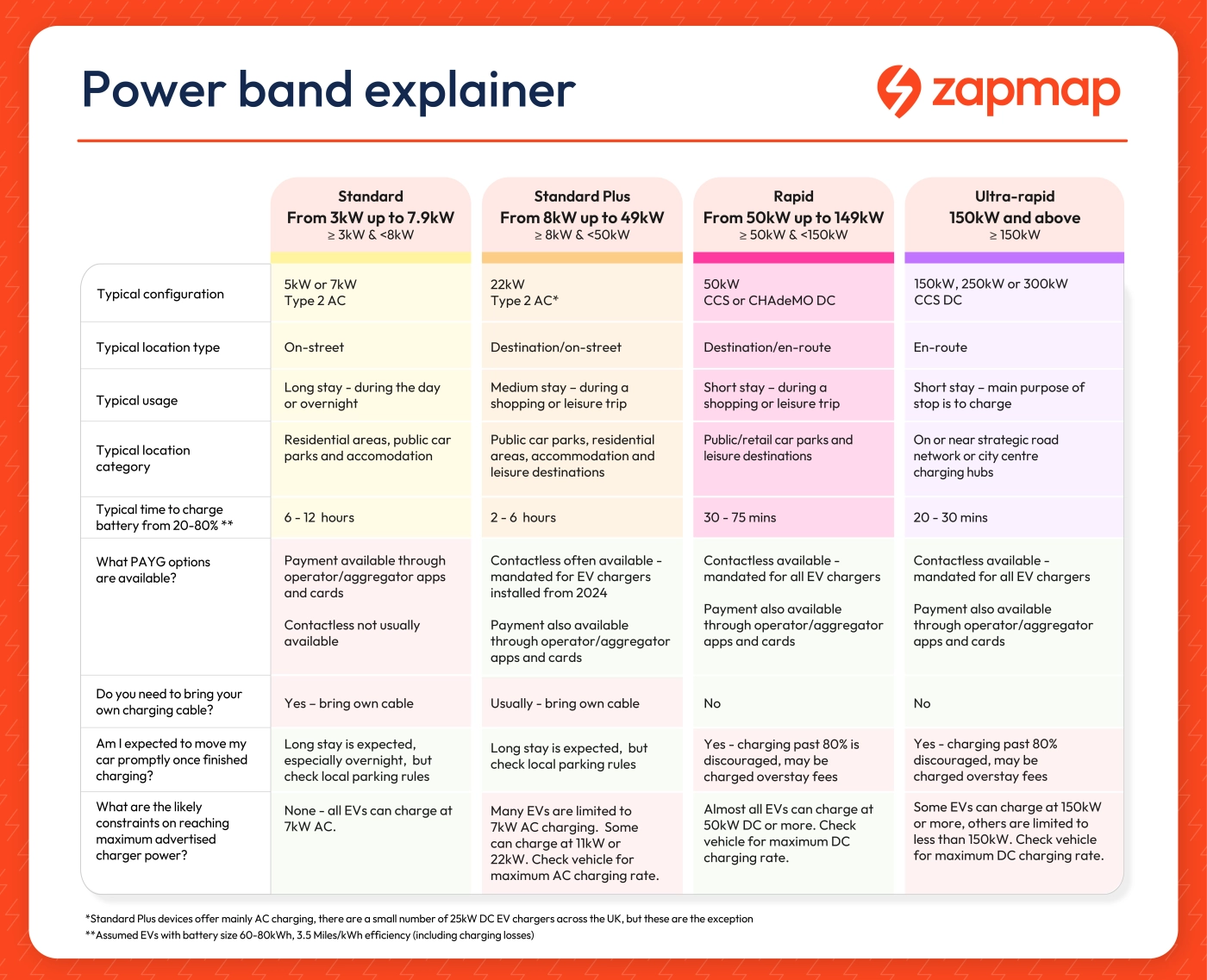
A Zapmap infographic explaining the different charging speeds for each type of charger

Zapmap recently published updated guidance about EV charger speeds, and the names that we give the different types of chargers. The same guidance has been supported by the Department for Transport, and now categorises electric vehicle chargers into these four categories:

  • Standard
  • Standard-Plus
  • Rapid
  • Ultra Rapid

I’ve put their infographic as the featured image above, and here’s how each category works in practice.

Standard charger

Standard chargers were often known as ‘slow’ chargers before, and cover speeds from 3 kW to 7 kW. These are the single-phase AC chargers that use a Type 2 cable (that you usually have to provide yourself). If you have a charger installed at home, then it will most likely be a Standard charger.

Renaming it from ‘slow’ to ‘standard’ is deliberate because ‘slow’ implies that these chargers are inferior. They’re not – I have one at home and so it’s the type of charger that I use the most. They’re also common as ‘destination chargers’, at places such as hotels or attractions where you would typically spend the whole day. As such, the slower speed is fine, and so ‘standard’ is a better term for these.

Standard-Plus charger

What are now known as ‘standard-plus’ chargers are those in the 8 kW to 49 kW speed bracket. Typically, these will also use Type 2 connectors, but will draw their power from a three-phase AC electricity supply. These were known as ‘fast’ before, but ‘standard-plus’ is a better name as they’re still slower than rapid chargers, and not all cars support the faster speeds.

For example, our Nissan Leaf can only charge at up to 6.6 kW. It’ll charge from a ‘standard plus’ charger, but at a ‘standard’ speed.

Both ‘standard’ and ‘standard plus’ chargers can be considered to be ‘level 2’ chargers, as per this guide I wrote in October. There exist a few older 25 kW DC chargers that would fit into this category based on speed, but these are in the minority and I haven’t personally come across them.

Rapid charger

Rapid chargers haven’t changed their name, and are still used to describe DC chargers that offer between 40 kW and 149 kW charging speeds. These will have a CCS-2 or CHAdeMO connector (or both), and are designed for fast charging. The charger units will include the cables, so you don’t need to bring your own.

Ultra Rapid charger

Increasingly, a new generation of charger can offer speeds of 150 kW or higher, and these are categorised as ‘ultra rapid’ – again, no change to the name. Like rapid chargers, these use a DC electric supply and will use CCS-2 or CHAdeMO connectors – although most that I’ve seen at this speed don’t offer CHAdeMO.

Our Nissan Leaf can only slurp down 46 kW using CHAdeMO, so whilst we can use an ultra rapid charger, we can’t take advantage of the faster speeds over a rapid charger.

Overall, I like the new categories, and I think they better manage the expectations for EV users needing to charge. Standard chargers are fine for even the biggest electric vehicles when staying overnight, for example, and so renaming them from ‘slow’ to ‘standard’ should mean that people aren’t discouraged from using them.

Bansky: Limitless exhibition

A timeline at the start of the Banksy Limitless immersive experience

This is the second of my blog posts about last month’s trip to London. The first was about Kinky Boots, and this is about the Banksy: Limitless exhibition which was the other thing that we pre-booked before travelling.

You’ve probably heard of the pseudonymous street artist Banksy. This exhibition is an ‘immersive experience’ which has around 250 of his artworks on display. These are a mixture of prints and recreations of his works, and include those displayed at Dismaland, the Walled Off Hotel, Ukraine and his London animal trail.

I’m not massively into art, but I find Banksy interesting – not least because his true identity remains a mystery to most. All most people know about him is that he is male, white, and that he probably comes from Bristol where his earlier works appeared. He has been producing street art since at least 1999, if not earlier.

He’s probably best known for his stencilled street art. Stencils allow him to design his pieces in his studio; then, when he’s out in a public place, he can then quickly spray paint his works and move on before he gets in trouble. However, his art takes many forms and this exhibition covers lots of them.

Immersive experience

Banksy: Limitless is billed as an ‘immersive experience’, which made me think about that infamous Willy Wonka experience in Glasgow. Thankfully, it’s not a load of AI generated slop. Instead, whilst some parts are like a typical art gallery, others parts are laid out like a tube station, or a recreation of Dismaland. The web site says that you can expect to spend at least 80 minutes here; we spent well over two hours in the end. And, of course, you Exit Through the Gift Shop.

It’s important to note that Banksy himself hasn’t authorised this exhibition. Instead, it’s a collection of (mostly) privately owned pieces and prints that have been brought together. I really enjoyed it.

Accessibility

Banksy: Limitless is in Sussex Mansions on Old Brompton Road. It’s a short walk from South Kensington tube station on the Piccadilly, Circle and District Lines. The nearest step-free tube station is Knightsbridge, the previous stop on the Piccadilly line, which is a one mile walk.

The building is wheelchair accessible. The exhibition is across two floors, and there is a lift available. There are also toilets on site. The nearest Changing Places toilets are at the Science Museum, and the Royal Brompton Hospital, which are both a short distance away. Strobe lighting is used in the exhibition, and there is also an optional section towards the end that people with motion sickness are advised to avoid.

Ticket prices start at £20 each; Google’s AI summary offered me the discount code LONDONBY10 which gave me a 10% discount. Tickets are handled by Fever who we also used for The Art of the Brick, and you can earn points from your booking to use against future bookings (although this can’t be combined with discount codes).

Happy Easter!

I hop you are having a good Easter break, if you celebrate it. As mentioned on Wednesday, we’re staying with my parents in York, having arrived yesterday and heading home tomorrow. Which, to be fair, is pretty much what we do every year – Covid years excepted.

The Easter weekend is a full two weeks earlier than last year, when Easter was unusually late – I wrote about the dates for Easter last year. Next year, Easter is even earlier, with Easter Sunday falling on the 28th March.

I went down with a cold last weekend, which, bearing in mind our trip to London, commuting to work and an Easter church service for our ten-year-old’s school, isn’t surprising considering how many people I’ve interacted with recently. However, it means that this may be a more subdued Easter weekend. A bit of rest is probably welcome.

The 29 WordPress plugins I use on this blog

Whilst this blog is powered by WordPress, it’s far from being a vanilla version of WordPress. Whilst I’ve not directly amended any WordPress code (nor should you as it makes updates a pain), I have, over the years, come to rely on various plugins to enhance WordPress’ core features. Right now, I have 29 plugins installed, and so here’s a list of them all and what they do:

ActivityPub

ActivityPub makes my blog available in the Fediverse. So, it’s possible to subscribe to it in Mastodon, for example, and have my blog posts appear, in full text, alongside various toots from regular Mastodon users. Though I don’t use Mastodon as much as I used to, it’s another way of making this blog accessible to people.

I reviewed an earlier version of this plugin back in 2022.

Akismet Anti-spam

Comment spam has always been a problem since blog comments became a thing, and Akismet catches almost all of them whilst letting legitimate ones through. This is the only premium plugin that I currently pay for.

Album Photostream Profile For Flickr

This plugin powers my Photography page, by showing photos that I have recently uploaded to Flickr. Whilst I still pay for my Flickr Pro account, I haven’t uploaded any new photos there in a while.

Featured Images in RSS

This plugin ensures that a post’s featured image appears in the RSS feed. Almost every post has a featured image, and the GeneratePress theme that I use on here uses a post’s featured image as its ‘hero image’ at the top. There’s probably a far more simple plugin available than this one, but it does the job.

Fediverse Embeds

Fediverse Embeds allows you to embed people’s posts from Mastodon and other Fediverse services in a nice way. However, as mentioned before, I don’t really use Mastodon now, so this is just here for a few posts from 2023 and 2024.

IndexNow

IndexNow automatically submits your blog’s URLs to Microsoft’s Bing search engine, along with Yandex and some other search engines that I haven’t heard of. That should mean that new blog posts appear in search results more quickly, and don’t need to wait for a manual crawl.

IndieAuth

IndieAuth lets you use your WordPress blog to log into other web sites that support IndieAuth, and vice versa. To date, I have yet to find a web site that supports login with IndieAuth, but it’s there should I need it.

IndieWeb

IndieWeb is something of a framework plugin that needs to be installed to allow other plugins to work, such as the aforementioned IndieAuth, and Webmention, which is, erm, mentioned below.

Internet Archive Wayback Machine Link Fixer

This plugin does two key things – it ensures your new blog posts are backed up to the Internet Archive’s Wayback Machine, and also does the same for other URLs that you link to. This is a newer plugin that I wrote about in November.

Koko Analytics

I use Koko Analytics for, well, analytics. It tells me how many visits I get, and on which pages and blog posts. It also shows where people have clicked through from. It doesn’t do much more than that, but that’s a deliberate decision as I don’t want or need to capture massive amounts of data from web site visitors. Here’s my review from 2024.

MailPoet

You can, if you wish, get an email with my new blog posts every Monday, by using the email sign-up form below. This is powered by the MailPoet plugin, and I reviewed it in 2024. As an aside, since I wrote that I’ve switched to sending the emails via MailPoet’s servers instead of my own; I found that Microsoft blocks emails from this site.

Modern Image Formats

This plugin used to be known as WebP Uploads, and would convert any images uploaded as PNG or JPEG files to the more efficient WebP format. It’s now called Modern Image Formats, as it supports the AVIF format too. I also reviewed this one in 2024.

Performance Lab

Modern Image Formats is part of a suite of plugins called Performance Lab, which offer various ways to monitor and improve the performance of your WordPress install. In time, these may become part of WordPress core.

Posts On This Day

This is a simple plugin that adds a widget which shows posts that were made on the same day in previous years. You can see it on the sidebar (or below, if you’re reading this on a mobile device). Obviously, it’s only useful if you have been blogging for at least a year.

Pressidium Cookie Consent

This plugin is responsible for the cookie consent pop-up box that all web sites need to have nowadays apparently. Whilst I try to have as few third-party tracking cookies as possible, this should allow you to opt out of those. I installed and reviewed this one as recently as December last year.

Redirection

Redirection allows you to set up redirects from within the WordPress interface. I use this extensively, as lots of URLs on this site have changed in the 24 years I’ve been running it.

Share on Mastodon

Share on Mastodon is another simple plugin that automatically posts a new status message (or ‘toot’) on Mastodon with a link to new blog posts when they go live.

Simple Yearly Archive

Another simple plugin that is responsible for generating the Archives page, which lists every blog post, split by year, going back to 2002.

Two Factor

This plugin enables two-factor authentication for when I log in as an admin user. I, of course, use a strong and unique password for this blog, but should it ever be compromised, this is another layer of security.

UpdraftPlus

I use UpdraftPlus to take weekly backups of this blog, which are then saved into my Dropbox account. I reviewed it back in 2024, and it recently saved my bacon when I botched an upgrade.

VS Link Manager

Older versions of WordPress used to have a Link Manager, where you could add lists of links to create a Blogroll, for example. The code is still there, but it’s disabled. VS Link Manager re-enables it, and adds a newer widget for putting those links in your sidebar. This powers my blogroll.

W3 Total Cache

Whilst caching plugins aren’t always mandatory with WordPress, having one should make it faster. I’ve always used the free version of W3 Total Cache and it works fine.

Webmention

Webmention is part of the IndieWeb, and is designed to allow people to post comments on their own site that then automatically links back to the post they were commenting on. I use it to allow Brid.gy to work; it means that replies to my posts on Mastodon and Bluesky that have a link to a blog post have those replies posted as comments.

WebSub

WebSub is also part of the IndieWeb, and means that, when new blog posts are published, Superfeedr and WebSubHub are notified. I assume that there’s some kind of benefit to doing so.

WP Crontrol

WP Crontrol offers an interface that allows you to manage the various scheduled tasks that WordPress performs, for example making scheduled posts go live at the correct time. I think I installed this as, sometimes, scheduled tasks were missed and it allowed me to see why.

WP to Buffer

This plugin allows you to share new and updated posts via Buffer, which I use for Bluesky and Facebook Page sharing. I used to also share posts with LinkedIn using Buffer, but not everything I post here is fit for LinkedIn.

WP Toolbelt

WP Toolbelt is a multi-tool plugin which is a bit like Automattic’s Jetpack. However, it does more locally, rather than relying on WordPress.com, and it means that I can do several things without having to install lots of smaller plugins. I wrote about it a couple of years ago; it still works even though its development appears to have been abandoned.

WP-Sweep

WP-Sweep lets you clear out data from your WordPress data that you may not need any more. This includes deleted comments, old post drafts, previous revisions of posts and orphaned metadata. As such, it can reduce the size of your WordPress database. It needs to be used carefully; for example, you don’t want to remove drafts if you’re halfway through writing a draft post.

Yoast SEO

Finally, I use Yoast SEO. This gives you suggestions when writing posts, to ensure that you’re using the right key words, have an image and use headings. It also measures the readability of your posts, so that you can avoid over-using passive language and overly-long sentences. There are also some more advanced features that are designed to optimise your WordPress site so that it could, potentially, appear higher in search engine results.

Le Poisson d’Avril

A photo of a clownfish in an aquarium. The French refer to an April Fool as 'un poisson d'Avril', which translates as an April Fish.

Something I learned back in secondary school was that the French call an April Fool’s joke ‘un poisson d’Avril’, which literally translates as ‘an April fish’. No April Fool’s Day jokes from me today though.

We’re part way though the Easter holidays here, with our ten-year-old having broken up from school last Friday. It would appear that not all schools are off this week, however; I had an email from Eureka about how they are running their Easter holiday activities over three weeks. Indeed, we would have loved to go to see Olaf Falafel’s Stupidest Super Stupid Show in Leeds on the 14th, but our ten-year-old will be back at school by then.

Christine is working on Good Friday, and so I’ll probably end up taking our ten-year-old to see the new Super Mario Galaxy Movie. Unless the weather ends up being especially good, and we end up doing something outdoors. We’ll then be spending the rest of the Easter weekend with my parents in York, as usual.

So far, my post about Kinky Boots is the only one about what we did in London that has gone live, but there are several more to come throughout this month. We packed quite a lot in to what was only a two-night trip; not having our ten-year-old in tow meant we could be a bit more agile. I also have plenty of other blog posts that I have already written to go live in the coming weeks.

Unblogged March

A photo of works on the Transpennine Route Upgrade at Thornhill Junction, taken from a passing train

I quite like doing these little end-of-the-month round-ups. I used to do the occasional ‘miscellaneous’ things blog posts back when I used to blog regularly in the 2010s, but it’s good to make them a regular occurrence.

The Transpennine Route Upgrade

Our train to London departed from Leeds, and so to get there we took another train from Sowerby Bridge via Dewsbury. Whilst I commute to work in Bradford by train regularly, it’s been a while since I went the other way via Dewsbury, and so it was my first time seeing the work on the Transpennine Route Upgrade. This is a major upgrade of the North Transpennine Route from York and Leeds to Manchester and Liverpool, via Huddersfield. Overhead electric wires are being installed, to allow faster and greener electric trains to run, and additional tracks are being added from the west of Dewsbury to Huddersfield, to separate slow and fast trains.

One of the biggest pieces of work is the re-design of Thornhill Junction, which will see a new flyover built and a new bridge across the River Calder. When we went past, the bridge piers had been installed, ahead of the decking being built. This will allow fast trains from Leeds to cross over slower trains joining the line from Wakefield, and will see a replacement station at Ravensthorpe being built. All the stations on the line are getting accessibility improvements too – we saw the lift towers being installed at Batley station. It’s nice to see some major investment in transport in the north.

Fuel prices

I tend not to talk about international geopolitics on here, partly because I work in international student recruitment and so have to deal with it as part of my day job. However, the impact of the war in Iran on fuel prices has made us very glad that we have an electric car. We do the vast majority of our charging at home, and our electricity prices are fixed until August. Furthermore, our solar panels keep the costs down even more, and we’ve been lucky enough to have had some quite sunny days of late.

Our old car was a diesel, and diesel prices have shot up faster than petrol. Whilst fuel prices have yet to hit the highs of 2022, our local garage wants £1.82 per litre for standard diesel, and I’ve seen prices as high as £1.93 per litre at a motorway services.

I’m just hoping that everything calms down soon – not least for the innocent civilians in Iran and across the Middle East who are caught up in all of this. It’s all just so unnecessary.

Bolster Moor Farm Shop

On the recommendation of Paul Bigland, a railway photographer and fellow blogger who lives across the valley from us, we went to Bolster Moor Farm Shop earlier this month. It’s in the hills above Huddersfield, and offers a good selection of food. It does plenty of pre-prepared meals, and is well known for the quality of its pork pies, and for having a butchers counter that can (usually) offer more unusual cuts of meat.

We normally go to Robertshaw’s Farm Shop near Queensbury, which is larger and has a better fruit and vegetable range, and an outdoor area with farm animals. But, we were impressed by Bolster Moor, and will certainly pop back there from time to time.

La Porchetta Pollo Bar

On the Friday night in London, we had dinner at the La Porchetta Pollo Bar in Soho. It’s not a big restaurant, but it’s open from mid-afternoon until late and so ideal for a pre- or post-theatre meal. Whilst the prices are typical for London, the portion sizes are generous. It’s independently owned and run by an Italian family, and can trace its origins back to the 1950s. We went there with a friend from university who now works in London, and who recommended it to us.

Kinky Boots at the London Coliseum

A photo of the inside of the London Coliseum before the start of Kinky Boots

We’ve been back from London for a week now, so I suppose it’s about time I started writing about what we got up to whilst we were away. We went down last Thursday, and on the Thursday evening, we went to see Kinky Boots at the London Coliseum.

When Christine and I are in London, we usually try to see a show there too. Sometimes it’s planned – we booked the tickets for Kinky Boots a week in advance, and have done the same with Matilda, Wicked and The Play That Goes Wrong in the past. And other times, like when we went to see We Will Rock You, we picked up last minute cheap seats on the afternoon of the show.

The plot of Kinky Boots

Kinky Boots was originally a film which same out in 2005, and is based on a true story that was featured in the BBC2 documentary series Trouble at the Top. It follows the story of Charlie Price, who inherits his family’s shoemaking business in Northampton. The business is falling on hard times; though the shoes it makes are good quality, it can’t compete with cheaper imports and is about to go bust. But a chance meeting with a drag queen, Lola, sees Charlie finding a niche – making high quality boots for drag artists.

As you would expect from a musical that features drag artists, it’s very camp, but also touches on homophobia and transphobia.

The musical of Kinky Boots premiered in Chicago in 2012, and moved to Broadway the following year. The actor Billy Porter earned a Tony award for his portrayal of Lola, and he sings on the official soundtrack. The music was written by Cindy Lauper, but it’s not a jukebox musical – the songs were written for the show, so there’s no renditions of Girls Just Wanna Have Fun. The music is really good, and I appreciate musicals that have new music written for them as opposed to jukebox musicals.

Kinky Boots in the West End

Its first London run was in 2015, where it ran for four years at the Adelphi Theatre, closing in 2019.

This time, it’s at the London Coliseum, which is the largest theatre in the West End seating 2,359 people. Normally the Coliseum is the home of the English National Opera, so Kinky Boots probably attracts a rather different crowd. The role of Charlie Price is played by X-Factor winner Matt Cardle, with the South African actor Johannes Radebe playing Lola.

We really enjoyed the show. There’s some sad bits, but (as mentioned) the music is excellent and it’s well put-together, with great use of lighting.

Kinky Boots is on a limited run, which, as it stands, ends in mid-July. Tickets start from £25; we bought the £35 tickets for the upper circle, which is the third of four tiers in the London Coliseum. The view was pretty good from our seats.

If you’re looking to save a little bit of money on tickets, then Official London Theatre charges a lower booking fee than booking direct with the theatre, and they accept Theatre Tokens. If you’re a member of a site like JamDoughnut or EverUp (referral link) then you can buy Theatre Tokens at a discount.

Accessibility

Accessibility at the London Coliseum is pretty good, as the theatre was extensively renovated in the early 2000s. There is lift access to most floors, and wheelchair spaces are available. There are disabled and unisex toilets available, but there isn’t a Changing Places toilet. That being said, the London Coliseum is only a short walk/wheel away from Trafalgar Square where there are Changing Places toilets in the National Gallery and the National Portrait Gallery, although they will only be available during the gallery opening times.

There are special showings with captions, audio descriptions and British Sign Language interpretation in April and May.

The nearest tube stations are Leicester Square and Charing Cross, and it’s not too far from Embankment station either.

4G Smart Meter Communications Hub

A photo of our electric meter with a new 4G communications hub on top.

If you’ve been reading this blog for some time now, you’ll be aware that, in March last year, our smart electric meter stopped being smart. It’s now fixed, and we have a new 4G communications hub too.

For some reason, that even now we’re not entirely sure of, no regular readings were being set back to our energy supplier. This meant that we had to take manual readings, which was a pain – our meter is in a cubby hole under the stairs in our cellar, behind our tumble dryer. We get our energy from Octopus (referral link), and although they tried various things at their end, after a few weeks, it was determined that we needed an engineer visit.

Unfortunately, this has coincided with the shutdown of the Radio Teleswitch service, which controls older Economy 7 meters. This means that, nationally, there’s huge demand for engineer visits to replace these older meters with newer smart meters. Whilst the shutdown should have happened last year, it’s been delayed and will (probably) happen this year. As such, it took until January for us to finally get an engineer visit.

The Communications Hub

It turns out that the electricity meter itself was fine. The issue was in the Communications Hub; if you have smart meters, then you’ll typically have:

  • An electricity meter
  • A gas meter (if you have mains gas)
  • A communications hub, which sits on top of the electricity meter and manages the home connection and the link with your energy supplier
  • An In-Home Display (IHD) which displays your usage
  • Some Octopus customers also have an Octopus Home Mini which sends your usage data over your Wi-Fi connection in real-time.

All these talk to each other using a private Zigbee mesh network. The Communications Hub then sends data to your energy supplier using one of three methods:

  1. If you live roughly south of the M62, then it’s sent over O2’s 2G or 3G data network.
  2. If you live roughly north of the M62, then it’s sent over a lower frequency 400 MHz radio data network operated by Arqiva.
  3. Or, if you have a newer communications hub, it’ll use Vodafone’s 4G network, and these are installed nationally.

4G migration

We originally had the second type, but now we have the third type which uses 4G. And it’s been working fine since the engineer installed it back in January, which is a relief. We’ve also noticed that it has a better connection with our IHD; before, it would periodically lose connection and wouldn’t show live data.

Plus, the new 4G communications hub is more future proof. If you have an older smart meter communications hub that uses 2G or 3G, then at some point in the future, your energy supplier will need to replace it. Of the four big networks, O2 is the only one still offering 3G at the time of writing. In fact, it may have already been switched off by the time you read this.

The slower 2G networks will be around a little longer, but the plan is that they too will be switched off in 2033. So, if you live in central and southern England, or in Wales, and have a smart meter, then sometime in the next 7 years, an engineer will need to come over and replace your Communications Hub. It should only take about an hour, and, at least in our case, there was no interruption to our electricity supply whilst the work was being done. There are no plans to shut down the 4G networks any time soon; according to this web site, Vodafone’s 4G contract runs until 2038.

If you live in the North of England or Scotland, then your current communications hub should carry on working. However, if you are having connection problems, then a 4G communications hub may work better.

Meanwhile, I’m just relieved that we don’t have to do any more manual readings.

Playlist of the month: Uncredited guest vocalists

A screenshot of the Uncredited Guest Vocalists playlist

This month’s playlist is all about uncredited guest vocalists. As in, songs released by bands and artists that feature another artist who doesn’t get a credit on the cover. Whilst collaborations are common in pop music – look at all the artists that have recorded with Ed Sheeran, for example – sometimes, the collaborating artist only receives a minor credit in the small print, if at all. That may be because the song was released before they were famous in their own right, due to contractual issues, or they may choose a pseudonym.

As usual, you can follow along with the playlist on Spotify.

  • “Wrap Her Up” by Elton John (featuring George Michael and Kiki Dee). Nowadays, George Michael is credited on Spotify, in this song where he sings in falsetto all the way through. However, Bradford’s own Kiki Dee, who famously collaborated with Elton on Don’t Go Breaking My Heart, doesn’t receive the same billing.
  • “Danger! High Voltage” by Electric Six (featuring Jack White). In the music video for this song, it’s presented as a duet between Electric Six’s lead singer, Dick Valentine, and the English actress Tina Kanarek. She doesn’t actually sing the vocals, however – they’re provided by Jack White, from the band The White Stripes, again in falsetto.
  • “Shiny Happy People” by R.E.M. (featuring Kate Pierson). It was listening to this song which prompted me to create this playlist, as R.E.M. is an all-male band. The female vocals are from Kate Pierson, better known as the female vocalist in the band The B52s.
  • “Got Your Money” by ODB (featuring Kelis). Like with Wrap Her Up above, Kelis is now credited on Spotify, but she wasn’t at the time. This was released shortly before her debut single, and so she was a relative unknown back then.
  • “The Opera Song” by Jurgen Vries featuring CMC. Two pseudonyms here – Jurgen Vries is one of the many names used by Darren Tate (along with Angelic, DT8 Project, Citizen Caned and being one half of KOTA). CMC is a pseudonym used by Charlotte Church, who at the time was only a singer of classical music – her pop album, Tissues and Issues, had yet to be released.
  • “The Gathering” by Delain (featuring Marko Hietala). Marko popped up a few times in last month’s symphonic metal covers playlist, and here he is again, uncredited on this single from Delain’s first album. He’s subsequently collaborated on several other Delain songs, including Sing To Me and Your Body Is A Battleground, where he is credited.
  • “Bring Me To Life” by Evanescence (featuring Paul McCoy). I’ve mentioned in a previous playlist how the male vocal part was added to this song at the insistence of the record label; they’re not in the original demo version, or the re-recorded version from 2017. Paul McCoy, from the band 12 Stones, provides the additional vocals.
  • “Just Around The Hill” by Sash! (featuring Tina Cousins). Sash! are no strangers to collaborations, with most of their singles featuring credited guest vocalists. Just Around The Hill was their first attempt at a ballad, rather than the Eurodance that they were better known for, and features vocals from Tina Cousins who wasn’t credited on the cover. Which is odd, as she previously collaborated with Sash! on Mysterious Times, their sixth single, where she was credited.
  • “You’ve Lost That Lovin’ Feelin'” by The Righteous Brothers (featuring Cher). Way back at the beginning of her music career, over 60 years ago, Cher recorded backing vocals for this song before she was well-known in her own right.
  • “Killer” by Adamski (featuring Seal). Nowadays, Seal is credited on Spotify, but at release in 1990 he wasn’t, as this was before he was established as an act in his own right. Seal later recorded his own version of the song for his 1991 debut album. ATB covered Killer in 2000, and that version also has uncredited vocals from Drue Williams (who, to be fair, isn’t famous enough to have his own Wikipedia page).

Graduated from car seats

Earlier this month, our ten-year-old reached an important milestone: they became tall enough not to need a car seat.

As I write this in March 2026, children need to use a car seat until they’re 135cm (4 feet and 5 inches) tall, or until they turn 12, whichever happens soonest. Obviously our ten-year-old isn’t twelve yet, so this means they’ve reached 135cm tall. They therefore no longer need to be strapped into a child car seat, and can sit in the front of the car for the first time.

Three different car seats

Since they were born at the end of 2015, we’ve had three different car seats. The first was a baby carrier type, which clipped into a base fitted to the car using Isofix. All three of our cars have had Isofix anchors built-in. We could also clip the car seat onto a pram frame, so transferring a sleeping baby from the car to a pram was possible without waking them up.

The second came when they were around 18 months old. This was a forward facing car seat that rotated, so we could easily get them in and out. Like the baby carrier, this came with a harness rather than using the seatbelt, but it remained in the car rather than being removable.

By the time they’d reached the age of four, it was time for another, larger car seat. This one was a more, front-facing seat that didn’t rotate, and didn’t include a harness. Instead, we strapped our ten-year-old in with a standard seatbelt that went across the car seat. Back when I was that age, I had a simple booster seat which had no back, but those aren’t sold any more. Instead, this one had a back and extra head protection against side impacts.

Now, there’s no need for any additional protection at all. Which is handy as it meant one less thing to pack whilst we were in London and our ten-year-old was with my parents. They can also take advantage of the heated seats in our Nissan Leaf.

What to do with old car seats

When it comes to what to do with old car seats, the advice is mainly to take them to your local authority recycling centre. You shouldn’t buy or receive a child car seat that’s second hand, unless you absolutely trust the person selling it to you about its age and condition. If it was in a car that has been in an accident, then there’s a risk that the car seat may have been damaged, and so it may not offer as much protection in another accident. It’s a shame, because car seats are expensive, and they’re not the easiest things to recycle either.

That being said, you can buy all-through car seats (sponsored link) that should serve most children from birth to age 12 (or 135cm). Had these been available back in 2015, we would have saved quite a bit of money, although I wonder how adaptable they are for older kids.

Creative Commons License
Except where otherwise noted, the content on this site is licensed under a Creative Commons Attribution-ShareAlike 4.0 International License.