Home improvements

We bought our first home back in 2015, when my wife was pregnant. The house we bought is one that estate agents would describe as ‘having potential’. That’s not to say it was derelict, but it had dated decor and needed a lot of work doing.

We spent much of 2015 renovating the downstairs rooms – new plaster on the walls, new electrics and fixing various issues which meant that, whilst we got the keys in June, it was October before we could finally move in. In 2016, we converted a newly-partitioned room into a downstairs toilet, and had a new central heating boiler fitted.

Progress with renovating the rest of the house slowed down after this. Working full-time and having a child meant that we just didn’t have the time, and money was also an issue. But then in 2020 I inherited a sizeable amount of money from a deceased relative, and so we were able to start work again.

Whilst we had done a lot of work downstairs, the upstairs rooms had remained pretty much as before. Of the three bedrooms, the one we had earmarked for our child needed the most work, so this is the first of the bedrooms to be renovated. As with the downstairs rooms, it was a big job.

Firstly, there was a large, built-in wardrobe which had to be removed – it was falling apart anyway, and it was partly there to house a water tank which was removed when we had the new boiler fitted. Once that was out, and after stripping the wallpaper, it became clear that re-plastering was necessary here as well. We also needed new wiring – before, we only had two single plug sockets for the whole room – new floorboards, and some central heating pipes needed re-routing. Thankfully, we were able to employ a builder who could do all of this for us.

The room now looks totally different; as with downstairs, we’ve gone for painted walls rather than wallpaper. We’ve also decided to have the floorboards varnished and put rugs down, rather than carpets, so that the room can more easily evolve with our child’s changing tastes as they get older. And it’s a more flexible space, with more options for where the bed can go.

This year, we’re renovating the kitchen. I’ll write more in detail about this later, but again, it’s a big project. When we moved in, we didn’t do much work on the kitchen, compared to the other downstairs rooms – just a few extra plug sockets and a new floor – but this time it’s a total renovation. It also includes opening up one of our cellars as a utility room.

There’s still more work to be done elsewhere – the bathroom needs renovating as well, as again we only did a small amount of work when we moved in. And the other two bedrooms could do with a refresh. We’ll need some more money first though.

Parenting a six year old

So, the last time I blogged regularly, I had a 2 1/2 year old child who had just had their first trip abroad to France. Now, that child is 6 and is in their last term of their second year at primary school.

It’s been an interesting time, not least because a big chunk of 2020 was spent stuck at home. Days before the UK went into full lockdown in March 2020, our childminder closed and initially I spent time at my parents’ house in York for childcare. When that became an impossibility, I had the joy of working at home whilst trying to keep a four-year-old entertained for four months.

In some respects, I was lucky; my child hadn’t started formal education yet and so home-schooling wasn’t required, but it was hard; taking awkward phone calls for work whilst your child is demanding attention isn’t anyone’s idea of fun. A lot of CBeebies was watched, as were various Netflix and Disney+ shows. Indeed, my child watched so much of Jake and the Never-land Pirates on Disney+ that Jake became their imaginary friend for a while. I had to do this on my own as my wife is a front-line NHS worker, and had no choice but to carry on going into work throughout the pandemic. Unsurprisingly, she contracted Covid-19 in April 2020 and was very ill with it, but thankfully made a full recovery.

Fortunately, in September 2020, my child was able to start school, and settled in well. The school wasn’t our first choice – indeed, it was actually our third. Our top two choices where schools that were more convenient for us, being as they were on our commute to work; this third choice of school was further away in the opposite direction to our workplaces. However, whilst it may not have been our first choice, in retrospect, it was probably the best choice for our child as it has much smaller class sizes due to it being comparatively under-subscribed. We were also fortunate to get a place in the out of school club.

We were also blessed with good fortune in January 2021, when the country went back into lockdown and the schools closed. This time around, the government widened the categories of key workers, meaning that I qualified as well (and our HR department responded very quickly to my request for a letter confirming as such) so we were able to get a key worker place and avoided two months of home schooling. Thankfully, apart from short periods due to possible exposure and ‘having a cough’, there’s not been so much disruption to their education this year.

Despite a rough time in 2020, I’m still enjoying being a parent and we have a lot of fun as a family. We have regular days out, and our child now has regular out of school activities on Saturdays too. Most importantly, they’re happy and healthy, with a group of friends.

We still only have the one child at present; that could change in future but we’re still waiting for my wife to take her driving test before we consider having another.

What’s this? A blog post?

Well, hello. This is my first blog post in almost four years.

I last wrote a post on here in September 2018, and then took an un-planned break from blogging. This was exacerbated at the end of 2018, when I attempted to upgrade the server that this web site runs on, and ended up wiping everything. And I mean, everything, including the backups that I thought I’d saved elsewhere but hadn’t.

Just like that, 16 and a half years of blog posts were gone, along with all the comments. Now, it’s possible that I could have re-built most of the blog posts, using things like the Web Archive and help from others, but between working full-time and being a parent, I just didn’t have the time or the inclination to do so.

Furthermore, I was beginning to become uncomfortable with how much I had shared about my life over the years. Back when I started the blog, aged 17, I had a tendency to over-share. Over time I reigned that in; I was in a relationship with someone between 2005 and 2009 where I agreed not to share her real name on here, and though we’ve both moved on I’m keeping that commitment – not least because we’re still in touch and actually met up recently.

But I also wanted to reign in how much I talk about my child, who is now six. I’m happy to share their age, but I’m afraid you won’t be knowing their name or seeing recent photos, and I’m even keeping their gender off here now too. It’s about consent and privacy – as a parent, I want to protect my child, and they’re too young to really know what a blog is, never mind have lots of information about their life made public.

I am hoping to get back into the habit of blogging regularly, though not on a daily basis as I had aimed for in the past. Initially I’m aiming for twice a week, as there are four years of news to catch up on, but my minimum aspiration is for one new blog post per week.

Why now? Well, I’ve wanted to get back into writing for pleasure again. I’ve written a few things on Medium, but it feels like writing for a magazine; I’d rather stick to somewhere more personal that’s just about and run by me. I feel like I have things to say now, and hopefully the time to put those things into written words.

If you’re an old-time reader of my blog, welcome back, and I hope that this wasn’t too much of a surprise when it popped up in your RSS reader. And if you’re a new reader, hello. You can read my very dry ‘about me‘ page which is more focussed on my work, but I hope you’ll stick around and will get to know me better.

Why your next slow cooker should be a multi-cooker

A photo of an Instant Pot next to a standard slow cooker

Since the start of lockdown, almost a year ago, I’ve been working at home and used more slow-cooked recipes for our evening meals. I like being able to do the preparation during my lunch break, and then leaving the slow cooker to do its work, so that when I’m done all I need to do is serve (or quickly cook some carbs, like pasta). Not having to do lots of food preparation at the end of the day is nice.

Originally we had a very basic slow cooker. Ours was old – inherited from a grandparent – but similar models are still on sale today. The most basic just heat at one setting once plugged in; this one was slightly more advanced in that it had three heat settings, but that was it.

Nowadays, you can buy ‘multi-cookers’. These are devices that combine several different modes; as well as slow cooking, they will also offer a sauté mode and perhaps even a pressure cooking mode. We have an Instant Pot, which is the brand leader, but others are available. Crockpot, who are best known for slow cookers, have also branched out into multi-cookers as well.

So what makes a multi-cooker more useful? I’m going to go through some of the key features, which I think you should look out for when buying your next slow cooker or multi-cooker.

Sauté mode

Quite a lot of slow cooker recipes actually require you to do some pre-cooking – especially those involving meat, where you often need to brown it off before starting the slow cooking process. Sauté mode allows you to do the frying stage in the multi-cooker itself, rather than using a separate frying pan. This cuts down on the washing up and mess, and also means that the inner pan of your multi-cooker is already warm when you start. Some newer slow cookers that don’t offer a sauté function have inner pans that can be used on a regular hob, which achieves a similar result.

Timer

As mentioned, our basic slow cooker did not come with a timer. Of course, you can use an external timer, or even a timer switch to cut the power after a time to stop your food being overcooked. But the main advantage of having a built-in timer is that, once the time is up, the cooker will go into a ‘keep warm’ mode until you’re ready to serve. This should avoid over-cooking but also prevent your food from getting cold if you’re running late.

Delayed start

Building on this is delayed start mode. Let’s say you have a recipe that should be slow cooked for 6 hours, but you leave the house at 8am and aren’t back until 5:30pm. Delayed start allows you to prepare your ingredients and place them in the slow cooker before you go, and then have the slow cooker start at, say, 11:30am, so that when you are back six hours later the meal should be ready. It’s a useful function and not all slow cookers offer it – even those with timers.

Using an Instant Pot as a slow cooker

As mentioned, we have an Instant Pot, and slow cooking is one of its modes (as is sauté). It’s worth taking a couple of minutes to read how an Instant Pot can be used as a slow cooker, because although it offers low, medium and high settings, the low setting essentially only keeps food warm and doesn’t really cook it. Even the ‘more’ (high) setting is probably closer to ‘medium-high’ on a dedicated slow cooker.

The Instant Pot is, first and foremost, a pressure cooker. If you are going to use it regularly as a slow cooker, then I would advise buying a glass lid for it, rather than using the provided pressure cooker lid. Instant Pot sell an official one and it’s available from the usual places.

The other advantage that we have found is that because our Instant Pot has a bigger inner pot, we don’t encounter issues with liquids running over. But a larger slow cooker would also not have this issue, so it’s not a specific advantage of the Instant Pot.

This post originally appeared on Medium.

Some predictions about the post-Covid-19 ‘new normal’

When there’s effective treatment and we can stop social distancing, what will the world look like?

As I write this in July 2020, we’ve had 4 months of ‘lockdown’ in England where all but the most essential shops have been closed, travelling by public transport has been almost completely discouraged, and all forms of hospitality and nightlife have been suspended, to prevent the spread of Covid-19. Whilst we’re emerging into another ‘temporary normal’, where we can do many of these things again but with social distancing, I wanted to look further into the future.

Let’s assume that the various studies into a vaccine and new treatments are successful in the near future (and this is by no means guaranteed). What will the world be like? And how will it differ from a pre-lockdown world that we enjoyed before March 2020?

I live in England, and so this will mostly focus on what I am most familiar with, but of course some of these ideas are transferable elsewhere.

The old/new normal

To clarify, I’m using the following terms in this piece:

  • The ‘old’ normal is what we experienced before lockdown, i.e. before March 2020
  • The ‘current’ or ‘temporary’ normal is what we’re in now, where we need to socially distance, work at home where possible and wear masks in some situations
  • The ‘new’ normal will be when such restrictions are no longer necessary because the virus has been essentially eradicated from the population, or we can treat it effectively. Arguably, this is where New Zealand is, albeit with strict immigration controls to prevent the virus being re-imported.

Travel

When lockdown began in England, we were told:

  • Don’t leave your home for more than an hour, and only go out for essential journeys or for exercise
  • Avoid public transport unless it is your only option

Over time, this messaging has eased as active Covid-19 cases have fallen. As I write this in July, the public are now being encouraged back onto public transport, albeit with mandatory face masks and needing to sit at least a metre apart, preferably two metres. This may have something to do with the millions of pounds that the government has had to spend over the past few months to prop up Britain’s transport companies so that they can run a minimum service for key workers. But also, as more people return to work, there’s a risk of major congestion on the roads if everyone who can drive decides to, rather than taking a train or a bus.

I suspect it will be several years before the usage levels of public transport return to pre-lockdown levels. People will remain wary of using public transport – especially in places where buses and trains are often full and standing, like London. I also think more people will carry on working at home, and more meetings will take place virtually – points which I will cover in more detail later. So fewer people will need to commute to work every day, and there will be less of a need for long distance and international business travel.

Face masks

At the start of lockdown, the scientific evidence behind the effectiveness of mask-wearing to prevent infections seemed unclear. In many cases, recommendations were made that the public not wear masks, as doing so improperly would be ineffective and may give a false sense of protection.

But the advice evolved, and soon face masks became mandatory on public transport in England. Later in July, it’ll also become mandatory to wear a face covering in shops, or risk a financial penalty. Having a mask on means that the advice to keep two metres apart from anyone outside of your household can be relaxed to one metre, without substantially increasing the risk of infection – provided that everyone complies, of course.

In future, even when not mandatory to do so, I can see it being more socially acceptable to wear face masks in public. Prior to 2020, people in some far eastern countries would wear masks in public, to avoid catching airborne diseases or spreading their own minor infections. I would expect this to be more common in western cultures as well – especially amongst those who have invested in reusable cloth masks. It would be interesting to see if, long term, this would have an effect on reducing transmission rates of infectious diseases.

Working at home

Like many people, back in March I was sent to work from home for the foreseeable future. This wasn’t something that employees of the organisation I worked for often got to do in the past – whilst the option was there, there was the expectation that you would be less productive and doing so was generally the exception.

Once we were forced to do so, it turned out that, for many of us, we could be just as productive at home. I’m fortunate that the organisation had invested in IT systems that allowed off-site access to many of our services and platforms, so we could do the vast majority of our work at home and retain access to telephony and database systems remotely.

Office workers can begin to return to on-site work from August in England and I expect some will be keen to get at least some of their employees back in the office as soon as possible. But some big organisations like Twitter have already decided that, even when the situation improves, employees can continue to work remotely indefinitely. Companies like Automattic and AgileBits had, prior to 2020, embraced remote work, but many others were reluctant to do so until forced to, and will now be changing their attitudes.

I expect more companies will include the availability of remote work in their job adverts, and this could have a knock-on effect on where people choose to live. If you no longer need to commute to central London to work, then theoretically you can live anywhere with a good internet connection. That could have a noticeable effect on commuting into London, and demand for property. That being said, if people start living further away from work, then it’s important that mid-distance travel remains available, and therefore we will still need schemes like HS2 which will enable more capacity for such journeys.

My personal preference would be for a mixed mode – say, three days a week in the office and two at home, with the flexibility to adjust this based on the need to attend meetings, or be home to look after ill children, receive deliveries or have work done in the house. I used to work extra hours to bank up flexi-time to take as and when our four-year-old was ill; in future, I may be able to work from home instead, and not feel like I constantly had to take shorter lunch breaks. And hopefully the days of booking a whole day off work for a plumber who turns up at 16:55 will be over, as I would be able to work from home during the day.

Online meetings

Whilst videoconferencing technologies have been around in some shape or form for years, they reached a point of maturity just at the right time. I had only heard of Zoom last year – and now everyone uses it. Back in October, myself and a colleague went to a meeting with a client in Coventry, which involved booking a hire car and travelling over five hours there and back. The meeting took all of a couple of hours, with lunch – and really, there was nothing that couldn’t have been done over a video call.

I strongly suspect such meetings are a thing of the past – a two hour Zoom call would’ve been a lot cheaper and had less of an impact on the day. For some of the meetings I attend, I’m only needed for parts of it – being online, I can carry on working whilst listening in and then contributing when needed.

I think this will have an impact on the demand for international travel – I’ve heard stories of creatives who have flown to Los Angeles literally just for a two hour meeting. I can’t see those being common in the new normal.

Decline in air travel

Air travel is pretty bad for the environment, and even before lockdown some people were vowing to cut down their use of planes. Sleeper trains, which were at risk of being completely eradicated across Europe, were starting to launch new routes or re-established services that had been cancelled.

There will be a fall in international business travel, as online meetings are seen as a suitable alternative. And I expect some airlines will simply go bust, along with some smaller airports. I would be very surprised if the controversial third runway at Heathrow Airport ever gets built now. High speed rail will hopefully attract more people away for the journeys that remain necessary – especially if they can offer good quality internet connections during the journey.

The importance of good internet

One policy of the Labour Party in the run-up to the General Election in 2019 was of universal broadband provision – and internet access being treated as an essential utility along with water and electricity. It was laughed off by some at the time, and yet the only way that many companies have been able to continue business over the past few months is because their employees have had good internet connections at home. Every property in the UK should be able to access some kind of broadband internet connection; ideally, we would have fibre connections rolled out to every home and office, but there is a role for mobile internet services as well. 5G connections will help where a fixed line connection isn’t possible or practical.

I’ve been fortunate that, despite us only having an ADSL line, it’s enough bandwidth for streaming Netflix (for our ten-year-old), a video call and access to work systems at the same time. For families struggling with just one pre-pay mobile handset between several kids, the last few months must have been very hard.

When it comes to buying or renting property, those buildings with poor internet access are not going to be able to command such a high price in future.

Patience and planning

This is something less tangible, but we’ve had to get used to waiting for things and planning ahead as lockdown has eased. We’ve had to queue for shops, so that they can manage the numbers of people inside and maintain social distancing. Similarly, for days out, many places have moved to pre-booking only. There aren’t many places that you can go to on a whim anymore; and popular attractions tend to be booked up weeks in advance.

The decline of cash

So far this year, I think I have withdrawn cash from an ATM approximately three times. The shift to purchasing goods online and shops preferring customers to use contactless forms of payment means that I just haven’t needed to have coins and notes available to pay for goods, most of the time. There will always be a need for cash but I wouldn’t be surprised if more shops and venues become card-only.

The rise of online learning

Schools and universities had to very quickly adapt to a model where students could not physically be on campus. Some universities have begun to offer some programmes by distance learning, but for most courses there was an expectation that you will take at least a year out to study full-time for a qualification. In future, I expect more universities to offer completely online programmes, including online tests, or adopt a more blended approach where students are not required to be on campus as much. Many people will have lost their jobs as a result of the economic crash; offering flexible and online degree courses will be one way that universities can encourage people to up-skill whilst they wait for the job market to improve. Similarly, international students will be less willing, or indeed able to travel across the world to study, so offering courses that they can take in their own countries would replace the lost income from international students.

These online courses need to be proper courses, with assessments – whilst MOOCs (massively open online courses) have been popular, they are not a replacement for a full degree.

Takeaway delivery and online shops

Faced with being unable to open for weeks and months, restaurants and shops pivoted to online sales, and delivering takeaways. Many restaurants near us that had never offered takeaways, never mind deliveries, suddenly started appearing on services like Just Eat and Deliveroo. Whilst these places can now re-open, I expect that many will carry on offering food for delivery, and shops will continue to sell online where they perhaps wouldn’t before. Of course, this may have a knock-0n effect on footfall on high streets and in shopping centres – and with one of Britain’s largest shopping centre owners going into administration, I wouldn’t be surprised if at least one closes down in the coming years.

These are some of the things that I think will change, when compared to the ‘normal’ that we knew before March 2020. I’m mostly writing this down as a way of recording what we accepted for normal now, and what I hope or expect will come about. I may be completely wrong and things will largely go back to how they were, but for many, ‘how things were’ wasn’t ideal. The Covid-19 crisis has been awful for everyone – I lost a friend and former colleague to the disease – but it’s also an opportunity for society to reset, and challenge the norms and expectations that we had before the crisis. I hope that, once we’re in the ‘new’ normal, we’ll be able to embrace technology for remote and flexible work and study, be more patient and understanding, and stop doing the things that are destroying our planet. We’ll see what happens.

This was originally posted on Medium.

Why I’ve sort-of quit Twitter

I’ve been a Twitter user since June 2006, apparently, and in that time there have been very few days where I haven’t been on it. It’s been a major source of both information, news and entertainment for me for over a decade.

I’m probably not your typical Twitter user, either. For a start, I generally don’t use the official Twitter app; instead, I prefer Tweetbot, a third-party client which had a ‘mute’ filter long before it became available to all Twitter users. And, barring tweets that I’ve muted, I try to read every tweet on my timeline; Tweetbot even remembers my ‘position’ in the timeline and synchronises this between devices. Typically, I would read about 500 tweets per day.

Reading tweets would start at breakfast (which is about 6:30am for me), with catch-ups at lunchtime, whilst commuting on the train, and before bed. In all, I would typically spend over an hour every day reading tweets.

It’s when I have spelt it out like this that I realise that my relationship with Twitter wasn’t really a healthy one. I had a hunch that I was probably spending too much time on Twitter, but, I found it entertaining and enlightening and it was a good way of passing the time.

Until it wasn’t.

I know I’m not the only person who was very disappointed with the outcome of the UK’s general election last month. But as a remain-supporting Labour Party member, it was pretty devastating. And when I woke up to hundreds of tweets on my timeline on Friday 13th December, I just couldn’t face looking at them.

So, I basically quit Twitter. Not completely – I haven’t deleted my account, and I’ve still posted quite a few tweets in the month since then. But you may have noticed fewer retweets and replies, and far fewer ‘liked’ tweets by others. I’m allowing myself up to 5 minutes on Twitter, no more than twice a day, to read other people’s tweets.

And so far, it seems to be going okay. I’m not really missing it as much as I thought I would. I am, perhaps, spending a bit more time on Facebook instead, but Facebook is generally full of closer friends and people that I care about, rather than random internet people.

The time that I used to spend on Twitter is now available for other things. I’ve been a major user of the ‘read it later’ service Pocket, which I use to save interesting links to read later. By December, this inbox of unread links had hit 250 – and some of those articles were hour-long reads. As I write, it’s 33, and I’m hoping it’ll be 0 very soon. It hasn’t been 0 since 2018. Of course, many of these ‘interesting links’ were saved from Twitter, and so I have saved very few new links to read in recent weeks.

Once my reading list in Pocket is clear, I’m planning to tackle a different reading list: books. Most of the books that I ‘read’ are audiobooks – indeed, last year I only finished one printed book whilst on holiday. I started the e-book of Mark Watson’s ‘Eleven’ last January and then made no progress in the subsequent 12 months. All the while, piles – both actual and virtual – of unread books have been accumulating, and it’s about time that I actually read them. I’ve set myself a stretch target of 50 books on this year’s Goodreads Reading Challenge – that’s almost a book a week. So far, I’ve finished 2 audiobooks, although one was started in 2019 and the other was a relatively short book that I powered through on a couple of long car journeys at new year. Still, I’m on target.

I’m also trying to spend more quality time with my daughter. She has recently turned 4, and wants me to play with her more. Not needing to get one last fix of Twitter before bed has given me more opportunities to read books with her at bedtime, and I’m hoping that I can be more present with her.

The timing of this change is interesting, as it comes roughly at the start of a new year and new decade. I wouldn’t call giving up Twitter a ‘new year’s resolution’ – mainly because I made the resolution two weeks before the start of the new year. But it’s something I’m hoping to stick to as the year goes on.

When you walk past gambling shops, there’s usually a yellow sign in the window saying ‘When the fun stops, stop’. I think the fun stopped with Twitter some time ago and it’s taken me some time to realise.

This was originally posted on Medium.

Seatfrog – how to get a cheap first class upgrade

A screenshot of the Seatfrog app on iOS

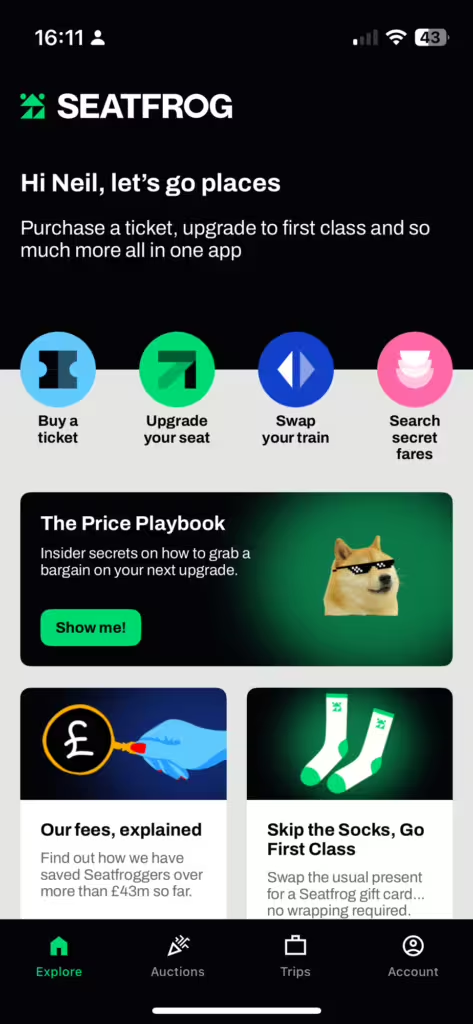
Tomorrow, Christine, our three-year-old and I are off to London (actually for the second time this week, but that’s another story). We’re going by train, and, thanks to Seatfrog, we’ll be travelling in first class, at a relatively low additional cost, having already saved some money with railcards and advance booking.

Seat auction

In the UK, Seatfrog is available on LNER services on the East Coast Main Line. You buy your standard class tickets online, as normal, and then put your booking reference into Seatfrog. The day before departure, Seatfrog holds an auction; enter your bid, and if you win, your updated tickets appear in the app.

We bid £10 per ticket for our journey, and this won (the minimum bid was £5). However, there may be a higher reserve on some services – for our return, the reserve was £9. Upgrading to first class gets you a wider, reclining seat, the majority of which are leather upholstered on LNER services. Plus, free Wi-Fi, regular offers of tea and coffee, and, for journeys over an hour, a complementary meal. This is easily worth £10 a head and means we won’t need to buy extra food for our journey.

Of course, there’s no guarantee that you’ll win, and there’s no point bidding too high as you can buy an upgrade outright for £35 per ticket. At least if you’re outbid, no money is taken.

I suppose it’s a good way of filling vacant first class seats. I could also see this being useful for people travelling on business, who can only claim standard class travel on expenses. Seatfrog would allow you to trade up to first class from your own pocket if you’re happy to pay a bit extra yourself.

For now, Seatfrog is only available on LNER services, however, it’s run by an independent company and so it’s possible that other travel companies could adopt it – potentially airlines as well as train operators,

So, tomorrow we’ll be smugly sat in first class, knowing that we paid well under the odds for our tickets,

My Podcast Diet – August 2018

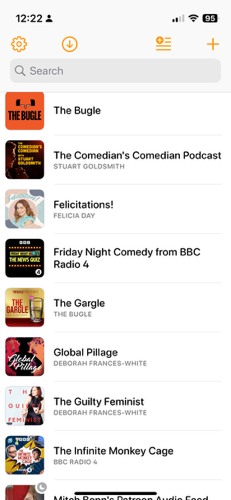
Matt Haughey, who has recently quit Twitter and returned to blogging more, has posted about which podcasts he listens to regularly and semi-regularly. It’s a good idea for a blog post, and so I’m going to steal it.

Podcasts that I listen to straightaway

These tend to be topical podcasts that would go stale very quickly.

  • BBC Radio 4 Friday Night Comedy Podcast – whichever show happens to occupying the 1830 Friday comedy slot on BBC Radio 4. Normally this alternates between The News Quiz and The Now Show, but Dead Ringers pops up in summer. Weekly, every Friday, somewhat obviously.
  • The Bugle – topical satirical comedy from Andy Zaltzman and rotating guest hosts filling the gap left by John Oliver (yes, that John Oliver). Weekly, every Friday.
  • The Guilty Feminist – this was the podcast that I saw live in March 2016, which mixes discussion of issues relating to feminism and stand-up comedy. Hosted by Deborah Frances-White with a rotating guest co-host. Weekly, every Monday.
  • Standard Issue Podcast – a magazine style-show covering women’s issues, as well as interviews, women’s sport, and regular features on TV shows and Disney films. Once a month, there’s a ‘gigcast’ with celebrity chats recorded live in front of an audience. Weekly, on Wednesdays, with occasional bonus content at weekends.
  • Reasons to be Cheerful – a new podcast co-hosted by Ed Milliband and Geoff Lloyd, which focuses on a political issue each week.

Podcasts I listen to regularly

  • The Comedian’s Comedian – stand-up comedian Stuart Goldsmith interviews a fellow comic (or comedy group) about how they work. Always enlightening. Weekly, on Mondays, but seemingly on a break at the moment – probably due to the Edinburgh Festival Fringe.
  • Made of Human – stand-up comedian Sofie Hagen (formally of The Guilty Feminist) interviews people about life and how they handle it. Warm and friendly. Weekly, on Wednesdays.
  • Felicitations – Felicia Day’s relatively new podcast, about what she’s been up to, and parenting. Weekly, on Thursdays, but seemingly on a break at the moment.

Podcasts that I listen to when there’s a new season

These podcasts run as seasons and so new episodes don’t come out all year round, but I listen to them regularly when they’re on.

  • Mrs Brightside – stand-up comedian Susan Calman interviews a fellow celebrity about depression and mental health. Weekly, on Mondays. Series one has just ended, but should be back later in the year.
  • The Infinite Monkey Cage – science podcast co-hosted by Professor Brian Cox and Robin Ince, with a different topic each week. Guests are a mixture of scientists and comedians. Weekly, on Mondays, with new episodes available now.
  • Global Pillage – comedy panel show about diversity, hosted by Deborah Frances-White. Weekly, on Mondays. No new episodes at present.
  • Richard Herring’s Leicester Square Theatre Podcast (RHLSTP) – stand-up comedian Richard Herring interviews a celebrity guest in front of a live audience in London’s Leicester Square Theatre. Weekly, on Wednesdays, back in the autumn.
  • Grownupland – a podcast for millennials about adulting.
  • Newsjack – weekly comedy sketches with an open-door writing policy, so anyone can submit.

How to: fix incorrect date and time on an Amazon Kindle Fire

Today, a colleague of mine asked for help with connecting her Amazon Kindle Fire (sponsored link) to the university Wi-Fi network (which is linked to eduroam). Whilst I’m not an IT employee, I offered to help.

eduroam, for those who aren’t aware, allows staff and students at universities to access Wi-Fi at any other participating university. This includes almost all UK colleges and universities, and many others across the world. To do this, it uses WPA-Enterprise, with authentication using a username and password, rather than a Wi-Fi key like you would get on a home Wi-Fi network.

The problem was that the Kindle Fire couldn’t connect, despite the username and password being correct. And then I noticed that the time was wrong.

Problem 1: wrong date and time

The underlying cryptography behind WPA-Enterprise, and most other secure internet systems, is reliant on accurate clocks. For whatever reason, this Kindle Fire thought that it was about 3am in September 2010. Consequently, it couldn’t establish a secure connection.

So, I went to change the date and time.

Problem 2: you can’t manually change the date and time on a Kindle Fire

There’s no option to manually change the date and time on the Kindle Fire (although this may have existed on older devices). If you try to change the time, you get an error, telling you that your device will get the correct time from Amazon automatically. At best, you can change the time zone if this is incorrect, but this was no help when the clock was out by almost 8 years.

Problem 3: The Kindle Fire cannot automatically update the date and time without an internet connection

So now we’re at an impasse. We can’t get on the internet because the time is wrong, but Amazon has locked down the ability to change the date and time, and we can’t get the correct time from the internet because we can’t connect to the internet. ARGH.

Solution: use a second device as a Wi-Fi hotspot

Fortunately, I managed to solve this by using my iPhone as a personal hotspot. As this doesn’t require authentication via WPA-Enterprise, the Kindle Fire was able to connect, get onto the internet, and update the time on the device to the correct time. I was then able to disconnect from the personal hotspot, and connect to eduroam without any problems.

I can understand why Amazon have locked down the date and time settings, as, if they are wrong, all your secure connections will fail. And considering that many web sites now use HTTPS all the time, this would break a lot of things. But it doesn’t account for when a Kindle Fire’s battery goes completely flat, and it resets to a default time. Which I assume is what happened in this instance.

I checked my iPhone, and Apple does let you manually override the automatic date and time that it receives when you’re online. I assume most Android devices are similar – by default, they set the time automatically but give the user the opportunity to override this if needed. Amazon’s decision, whilst understandable, is frustrating in edge cases like this one.

Stockeld Park Summer Adventure

A photo of an animatronic dragon at Stockeld Park

Last Monday, we went to Stockeld Park, near Wetherby. Stockeld Park is a privately-owned country house estate, but it opens for special spring, summer and Christmas ‘adventure’ events. The summer season started a couple of weeks ago, in line with summer holidays, and so I took our two-year-old along. We were joined by a friend and her almost four-year-old, so that we could take advantage of a family ticket.

This was actually my second visit to Stockeld Park. The last time I went was for the Christmas Adventure in 2009, with my extended family. Looking back, I seemingly didn’t blog about this. I had only just met Christine at the time; I was living in Bradford and she was in Blackpool. I’m guessing she was working that weekend as she didn’t join us. That 2009 trip was in the evening, whereas this time we went during the daytime.

The main attraction at Stockeld Park is the ‘Enchanted Forest’, a woodland walk, with various activities on the route. These include an animatronic dragon, a tree with various tiny doors (and doorbells which play a message from their ‘occupants’), and several themed slides and adventure playgrounds. It’s not a long walk, but if you stop off everywhere then it can take a couple of hours to get around.

In addition, there’s the obligatory café and shop, and an indoor bouncy castle. Outdoors, there’s a roller skating rink (this is replaced by an ice skating rink in winter) and a maze. For an extra fee, you can go on a boat on the lake, ride around the forest on a scooter (Nordic skis in winter) or play laser tag. So there’s plenty to do; we only did the enchanted forest and the indoor activities and this still took up most of the day.

On the gate tickets are quite expensive; only the under-2s are free, so expect to pay £52 for a family of four. Thankfully, we pre-booked; using the discount code ‘TRAIN’ that I had seen advertised, we got a family ticket for £40 for four people. You can also pre-book a picnic hamper; this came to £20 for four people. Again, this saves you money versus buying on the day, and we got a free balloon thrown in.

The Summer Adventure is open until the 2nd September; after that Stockeld Park closes until the week before Hallowe’en. We’ll probably go back for the Christmas Adventure; it’s open late and you get to see the enchanted forest illuminated. It’s great for kids aged two and up and two-year-old really enjoyed it.

Creative Commons License
Except where otherwise noted, the content on this site is licensed under a Creative Commons Attribution-ShareAlike 4.0 International License.