
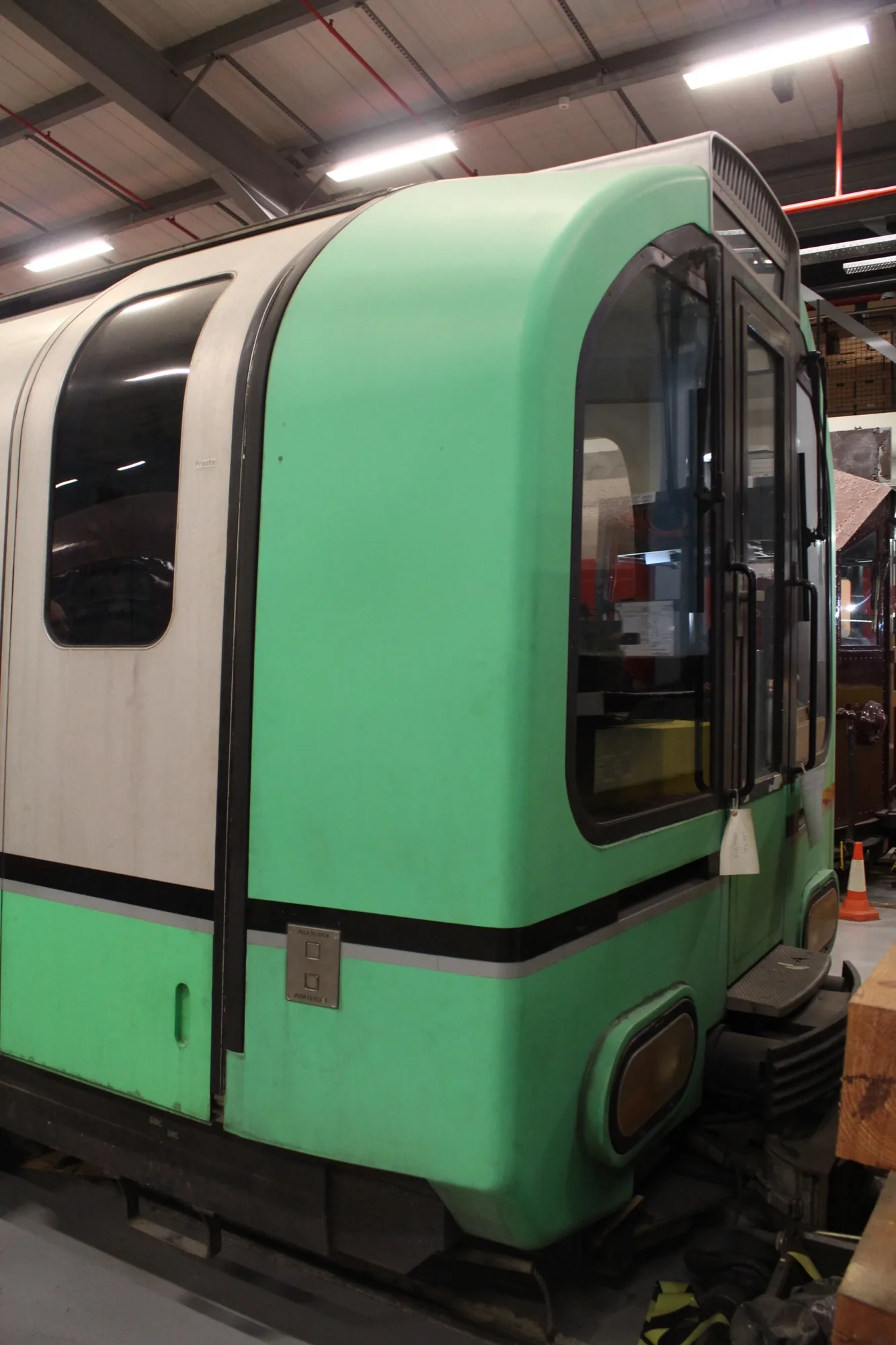
How do you solve a problem like the Central Line?

A photo of a prototype train for the Central Line, now on display at the London Transport Museum Depot in Acton

The Central Line of the London Underground is not having a good time at the moment. We experienced this first hand on our recent trip to London. As the Young V&A is close to Bethnal Green tube station, when we visited we tried to use the Central Line to head back into central London.

We gave up after two trains stopped where it was literally impossible to fit on. Every carriage was crush-loaded, and this was mid-afternoon on a Saturday – not exactly rush hour.

The issue is with the trains that run on the Central Line. These are 1992 Stock, which, as the name suggests, date from 1992 and were built by the newly-privatised BREL. Specifically, it’s the traction motors on these trains, which are failing at a faster than expected rate. Without a working motor, the trains can’t move, and so they have to be taken out of service. Consequently, there are fewer trains available for service, and so passengers are being crammed into less frequent services.

Transport for London have short, medium and long-term solutions to this issue:

Short term

In the short term, there are fewer trains in the timetable. With around a third of the fleet out of service, the timetable has been cut to reduce short-term cancellations. It’s something we’ve seen elsewhere in the country – Transpennine Express cut several trains to improve reliability.

Medium term

In the medium term, there is the Central Line Improvement Programme (CLIP). This is a major refurbishment of the trains, which includes replacing the troublesome motors as well as installing CCTV and accessibility improvements. For example, trains will now have wheelchair accessible spaces, and there are new screens with visual announcements of the next stop – standard on other lines, but new to the Central Line.

As an aside, I can’t help but feel that CLIP is a boring name when Central Line Improvement to Train Operation and Reliability Investment Scheme was right there. Even if the acronym does spell CLITORIS.

The CLIP started before the reliability issues came to ahead, and the first refurbished train was in service in December. But it’ll be a while before work on the full fleet of 77 trains is completed.

Long term

Ultimately, these are 30 year old trains, and eventually they will need replacing. They’re not the oldest on the network – that ‘honour’ goes to the Bakerloo Line, with trains that are over 50 years old. Slightly newer, but only just, are those on the Piccadilly Line, which are being replaced with 2024 stock to support an increase in service. Right now, there’s only funding available for new trains for the Piccadilly Line, but TfL’s long term aim is that the same trains will run on the Central, Bakerloo and Waterloo & City Lines too. Whilst the first units are being assembled in Germany and Austria, most will be built by Siemens in a brand new factory in Goole, East Yorkshire.

Where I live in the north of England, a big deal was made out of the replacement of 1980s era Pacer trains which were no longer fit for purpose. And whilst there’s a feeling in the north that London gets more than its fair share of UK public transport spending, the oldest tube trains are 10 years older than the oldest Northern Rail trains. Ordering a completely new fleet for all the London Underground lines that need it will result ensure skilled manufacturing jobs remain in Yorkshire for at least the next decade.

Some collected thoughts about today’s London tube bomb

This morning, what appears to be an improvised explosive device detonated on a London Underground train at Parson’s Green station. At the time of writing, we know that:

  • 18 people have received non-serious injuries, mostly burns
  • There are no confirmed fatalities
  • It is being treated as a terrorist incident.

I’m basing what I know purely on what I’ve read on the BBC, as I trust them to report accurately and to verify their statements. I will be making some assumptions, and these are based on my 30+ years of living in the UK. I’m not a terrorism expert (although colleagues of mine are) — I am just a regular person who follows the news.

1. We don’t know who did it

Naturally I’ve seen some people jump to conclusions that this is an attack by Islamic fundamentalists groups, possibly linked to Islamic State. We don’t know this.

Notably, this did not appear to be a suicide bomb. Most of the recent attacks, especially the Manchester Arena attack in May this year, were caused by suicide bombers. This appeared to be an abandoned object.

Leaving suspicious bags or packages behind was a tactic more commonly used by the IRA, the Irish terrorist group. It has been a long time since there was an attack by an Irish group, thanks to the peace process in Northern Ireland. And I would be surprised if this marked a resurgence.

2. It looked like a bomb

It’s rare that we get to see the remains of what exploded. In this case, it appeared to be a large plastic tub contained inside a plastic bag from a well-known German supermarket (I feel sorry for their PR team). Photos and videos of the smouldering remains also seemed to show wires, and the BBC report that the remains of a timer were recovered.

This, in my mind, rules out this being an accident. My view is that this was an incendiary device that was deliberately planted.

3. It didn’t do what it was supposed to do

The device did explode, but appears to have caused minor injury. Again, from the BBC news report, it seems to me that more people were injured trying to evacuate from the scene, than by the explosion itself.

Because we have been able to see photo and videos of the device, we have also been able to see how little damage has been caused to tube train. And whilst I have sympathy for the victims of the attack, I am also pleased that the injuries were minor.

This bomb did not managed to cause the devastation brought on by the bomb at the Manchester Arena, nor the tube bombings of July 2005.

4. It may be some time before a terrorist group claims responsibility

Because it wasn’t a large explosion, and hasn’t resulted in fatalities, I don’t think that any of the major terrorist groups will rush to claim responsibility for it. If anything, this may be viewed as a failure; I expect that services on that part of the District Line will be disrupted for a few days, but it won’t cause widespread panic or disruption.

5. London remains open

I think we’ll see the usual responses following a terrorist attack: a potential raising of the overall threat level, more police on the streets and so on. But it hasn’t — and probably won’t — send large parts of London into lockdown.

Indeed, London Underground is still running a reasonably good service on most other lines, as I write this a few hours after the explosion. Parson’s Green is on the Wimbledon branch of the District Line and so this is, of course, closed. The rest of the Wimbledon branch between Earl’s Court and Edgware Road is also experiencing delays, which is understandable, and there are some delays on the Piccadilly Line.

But the rest of the Tube is fine. London is a resilient city that has seen more than its fair share of attempts to terrify its residents. I think most Londoners will see the events of today as something of an inconvenience, rather than a concern.

As I said before, I’m not an expert — this is mostly a collection of my thoughts. I wish the victims a speedy recovery, and await the outcome of the full investigation into what happened. I also hope that this isn’t used as another attack on the vast majority of peaceful Muslims (especially if it turns out that this wasn’t an Islamist attack).

This post originally appeared on Medium.

London’s public transport

Bakerloo at Waterloo

As a non-Londoner who doesn’t drive, I am generally in awe of London’s public transport.

While any Londoner who’s had to make alternative arrangements during a tube strike will probably disagree, compared to the public transport available in most other British cities London is well ahead.

London Underground, or The Tube, is especially good. You get something like 20 trains every hour through central London, so you rarely have to wait more than 3 minutes for one. And it comes with at least 8 carriages, so you’re likely to be able to get on.

Its buses are cheap – £1.20 with an Oyster card for a single adult ticket (at the time of writing) – and pretty frequent too. And talking of Oyster, you have one card which lets you pay for basically any train, bus, tube or tram in greater London.

It’s not perfect; strikes, for one, happen more frequently than they probably should, and overcrowding is a problem. And the chaos which occurs when something breaks down during the peak periods.

Compare this to Bradford, where we have more expensive buses and no trams or tube to fall back on. The trains are thankfully cheaper but nowhere near as frequent, and not as pervasive – railway stations tend to be fewer and far between, so you’re left with the buses. Though we have some integrated ticketing, it’s only in the form of day rover tickets (which are only sold at travel interchanges) or weekly/monthly travel cards. There’s no pay-as-you-go scheme and it’s not a smartcard like Oyster.

London’s transport is on my mind as Christine and I are spending this weekend in London, and will hopefully be visiting London Zoo. It’s the first time I’ve been to London properly in almost three years, so naturally I’m a little excited.

Creative Commons License
Except where otherwise noted, the content on this site is licensed under a Creative Commons Attribution-ShareAlike 4.0 International License.